“Technically, we redistributed it.”
My mother laughed.
I looked at her.
She didn’t stop.
“What?”
Jason leaned forward.
“You’ve lived here for years.”
“I stay here between assignments.”
“Exactly.”
“You’ve never asked me for rent.”
“You shouldn’t have needed to be asked,” Dad said.
His voice was firmer now.
Almost righteous.
“We gave you a roof.”
“We fed you.”
“We kept a room for you.”
“You’re forty years old, Emily.”
“You owed this family.”
I stared at him.
“Owed you what?”
Advertisement
“Contribution.”
“You could have asked.”
Mom shook her head.
“That’s the problem with you. Everything has to be formal.”
I almost laughed.
Formal.
They had taken a bank card from my private desk.
Accessed an account without permission.
Transferred my money.
Packed my belongings.
And somehow I was the one being unreasonable.
“How much did you take?”
Jason smirked.
“All of it.”
The casual cruelty in those three words hit harder than I expected.
I looked again at my phone.
Advertisement
Years.
That money represented years of deployments, missed holidays, long nights, careful saving, canceled vacations, and the security of knowing that whatever happened in my career, I had built something of my own.
They had reduced it to zero and sat down for pie.
“Where did it go?”
Jason shrugged.
“Places where it was needed.”
“Your accounts?”
“Some.”
I looked at my parents.
“Did you know?”
My mother’s expression hardened.
“Of course we knew.”
That hurt more than Jason.
I don’t know why.
Advertisement
Maybe some part of me had hoped he had manipulated them.
Maybe I wanted to believe they would never willingly participate.
But my father nodded.
My mother looked straight at me.
And the final piece of denial disappeared.
Dad stood.
“We’re done discussing this.”
“No. We’re not.”
“Yes, we are.”
He pointed toward the hallway.
“Your things are packed.”
“You need to leave.”
Outside, wind scraped against the windows.
The temperature had dropped sharply that evening.
I looked toward the front door.
Advertisement
Then back at them.
Jason stood too.
“You heard him.”
I stayed where I was.
“What exactly did you tell the bank?”
For the first time, Jason hesitated.
Only for half a second.
But I saw it.
Then he laughed.
“Does it matter?”
“Yes.”
“We had the card.”
“That wasn’t my question.”
He stepped around the table.
“Emily, stop acting important.”
There it was.
The sentence that explained everything.
To Jason, I had never been dangerous.
Never been accomplished.
Never been someone whose boundaries mattered.
Advertisement
I was simply his younger sister.
Quiet Emily.
Government-office Emily.
The woman who disappeared for work and came back too tired to start arguments.
He mistook restraint for weakness.
My father walked into the hallway, grabbed my suitcase, and dragged it toward the door.
My mother followed.
Jason opened the door.
Cold air rushed inside.
Dad pushed my suitcase across the threshold.
It tipped onto one wheel and fell onto the porch.
“Go.”
I looked at all three of them.
Advertisement
No one apologized.
No one looked uncertain.
Jason smiled.
“Don’t come crawling back when you realize nobody else is going to put up with you.”
I should have been furious.
Maybe part of me was.
But something colder had already taken over.
Procedure.
Documentation.
Containment.
I put my phone into my pocket.
Picked up my suitcase.
Walked to my car.
And shut the door.
Through the windshield, I saw Jason standing on the porch.
He raised his beer toward me.
Advertisement
A toast.
Then he laughed and went back inside.
I didn’t drive away immediately.
Instead, I opened my secured phone.
Found a number.
And made one call.
The officer answered on the second ring.
“This is Carter.”
I kept my eyes on the house.
“This is Colonel Emily Carter. I need to report unauthorized access involving protected financial and identity credentials associated with my military profile.”
The officer’s tone changed immediately.
“Yes, Colonel.”
“My civilian banking account has been drained. My ATM card was stolen from a secured personal space. I believe family members accessed account information and may have used documents connected to my official records.”
May you like



There was a short pause.
“Are you currently safe?”
“Yes.”
“Do you believe any government-issued credentials or classified material were accessed?”
“Unknown.”
That was the word that changed everything.
Unknown.
Because the moment Jason had entered my private desk and taken banking information, we could no longer assume he had stopped there.
My desk had contained more than a debit card.
Not classified documents.
I would never bring those into an unsecured home.
But there were identifiers.
Mail.
Military correspondence.
Advertisement
Old financial paperwork.
Information that could potentially be used for impersonation.

The officer responded immediately.
“We’ll initiate the appropriate procedures.”
“Understood.”
“Colonel, do not confront them again.”
“I won’t.”
“We’ll coordinate with local authorities and the bank.”
I looked at the front window.
My mother walked past carrying plates.
She was still smiling.
“Thank you.”
I ended the call.
Then I drove away.
That night, I checked into a hotel outside Columbus.
I barely slept.
Not because I was worried about the money.
Advertisement
Money could be traced.
Transactions could be investigated.
Fraud could be prosecuted.
What kept me awake was something much simpler.
My mother had laughed.
Every time I closed my eyes, I heard it.
The next morning, investigators began reconstructing what had happened.
The first thing they learned was that Jason had not acted impulsively.
This had been planned.
The transactions had started before I returned home.
Small amounts first.
Then larger transfers.
Someone had attempted to make the withdrawals look gradual.
Advertisement
The bank had generated automated warnings, but those warnings had been intercepted.
My contact information had been altered.
A temporary phone number had been added.
Security questions had been answered.
An address associated with one of the transfers belonged to Jason.
Another transfer led to an account connected to my father.
Then investigators found something worse.
An attempt had been made to access a separate savings instrument connected to long-term military compensation and benefits records.
That attempt had failed.
And the failure triggered a much higher level of scrutiny.
Advertisement
That was the mistake Jason never knew he made.
He thought he had discovered another pool of money.
What he actually touched was a system designed to notice suspicious access.
By Friday afternoon, Detective Marcus Hale of the Columbus Police Department had joined the case.
He called me at the hotel.
“Colonel Carter?”
“Yes.”
“This is Detective Hale.”
His voice was steady.
Professional.
“I’m reviewing the fraud complaint connected to your accounts.”
“What have you found?”
“Enough that I’d advise you not to contact your family.”
Advertisement
“I haven’t.”
“Good.”
He paused.
“We have surveillance from multiple ATMs.”
My fingers tightened around the phone.
“Jason?”
“Yes.”
“Anyone else?”
Another pause.
“Your father appears in footage from one withdrawal.”
I closed my eyes.
I had expected it.
It still hurt.
“Your mother?”
“Not on ATM footage.”
“But?”
“She was present at the bank during one in-person inquiry.”
I sat down on the edge of the bed.
All three.
Not one.
Not two.
All three.
“They did this together.”
Advertisement
“That’s what the evidence currently suggests.”
“What did they spend it on?”
“We’re still tracing everything.”
Then Hale said something I didn’t expect.
“There’s one more issue.”
“What?”
“Your brother attempted to open credit using your information.”
The room suddenly felt colder.
“When?”
“Two days ago.”
“After they had already emptied the account?”
“Yes.”
“So the account wasn’t the end.”
“No, Colonel.”
It had never been about what I owed them.
It had been about what they believed they could take.
Advertisement
The next forty-eight hours moved quickly.
Banks preserved records.
Security footage was collected.
Electronic transfers were frozen where possible.
Devices were identified.
A judge authorized additional investigative steps based on the evidence.
Jason, meanwhile, behaved as though nothing had happened.
That Saturday, he organized a barbecue at my parents’ house.
I knew about it because one of our neighbors, Mrs. Patterson, sent me a message.
Emily, are you okay? Your family says you moved out suddenly.
Moved out.
That was how they were telling the story.
Advertisement
Not robbed.
Not thrown out.
Moved out.
I responded with only four words.
I’m fine. Thank you.
By Sunday, Detective Hale called again.
“We’re ready.”
“For what?”
“To execute the next phase.”
I knew enough not to ask questions that didn’t need answers.
“What do you need from me?”
“Your presence.”
That afternoon, my parents’ neighborhood looked almost painfully normal.
Children rode bicycles along the sidewalks.
Lawn sprinklers ticked across grass.
Someone had a football game playing loudly through an open garage.
Advertisement
Behind my parents’ house, barbecue smoke drifted over the fence.
Jason had invited neighbors.
Friends.
People from his job.
He was doing exactly what he always did when he wanted to feel important.
He created an audience.
This time, he got one.
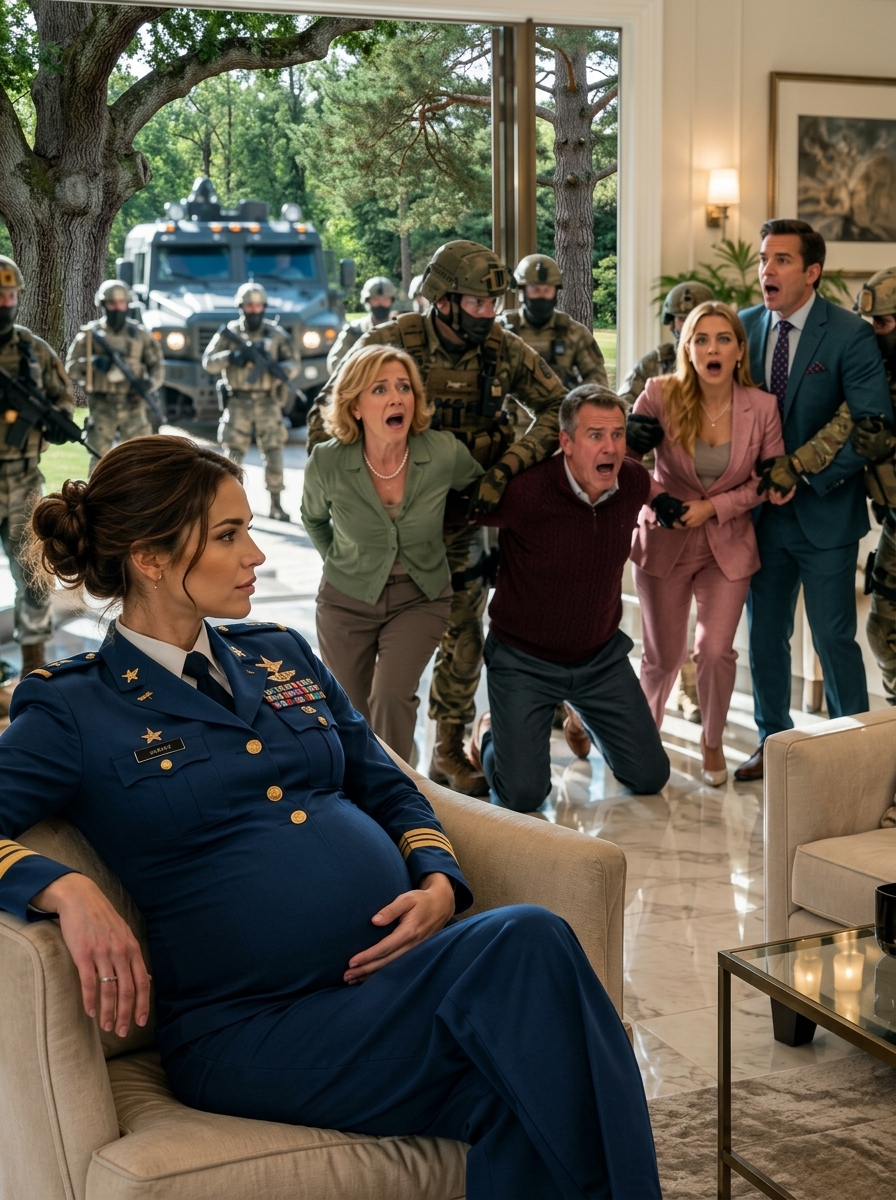
The first engines appeared at the far end of the street.
Conversations stopped.
A dark government vehicle turned the corner.
Then another.
Police cruisers followed.
A pair of military vehicles rolled slowly behind them.
People began stepping out of houses.
Jason walked from the backyard toward the driveway holding a beer.
At first, he looked curious.
Then he saw me.
I stepped out of the lead vehicle wearing my Army service dress uniform.
For years, my family had seen me in jeans, sweaters, workout clothes, and ordinary jackets.
They had never seen the silver eagle on my shoulders.
They had never seen ribbons across my chest.
They had never seen how military personnel reacted when I approached.
A senior officer turned toward me.
His heels came together.
“Good afternoon, Colonel Carter.”
Every soldier behind him snapped into salute.
Perfectly synchronized.
The entire street went silent.
I returned the salute.
Then lowered my hand.
My father had stepped onto the porch.
His mouth was open.
My mother stood behind him with one hand pressed against the railing.
Jason stared at me.
The beer can slowly lowered from his hand.
For several seconds, nobody spoke.
Then Jason laughed once.
A strange, nervous sound.
“This is some kind of joke.”
No one answered him.
Detective Marcus Hale stepped forward carrying a thick case file.
“Colonel Carter.”
“Detective.”
“Our investigation into unauthorized access to your financial accounts and identity information has progressed substantially.”
Jason looked from him to me.
“Emily?”
I said nothing.
The barbecue music continued playing in the backyard.
Some cheerful song about summer.
No one moved to turn it off.
Detective Hale opened the file.
“Unauthorized withdrawals.”
He turned one page.
“Electronic transfers.”
Another.
“Cash advances.”
Another.
“Fraudulent modification of contact information.”
Jason’s face changed.
“Attempted credit application.”
My father took a step backward.
“Unauthorized access to protected financial systems associated with Colonel Carter’s military profile.”
That sentence landed like a bomb.
My mother whispered, “Colonel?”
I finally looked at her.
“Yes.”
Her lips parted.
“You never told us.”
“No.”
“Why?”
“Because my work was not your business.”
Jason suddenly became angry.
That was always his response when fear started winning.
“This is ridiculous. She’s our sister.”
Detective Hale looked at him.
“That does not give you legal authority over her bank account.”
“We’re family.”
“Family members can commit financial crimes against each other.”
“We were taking what she owed us.”
“You cannot decide someone owes you money and remove funds from their account without authorization.”
Dad stepped forward.
“She lived in our house.”
Hale turned to him.
“Was there a written rental agreement?”
“No.”
“Any documented debt?”
“No.”
“Court judgment?”
Dad said nothing.
“Loan contract?”
Silence.
Hale closed the folder halfway.
“Then what you had was a disagreement. What you allegedly did in response is another matter.”
Jason looked at me again.
“You called the military on us?”
“No.”
My voice was quiet.
“You accessed something you didn’t understand.”
His expression tightened.
“What does that mean?”
“It means when you tried to reach money beyond my checking account, you triggered protections attached to systems associated with my military identity.”
His eyes widened slightly.
“You told the bank?”
“I didn’t have to tell them everything.”
For the first time, Jason looked genuinely afraid.
Then he pointed at me.
“She gave us access.”
“No, I didn’t.”
“You left your card in the house.”
“A card is not permission.”
“Dad knew the PIN.”
I turned toward my father.
That detail had not been included in anything I’d been told.
Hale immediately looked at him.
“How did you know her PIN?”
My father froze.
Jason realized too late what he had said.
Mom whispered, “Jason…”
But it was already out.
Hale’s voice sharpened.
“Mr. Carter?”
Dad swallowed.
“She used the same number for years.”
“How did you obtain it?”
He looked at me.
Then at Hale.
No answer.
Detective Hale opened the file again.
“We recovered security footage from an ATM on Broad Street showing you entering the PIN yourself.”
Dad’s face went pale.
“We also recovered footage showing Jason withdrawing funds at a second location.”
Jason’s jaw tightened.
“And bank records place your wife at a branch where questions were asked regarding account access.”
My mother’s knees seemed to weaken.
She gripped the railing harder.
“I didn’t take anything.”
“No one said you personally operated the ATM.”
“I just went with them.”
“Then you can explain that during your statement.”
The officers moved forward.
Jason stepped back.
“Wait.”
His voice cracked.
That was the first moment his confidence truly disappeared.
“Emily, come on.”
I looked at him.
Three nights earlier, he had thrown my suitcase onto a porch.
Now his hands were open in front of him.
Pleading.
“We’re family.”
I almost smiled at the irony.
“You remembered that very late.”
“Tell them this is a misunderstanding.”
“It isn’t.”
“I’ll give the money back.”
“You already spent some of it.”
His eyes widened.
“How do you know that?”
Hale answered.
“We have the records.”
Jason’s face drained.
Apparently, he had assumed cash withdrawals made the money disappear.
They didn’t.
Not once investigators had the timeline.
Hale began reading from the file.
A payment toward Jason’s truck.
Several thousand dollars toward credit-card debt.
An electronic transfer toward a failed business investment.
A cash deposit into my father’s account.
Home improvement purchases.
And one large payment my mother had made toward a vacation reservation.
I stared at her.
“A vacation?”
She started crying.
Not when I arrived to find my belongings packed.
Not when I discovered my savings were gone.
Now.
When consequences had arrived.
“We were going to pay it back.”
“When?”
She shook her head.
“Emily…”
“When?”
No answer.
Jason interrupted.
“She had money sitting there doing nothing.”
I turned toward him.
“That was your justification?”
“You don’t have kids.”
“You’re never home.”
“You make good money.”
“You weren’t using it.”
Every sentence was worse than the last.
I realized something then.
Jason did not think of theft the way normal people did.
To him, ownership depended on whether he believed the owner deserved what they had.
If he wanted something more, then somehow taking it became fairness.
“You thought my savings belonged to you because I didn’t spend them fast enough?”
“I thought family helped family.”
“You didn’t ask for help.”
“You would have said no.”
“Yes.”
He blinked.
I took one step closer.
“I would have said no.”
His expression hardened.
“That proves my point.”
“No, Jason.”
I kept my voice level.
“It proves you knew you didn’t have permission.”
Silence.
Even Detective Hale glanced at him.
Jason realized he had walked directly into the truth.
He had known.
From the beginning.
The police officer nearest him stepped forward.
“Jason Carter, turn around.”
Jason backed away.
“Hold on.”
“Turn around.”
“No. Emily, fix this.”
I didn’t move.
“Emily!”
He raised his voice.
People in neighboring yards watched.
The same neighbors he had been entertaining minutes earlier were now witnessing everything.
“You’re really going to let them arrest your own brother?”
I looked at him.
“You were willing to leave your own sister outside with an empty account and a suitcase.”
“That’s different.”
“Why?”
He had no answer.
The officer took his arm.
Jason pulled away once.
“Don’t touch me!”
Three officers moved immediately.
“Do not resist.”
His bravado disappeared.
Within seconds, his wrists were behind him.
Handcuffs closed.
Click.
Click.
My mother cried out.
“Please!”
My father stepped down from the porch.
“Take me instead.”
Hale looked at him.
“This isn’t a negotiation.”
My father’s shoulders collapsed.
For the first time in my life, he looked old.
Not strict.
Not authoritative.
Old.
Another officer approached him.
Then my mother.
I watched as the three people I had trusted most were separated and questioned.
There was no satisfaction in it.
That surprised me.
For three days, I had imagined this moment.
I thought I might feel vindicated.
Powerful.
Relieved.
Instead, I felt empty.
Jason twisted around before being placed into the cruiser.
“This is because you think you’re better than us now?”
I stared at him.
“No.”
“You show up in that uniform with all these soldiers like some kind of queen.”
“This isn’t about my rank.”
“Then why are they here?”
“Because you crossed into systems connected to my military identity and created a security concern.”
“That’s not fair!”
The words exploded out of him.
I almost couldn’t believe it.
Not fair.
He had stolen my card.
Drained my bank account.
Tried to open credit in my name.
Helped throw me out of the house.
And now the investigation was unfair.
I walked closer to the cruiser.
“You want to know the part you still don’t understand?”
Jason glared at me.
“You thought this became serious because I’m a Colonel.”
I shook my head.
“It became serious the second you decided my property was yours.”
For once, he had nothing to say.
Detective Hale approached me after Jason was placed inside the cruiser.
“There’s more.”
I looked at him.
“What?”
He lowered his voice.
“We executed a search warrant on the electronic evidence linked to the fraudulent credit application.”
My stomach tightened.
“And?”
“We recovered a message thread.”
“Between who?”
“Your brother and your father.”
My eyes moved toward Dad.
He was standing beside an officer near the porch.
“What did it say?”
Hale opened a digital copy on his tablet.
I read.
The messages had started weeks earlier.
Jason had been asking questions about my schedule.
When I would be home.
How long I would be gone.
Whether I kept bank mail in my room.
Then came a message from my father.
She’ll be away until Thursday. Do it before she gets back.
My throat tightened.
Jason answered:
Once the money is moved, we pack her stuff. She won’t fight Mom.
I read the sentence twice.
She won’t fight Mom.
They had known me so well.
And not at all.
Another message appeared.
Dad:
What if she calls the bank?
Jason:
She’ll complain, but she hates drama. She’ll let it go eventually.
I stopped reading.
There it was.
The real reason they had chosen me.
Not desperation.
Not confusion.
Not some sudden family emergency.
They had built their entire plan around my personality.
Emily doesn’t fight.
Emily keeps quiet.
Emily avoids drama.
Emily will let it go.
My restraint had become part of their criminal strategy.
I handed the tablet back.
Hale watched me carefully.
“You okay?”
“Yes.”
It was not completely true.
But it was close enough.
He hesitated.
“There’s another exchange.”
“Let me see it.”
He returned the tablet.
Jason:
Once she’s out, I can use her room for the office.
Dad:
Your mother already boxed most of it.
Jason:
Perfect.
I laughed.
A small sound.
I couldn’t stop myself.
My bedroom.
That was the prize after the money.
A home office.
Years of trust exchanged for a room and a pile of cash.
My mother saw the tablet in my hand.
“Emily.”
I looked up.
She stepped toward me until an officer stopped her.
“I didn’t know about everything.”
“You packed my room.”
Tears filled her eyes.
“I was angry.”
“You packed my room.”
“Your father said—”
“You packed my room.”
She covered her mouth.
I remembered my jewelry case carefully placed inside the suitcase.
My sweaters folded.
My shoes lined up in the cardboard box.
She had not done it in anger.
Anger throws things.
She had taken her time.
That was what hurt.
“You had hours to change your mind,” I said.
She cried harder.
“I’m your mother.”
“Yes.”
The word came out softer than I intended.
“That’s why it hurt.”
She looked like I had struck her.
I turned away.
Over the next several weeks, the case became less theatrical and more painful.
There were interviews.
Statements.
Bank affidavits.
Meetings with attorneys.
Digital evidence reviews.
The accounts receiving my money were restricted while investigators traced transfers.
Some funds were recovered quickly.
Some had already been spent.
The attempted credit account was canceled before it could be used.
My bank restored portions of the stolen funds while the fraud investigation continued.
The larger identity-security review confirmed that Jason had not accessed classified systems.
That mattered.
It meant the nightmare stayed financial instead of becoming something much worse.
But the criminal case continued.
Jason was charged in connection with unauthorized account access, theft, identity-related fraud, and the attempted credit application.
My father faced charges connected to the withdrawals and conspiracy.
My mother’s involvement was evaluated separately based on what investigators could prove she had knowingly participated in.
Their attorneys immediately tried to reshape the story.
Family dispute.
Misunderstood household contribution.
Informal reimbursement.
No criminal intent.
Then prosecutors introduced the messages.
Do it before she gets back.
Once the money is moved, we pack her stuff.
She hates drama.
She’ll let it go.
After that, the word misunderstanding became much harder to use.
Jason called me from jail once.
I almost declined.
Then I answered.
For several seconds, neither of us spoke.
Finally he said, “You happy now?”
“No.”
“You ruined my life.”
I looked out the hotel window.
“No, Jason.”
“You could drop this.”
“I can’t erase evidence.”
“You can tell them you gave permission.”
“That would be a lie.”
“You always thought you were better than me.”
“That isn’t true.”
“Then help me.”
I closed my eyes.
There had been a time when I would have.
That was the saddest part.
If Jason had called me six months earlier and admitted he was drowning in debt, I probably would have helped.
If my parents had asked me for money to repair the house, I would have helped.
If Mom had told me she desperately wanted a vacation and couldn’t afford it, I might even have paid for part of it.
They never asked.
Because asking would have meant accepting that the answer belonged to me.
Stealing removed my choice.
“You should have asked,” I said.
Jason was silent.
Then he whispered, “Would you have given it to me?”
“Maybe.”
That answer seemed to hurt him more than no.
He hung up.
I never returned to live in my parents’ house.
Instead, I rented an apartment outside Columbus for the periods when my work brought me back to Ohio.
A small place.
Two bedrooms.
Nothing fancy.
The first night I slept there, I placed my suitcase inside the closet and stood looking at it for a long time.
No one could pack it without my permission.
No one had a key except me.
That feeling was worth more than I expected.
Months later, the court proceedings reached their conclusion.
Restitution orders addressed the remaining financial losses.
Jason’s attempt to explain the theft as “family money” went nowhere against the transaction records, surveillance footage, messages, and credit application.
My father eventually admitted that he had convinced himself I could afford the loss.
My mother admitted she knew I had not given permission.
None of those admissions repaired anything.
But they ended the pretending.
After one hearing, I walked down the courthouse steps in civilian clothes.
Detective Marcus Hale was standing near the sidewalk.
He nodded when he saw me.
“Colonel.”
“Detective.”
“How are you doing?”
“Better.”
He smiled slightly.
“I heard the bank completed the last major restoration.”
“They did.”
“Good.”
I looked toward the courthouse doors.
“My parents keep saying they never understood how serious it was.”
Hale slipped his hands into his coat pockets.
“People often understand boundaries perfectly well until consequences arrive.”
I thought about that.
Then I smiled.
“You always talk like a detective?”
“Occupational hazard.”
We both laughed.
A black government vehicle waited at the curb for me.
I was scheduled to leave Ohio that afternoon.
Another assignment.
Another city.
Another stretch of time when my family would have once wondered where I had gone.
This time, they wouldn’t be waiting when I returned.
Strangely, that realization no longer frightened me.
Before getting into the vehicle, I checked my phone.
There was a message from my mother.
I’m sorry. I hope one day you can forgive us.
I stared at it for several seconds.
Then I locked the screen.
Forgiveness, I had learned, was not the same thing as access.
I could let go of anger without handing someone another key.
I could love people from a distance.
I could remember the good years without pretending the bad ones had never happened.
And I could protect myself without becoming cruel.
The vehicle pulled away from the courthouse.
Columbus passed outside the window.
Traffic lights.
Restaurants.
Office buildings.
Ordinary people living ordinary lives.
I thought back to that Thursday evening.
The suitcase.
The empty bank account.
Jason’s beer raised in a mocking toast.
My father pointing toward the door.
My mother laughing.
They believed that was the moment they had stripped me of everything.
They were wrong.
Money could be restored.
A room could be replaced.
A house was only a building.
What they had actually taken from me was the illusion that family deserved unlimited trust simply because we shared the same name.
And what they gave me in return was something far more valuable.
Clarity.
Jason had once told me not to come crawling back.
He never understood that I had survived places far more dangerous than my parents’ front porch.
I had led soldiers.
Made decisions under pressure.
Worked through nights when mistakes carried consequences far greater than money.
I did not need revenge.
I needed truth.
And truth had arrived in police records, bank statements, surveillance footage, digital messages, and the sound of handcuffs closing around the wrists of a man who believed his little sister would never fight back.
The last time I saw Jason before leaving Ohio, he looked at me across a courthouse hallway.
No grin.
No beer.
No smug laughter.
Just silence.
Then he said, almost too quietly to hear:
“I really didn’t know who you were.”
I looked at him for a long moment.
He meant Colonel.
The rank.
The uniform.
The military vehicles.
The salutes.
But that had never been the real secret.
“You did know who I was,” I said.
His brow tightened.
“I was your sister.”
I turned toward the exit.
“You just decided that wasn’t worth respecting.”
And I walked away.
Not as the daughter they had thrown out.
Not as the sister they thought they could steal from.
Not even as Colonel Emily Carter.
I walked away simply as a woman who had finally learned that silence was not surrender, kindness was not weakness, and family was never permission to take what did not belong to them.
Behind me, the courthouse doors closed.
Ahead of me, the driver opened the vehicle door and stood at attention.
“Ready, Colonel?”
I looked toward the road.
Then I smiled.
“Ready.”
And this time, when I left Columbus, everything I truly needed came with me.