That sentence almost made me smile.
Almost.
But I kept working.
I could have turned around.
I could have answered him in German.
One sentence would have been enough.
I could have watched the confidence disappear from his face immediately.
But experience had taught me something important.
There are moments when confrontation solves a problem.
And there are moments when silence reveals more.
Calloway did not need to be embarrassed.
He needed to be allowed to finish showing everyone exactly who he was.
Advertisement
So I let him.
Five minutes later, the doors opened.
The NATO delegation arrived.
The atmosphere changed instantly.
American officers moved into position.
Conversations quieted.
Introductions began.
Representatives from Germany entered first, followed by officers from France, Italy, Poland, and several multinational planning staffs.
At the center of the German delegation walked General Lukas Reinhardt.
I had not seen him in almost two years.
The moment he noticed me, his face changed.
“Colonel Quinn!”
He left the officers beside him and walked directly across the room.
Advertisement
Calloway turned.
So did Pierce.
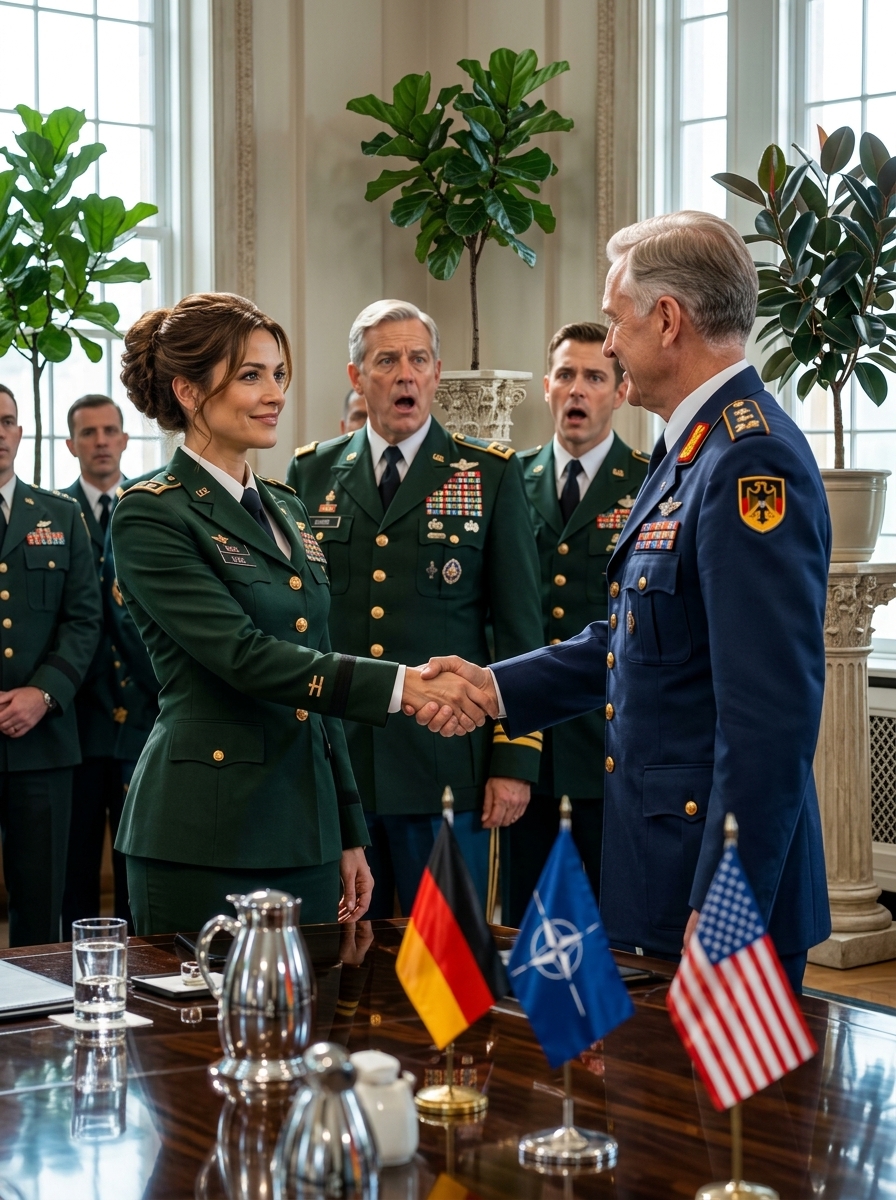
General Reinhardt reached me and extended his hand.
Then he began speaking rapidly in German.
Not slowly.
Not carefully.
Not the simplified German someone might use with a foreign visitor.
Natural German.
Fast German.
The kind used between two officers who had already spent long nights trying to solve impossible transportation problems.
“Harper, I was beginning to think they had hidden you somewhere in headquarters.”
I laughed.
“They tried. I escaped.”
Reinhardt grinned.
“How long has it been?”
Advertisement
“Twenty-two months.”
“Too long.”
He shook his head.
“You still owe me coffee after what happened in Grafenwöhr.”
“You changed the rail schedule three times in one night.”
“Twice.”
“Three.”
“Twice.”
“General, I still have the messages.”
He laughed loudly enough that several officers nearby smiled without understanding why.
Then our conversation shifted.
Immediately.
No warm-up.
No ceremony.
Professional instinct took over.
Reinhardt opened the folder in his hand.
“We have a concern about the eastern rail corridor.”
I answered in German.
Advertisement
“The bridge inspection?”
His smile disappeared.
“You already know.”
“I saw the engineering report this afternoon.”
“That corridor becomes a problem if heavy vehicles are restricted.”
“Only if we keep the original sequence.”
He looked at me more carefully.
“You have an alternative?”
“Yes.”
I pulled a map from the nearest folder.
“Shift the first armored movement twelve hours earlier. Move sustainment vehicles through the southern route. Keep the fuel trucks on the original corridor because their axle load remains below the restriction.”
Advertisement
Reinhardt leaned over the map.
“What about Polish reception capacity?”
“They can absorb the change if we give them ninety-six hours.”
“Have they confirmed?”
“Not officially.”
I looked across the room.
A Polish colonel was entering with another delegation.
“But I know who to ask.”
Reinhardt smiled again.
“That is why I wanted you on this exercise.”
Behind him, the room had become strangely quiet.
I looked up.
General Calloway was staring directly at me.
Lieutenant Colonel Pierce no longer looked amused.
Advertisement
For several seconds, nobody said anything.
Then Reinhardt continued in German.
“There is also a problem with the maintenance convoy.”
I replied without hesitation.
“Belgian road restrictions?”
He nodded.
“We can bypass them.”
“How?”
“Rail two recovery sections ahead of the main convoy. Split the remainder into smaller serials.”
“That increases coordination.”
“Yes.”
“Risk?”
“Lower than losing eight hours at the border.”
He considered that.
Then nodded.
“Agreed.”
Within less than five minutes, we had discussed rail capacity, axle restrictions, fuel movements, border coordination, staging limits, and contingency routing.
Advertisement
Not greetings.
Not pleasantries.
Operational planning.
When we finished, Reinhardt shook my hand again.
“I am glad you’re here.”
“So am I, sir.”
He moved toward the conference table.
I remained beside the map.
Only then did I glance toward Calloway.
His face had changed.
The confidence was gone.
He knew.
Not just that I spoke German.
He knew I had understood everything.
Every comment.
Every insult.
Every assumption.
I did not smile at him.
That would have been too easy.
May you like

Instead, I simply picked up the remaining folders.
“General Calloway.”
He straightened slightly.
“Yes, Colonel?”
“Your seat is beside General Moreau. The revised rail documents are in the blue section of your folder.”
There was a pause.
Then he said quietly,
“Thank you.”
I nodded.
“Sir.”
Nothing more.
That seemed to bother him more than anger would have.
The reception transitioned into the formal planning session.
At the head of the table sat General Étienne Moreau, the senior NATO commander overseeing IRON BRIDGE.
Advertisement
Moreau was French, sixty years old, and famous for running meetings that moved quickly.
He disliked unnecessary speeches.
He disliked vague answers even more.
If someone said, “We should be able to,” he usually asked,
“Does that mean yes or no?”
No one enjoyed being the person who could not answer.
We took our seats.
Maps covered the table.
Screens came alive.
The first thirty minutes focused on exercise objectives.
Then came movement planning.
That was where the problems began.
Advertisement
An operations officer presented the original deployment sequence.
American armor would move through Germany.
Fuel and maintenance units would follow.
Polish staging bases would receive equipment before redistribution farther east.
French aircraft would transport command elements.
Italian units would support additional ground movement.
On the screen, the plan looked perfect.
Plans often did.
Then reality entered.
General Reinhardt raised the bridge restriction.
A Polish brigadier warned that his staging sites could not absorb two large convoys simultaneously.
A French officer said aircraft availability had shifted by six hours.
Advertisement
An Italian representative reported that one of the transportation corridors had scheduled civilian restrictions.
Within minutes, the clean plan began collapsing.
Questions moved around the table.
So did frustration.
Calloway spoke several times.
His recommendations were confident.
But they depended on the original movement order remaining largely intact.
General Reinhardt disagreed.
The Polish delegation objected.
A French colonel pointed out that airlift timing would make the schedule impossible.
Voices became sharper.
General Moreau finally raised one hand.
Silence returned.
“We are not here to defend yesterday’s plan,” he said.
Advertisement
“We are here to build tomorrow’s plan.”
No one spoke.
Moreau looked around the table.
Then his eyes landed on me.
“Colonel Quinn.”
I looked up.
He gestured toward the screen.
“You have been unusually quiet.”
A few officers turned toward me.
Calloway did too.
Moreau continued.
“You worked similar movements during Northern Spear, correct?”
“Yes, sir.”
“And during the Baltic deployment two years ago?”
“Yes, sir.”
“Then perhaps you should brief everyone on the operational plan.”
The room went still.
Advertisement
I closed the folder in front of me.
“Of course, sir.”
Across the table, Brigadier General Matthew Calloway shifted slightly in his chair.
I stood.
Walked to the screen.
And for the first time that evening, every person in the room was waiting for me to speak.
I began with one sentence.
“The current plan fails because we are treating transportation routes as fixed instead of treating time as the flexible resource.”
General Moreau leaned back.
“Continue.”
I changed the display.
Advertisement
A second map appeared.
I had built it earlier that afternoon after reviewing the bridge inspection report.
Three colored routes crossed Germany and Poland.
“The first problem is weight restriction on the eastern German rail corridor.”
I highlighted the route.
“We do not remove the armored movement. We change sequence.”
I moved the first brigade twelve hours earlier.
“The heaviest vehicles move before the restriction window.”
Then I shifted support units.
“Fuel remains on the primary corridor because axle weight is acceptable.”
Advertisement
I changed the next layer.
“Maintenance assets split.”
Another route appeared.
“Recovery vehicles move by rail. Lighter support vehicles use the southern road corridor.”
The Italian representative leaned forward.
“That corridor has civilian restrictions between sixteen hundred and nineteen hundred.”
I answered in Italian.
“We enter before fifteen thirty.”
His eyebrows rose.
A few heads turned.
I switched back to English.
“The convoy stages here for forty-five minutes, then crosses before the restriction begins.”
The Italian colonel studied the screen.
Advertisement
Then nodded.
“That would work.”
I continued.
“The second problem is Polish reception capacity.”
The Polish brigadier watched me carefully.
I pointed toward two staging areas.
“Instead of delivering both major formations into Site Echo, we divide them.”
I turned slightly toward him.
“Site Foxtrot can accept the secondary convoy if engineering support completes surface reinforcement.”
He replied in Polish.
“Foxtrot was removed from the plan three weeks ago.”
I answered in Polish.
“Because of drainage concerns, not structural failure.”
Advertisement
The room became silent again.
The brigadier stared at me.
Then smiled.
“Correct.”
I switched back to English.
“The forecast is dry for the exercise window. With temporary matting, Foxtrot becomes usable.”
General Moreau looked toward the Polish delegation.
“Can you support that?”
The brigadier nodded.
“If we receive the equipment early enough.”
“How early?”
“Ninety-six hours.”
I answered before anyone else could.
“We can deliver it in seventy-two.”
Calloway spoke.
“Through which transportation channel?”
I turned toward him.
“The reserve rail allocation from Bremerhaven.”
“That capacity is already assigned.”
“Only eighty percent.”
His expression tightened.
“The remaining twenty percent is contingency.”
“Yes, sir.”
“And you want to consume contingency before the exercise begins?”
“No, sir.”
I changed the screen.
“I want to replace it.”
A new line appeared.
“We move the engineering material using the unused nighttime commercial slot Tuesday morning, which preserves the military contingency allocation.”
General Reinhardt looked at me.
“How did you get that slot?”
“I haven’t.”
A few people shifted.
I continued.
“But the German rail authority offered it last month for a different movement that was later canceled.”
Reinhardt stared at the schedule.
Then looked toward one of his officers.
The officer checked a tablet.
After several seconds, he nodded.
“The slot still exists.”
Moreau looked at me.
“Good.”
We moved on.
Then came the French airlift issue.
Six hours of delay.
On paper, that delay should have disrupted command sequencing.
It did not have to.
I shifted personnel arrival behind equipment reception.
Then reassigned communications teams to an earlier flight.
A French major general challenged the change.
“Those communications specialists are assigned to the headquarters group.”
I answered in French.
“They are, General, but their equipment arrives before the headquarters group. If the technicians travel early, they can establish the network before the main staff lands.”
He studied me.
“You speak French as well?”
“Enough to get in trouble, sir.”
He laughed.
The room relaxed for the first time.
Then he replied in French.
“Your accent says otherwise.”
Calloway stared at the table.
Pierce had stopped taking notes.
I continued working through the plan.
For almost forty minutes, the meeting became something I loved.
Not politics.
Not rank.
Problems.
Real problems.
Each one had limits.
Capacity.
Time.
Weight.
Fuel.
Distance.
Weather.
Authority.
And somewhere inside those limits was usually a solution.
We revised convoy sequencing.
Changed rail schedules.
Adjusted fuel delivery.
Moved maintenance assets.
Created alternate border routes.
Coordinated staging zones.
Built redundancies.
By the end, IRON BRIDGE looked nothing like the plan that had entered the room.
But it worked.
General Moreau looked around the table.
“Objections?”
No one spoke.
He looked toward General Reinhardt.
“Germany?”
“Approved.”
“Poland?”
“Approved.”
“France?”
“Approved.”
“Italy?”
“Approved.”
Then Moreau looked toward the American side.
General Calloway cleared his throat.
“Approved.”
Moreau closed his folder.
“Then that is the plan.”
For a moment, there was only the sound of chairs shifting.
Then officers began gathering their documents.
I thought the meeting was over.
It wasn’t.
General Moreau remained seated.
“Colonel Quinn.”
I stopped.
“Yes, sir?”
He held up one hand.
“Remain, please.”
Several officers paused.
Moreau looked at the delegation.
“Actually, everyone remain for one minute.”
The room settled again.
He turned toward General Reinhardt.
“General, you requested Colonel Quinn specifically for this planning cycle?”
“Yes.”
The answer came immediately.
Moreau turned toward the French delegation.
“You worked with her previously?”
The French major general nodded.
“Twice.”
The Polish brigadier smiled.
“So have we.”
Moreau looked toward me.
Then toward Calloway.
“Interesting.”
Calloway remained still.
Moreau continued.
“I reviewed the staffing recommendations before this meeting.”
My stomach tightened slightly.
I had no idea where he was going.
“There has been disagreement regarding who should lead multinational logistics coordination during IRON BRIDGE.”
I glanced toward Calloway.
His face was unreadable.
Moreau continued.
“Several names were proposed.”
He opened a folder.
“One recommendation described Colonel Quinn as technically strong but suggested she lacked sufficient international presence for senior coalition coordination.”
The room became very quiet.
I did not move.
Moreau looked toward Calloway.
“General Calloway, that recommendation came from your headquarters.”
Calloway’s jaw tightened.
“Yes, sir.”
There it was.
Suddenly, the German conversation made more sense.
This had never been casual arrogance.
Calloway had already questioned my suitability before meeting me.
Moreau placed the paper down.
“Would you like to revise the assessment?”
Every eye turned toward him.
Calloway looked at me.
For the first time that night, his expression did not contain superiority.
It contained calculation.
Maybe embarrassment.
Maybe regret.
Probably both.
He could have defended himself.
He could have blamed incomplete information.
He could have said the recommendation came from staff.
Instead, he took a breath.
“Yes, sir.”
Moreau waited.
Calloway continued.
“My assessment was based on insufficient information.”
Moreau said nothing.
Calloway looked directly at me.
“And assumptions I should not have made.”
No one moved.
He continued.
“Colonel Quinn demonstrated tonight that she has substantial coalition experience, operational knowledge, and communication capability beyond what I understood.”
It was not an elegant apology.
But it was honest.
Then he added,
“My recommendation was wrong.”
That sentence carried more weight than anything else he could have said.
Senior officers rarely admitted error publicly.
Especially errors involving judgment.
General Moreau nodded once.
“Thank you.”
Then he looked at me.
“Colonel Quinn, effective immediately, I want you as lead logistics coordinator for the multinational planning group.”
For the first time that evening, I was caught off guard.
I kept my expression steady.
“Sir?”
“You heard me.”
“Yes, sir.”
“Do you accept?”
I glanced around the table.
German officers.
French officers.
Polish officers.
Italian officers.
American officers.
People I had worked with.
People I had just met.
People who had underestimated me.
People who had not.
Then I looked back at General Moreau.
“Yes, sir.”
“Good.”
He closed the folder.
“Then tomorrow at zero seven hundred, you will lead the next coordination meeting.”
A few officers smiled.
General Reinhardt said,
“Try not to make it too early, Harper.”
I answered in German.
“You’re the one who drinks terrible coffee at five in the morning.”
He laughed.
Moreau stood.
“Meeting complete.”
This time, everyone rose.
The delegations began leaving.
I collected my notes.
Then I heard a voice behind me.
“Colonel Quinn.”
Calloway.
I turned.
He stood alone now.
Pierce had moved toward the door.
For several seconds, Calloway seemed uncertain what to say.
That was almost strange.
He had not seemed uncertain about anything earlier.
Finally, he spoke.
“In my office tomorrow morning.”
I raised an eyebrow.
“Sir?”
“Not an order.”
He exhaled.
“A conversation.”
I nodded.
“Understood.”
Then he paused.
“And Colonel?”
“Yes, sir?”
His voice dropped.
“How much German did you understand earlier?”
I held his gaze.
“All of it.”
He closed his eyes for half a second.
“I thought so.”
I could have enjoyed the moment.
Part of me wanted to.
I was human.
But humiliation was not leadership.
So I said,
“General, I wasn’t trying to embarrass you.”
“I know.”
“That wasn’t why I stayed quiet.”
“Then why?”
I thought about the question.
“Because if I had corrected you immediately, you might have changed your behavior.”
He looked confused.
I continued.
“But you wouldn’t have changed your assumption.”
That landed.
Hard.
Calloway looked toward the empty conference table.
“You wanted me to discover I was wrong.”
“No, sir.”
I picked up my folder.
“I wanted the work to speak for itself.”
He nodded slowly.
Then he said something I did not expect.
“You should have been angry.”
“I was.”
That surprised him.
I continued.
“Discipline doesn’t mean you don’t feel anger. It means anger doesn’t get to choose your next move.”
For several seconds, he said nothing.
Then he extended his hand.
I shook it.
“Tomorrow,” he said.
“Tomorrow, sir.”
He walked away.
I thought that was the end of it.
It still wasn’t.
The next morning, I arrived at Calloway’s office at 0630.
His door was open.
Lieutenant Colonel Daniel Pierce was inside.
Calloway motioned toward a chair.
“Colonel.”
“Sir.”
Pierce avoided my eyes.
Calloway closed the door.
Then he spoke.
“I owe you an apology.”
No preamble.
No explanation.
I waited.
“What I said yesterday was unprofessional.”
He looked toward Pierce.
“So was what happened in my presence.”
Pierce swallowed.
“Yes, sir.”
Calloway continued.
“I made assumptions based on limited information. Worse, I discussed those assumptions in a way that was disrespectful to a fellow officer.”
Then he looked directly at me.
“That should not have happened.”
I nodded once.
“Thank you, sir.”
Pierce finally spoke.
“Colonel Quinn, I owe you one too.”
He looked uncomfortable.
Good.
Some lessons were supposed to be uncomfortable.
“I joined a conversation I should have stopped.”
He paused.
“And what I said about your experience was wrong.”
“Thank you.”
Calloway leaned back.
“I’ve spent most of the night thinking about something you said.”
I waited.
“That if you had corrected me immediately, I would have changed my behavior but not necessarily my assumption.”
“Yes, sir.”
“You were right.”
He looked toward the window.
“I’ve been doing this long enough to know better.”
I did not answer.
He continued.
“The problem with rank is that eventually fewer people tell you when you’re wrong.”
That sentence stayed with me.
Because it was true.
The higher people climbed, the more dangerous their blind spots became.
Not because senior leaders were worse people.
But because power could slowly remove friction.
Fewer challenges.
Fewer corrections.
More agreement.
Calloway looked back at me.
“I don’t want that happening in my command.”
“What do you want from me, sir?”
“The same thing you gave that room yesterday.”
“The truth?”
“Exactly.”
I nodded.
“You may not always like it.”
“I assume that’s part of the package.”
For the first time, I smiled.
“Yes, sir.”
He smiled back.
Then his expression became serious again.
“Moreau wants you leading IRON BRIDGE logistics.”
“Yes, sir.”
“And if you need anything from my headquarters, you have direct access.”
“Understood.”
He stood.
So did I.
Before I reached the door, Calloway spoke again.
“Colonel.”
I turned.
“Your German really is flawless.”
I almost laughed.
“It’s not.”
He frowned.
“Reinhardt says my accent sounds Austrian when I’m tired.”
Calloway actually laughed.
“Does it?”
“Apparently.”
Then Pierce muttered,
“I don’t even want to know how many languages you speak.”
I looked at him.
“Seven.”
His mouth opened slightly.
Calloway shook his head.
“You could have mentioned that.”
“I just did.”
Then I left.
Over the next three weeks, IRON BRIDGE became the most demanding multinational exercise planning cycle I had handled in years.
Every day brought a new problem.
A rail strike threatened transportation windows.
Weather damaged one staging area.
A fuel contract changed.
Two border clearance documents contained conflicting vehicle numbers.
A convoy commander requested a route that would have placed heavy equipment onto a civilian bridge with insufficient load capacity.
We solved each one.
Not alone.
That was the part people often misunderstood about leadership.
The person standing at the front of the room was rarely the person who knew everything.
The real skill was knowing who knew the answer.
German rail officers knew rail capacity.
Polish engineers knew their staging areas.
French planners knew airlift limits.
Italian transportation officers knew road restrictions.
American sustainment teams knew our equipment.
My job was not to prove I was smarter than everyone.
My job was to make sure everyone was heard before the plan was built.
That became the difference.
The multinational planning group stopped behaving like separate delegations protecting separate systems.
We became one team.
Calloway attended several meetings.
At first, he mostly observed.
Then something changed.
He started asking questions differently.
Instead of saying,
“That won’t work,”
he asked,
“What would have to change for that to work?”
Instead of dismissing an objection, he asked the officer raising it to explain the operational risk.
And when junior officers challenged his assumptions, he listened.
Not perfectly.
Nobody transforms overnight.
But enough.
Pierce changed too.
One afternoon, a young captain nervously corrected one of his transportation estimates.
The old Pierce might have dismissed him.
Instead, he stopped the briefing.
Checked the numbers.
Then said,
“The captain is right. Use his figure.”
Small moment.
Big difference.
IRON BRIDGE eventually began.
Thousands of soldiers moved across multiple countries.
Armored vehicles rolled through rail terminals before sunrise.
Fuel convoys crossed borders under tightly coordinated schedules.
Aircraft landed inside revised windows.
Maintenance units arrived before the equipment they were assigned to support.
There were problems.
There were always problems.
But none became disasters.
On the third day of the exercise, General Moreau visited the main logistics coordination center.
Screens covered an entire wall.
Maps showed equipment moving across Europe.
Officers from five nations sat side by side.
German and Polish radio traffic mixed with English.
Phones rang.
Printers ran constantly.
Coffee disappeared faster than ammunition reports.
Moreau stood behind me for several minutes without speaking.
Finally, he said,
“Colonel Quinn.”
I turned.
“Sir.”
“Do you remember the dinner reception?”
“Yes, sir.”
“I thought you might.”
He looked around the room.
“Do you know what impressed me that evening?”
“The revised rail plan?”
“No.”
“The language?”
“No.”
I waited.
He pointed toward the officers working around us.
“This.”
I looked around.
“I don’t understand, sir.”
“You never tried to prove you were the most important person in the room.”
He paused.
“You made everyone else useful.”
That hit me harder than any medal ever had.
Moreau continued.
“That is why the plan succeeded.”
I looked back toward the screens.
A German convoy had just cleared one checkpoint.
A Polish staging base confirmed receipt.
A French aircraft was thirty minutes ahead of schedule.
Everything was moving.
Not because of one person.
Because hundreds of people had done their jobs.
“Thank you, sir.”
Moreau nodded.
Then he walked away.
That evening, after nearly sixteen hours inside the coordination center, I finally stepped outside.
The air was cold.
Vehicles moved in the distance.
For the first time all day, there were no voices around me.
No phones.
No briefings.
No maps.
Just silence.
General Calloway walked out a few minutes later.
He stood beside me.
For a while, neither of us spoke.
Then he said,
“Do you ever think about saying something that night?”
“At the reception?”
“Yes.”
“Sometimes.”
“What would you have said?”
I thought about it.
Then answered in German.
“You should be careful what you say around logistics officers. We usually know more than people think.”
He laughed.
“That’s what you would’ve said?”
“No.”
“What then?”
I looked toward the distant vehicles.
“I probably would’ve said, ‘Good evening, General.’”
He shook his head.
“That would have been worse.”
“Yes.”
Another silence.
Then he said,
“I learned something because of you.”
I looked at him.
Calloway continued.
“I used to think confidence meant making fast judgments.”
He folded his arms.
“Now I think sometimes confidence means delaying judgment until you actually know what you’re looking at.”
I nodded.
“That lesson took me a long time too.”
He seemed surprised.
“You?”
“Of course.”
I looked at him.
“You think I’ve never underestimated anyone?”
He didn’t answer.
“I have,” I said. “And I was wrong.”
That was another truth people avoided.
Humility was not believing you were never wrong.
Humility was remembering exactly how wrong you had been before.
Calloway nodded.
Then he walked back inside.
I remained outside for another minute.
Later, people would talk about IRON BRIDGE as a successful NATO exercise.
Reports would describe transportation efficiency.
Command coordination.
Multinational interoperability.
Lessons learned.
No official report would mention a conversation in German at an officers’ reception.
No document would record the expression on Brigadier General Matthew Calloway’s face when he realized the woman standing twenty feet away had understood every word.
And that was fine.
Because the important part was never that I proved him wrong.
The important part was what happened afterward.
A senior officer confronted his own assumptions.
A planning team learned to listen differently.
People who had arrived as separate delegations learned to work as one organization.
And somewhere in the middle of all that, a room full of leaders was reminded of something simple.
Competence does not always announce itself.
Experience does not always demand attention.
And the quietest person in the room may understand far more than anyone realizes.
I never needed General Calloway to feel humiliated.
I never needed Lieutenant Colonel Daniel Pierce to look foolish.
I did not need revenge.
I needed the mission to work.
That was the difference.
Years in uniform had taught me that rank could open doors.
Authority could control a room.
Language could connect people who otherwise struggled to understand one another.
But none of those things created leadership by themselves.
Leadership appeared in smaller moments.
When someone listened before judging.
When someone admitted being wrong.
When someone gave credit instead of taking it.
When someone stayed disciplined even while angry.
And sometimes…
Leadership meant standing quietly while someone underestimated you.
Not because you were weak.
Not because you were afraid.
But because you understood something they did not.
Sooner or later, the work would speak.
And when it did…
You wouldn’t need to say anything at all.