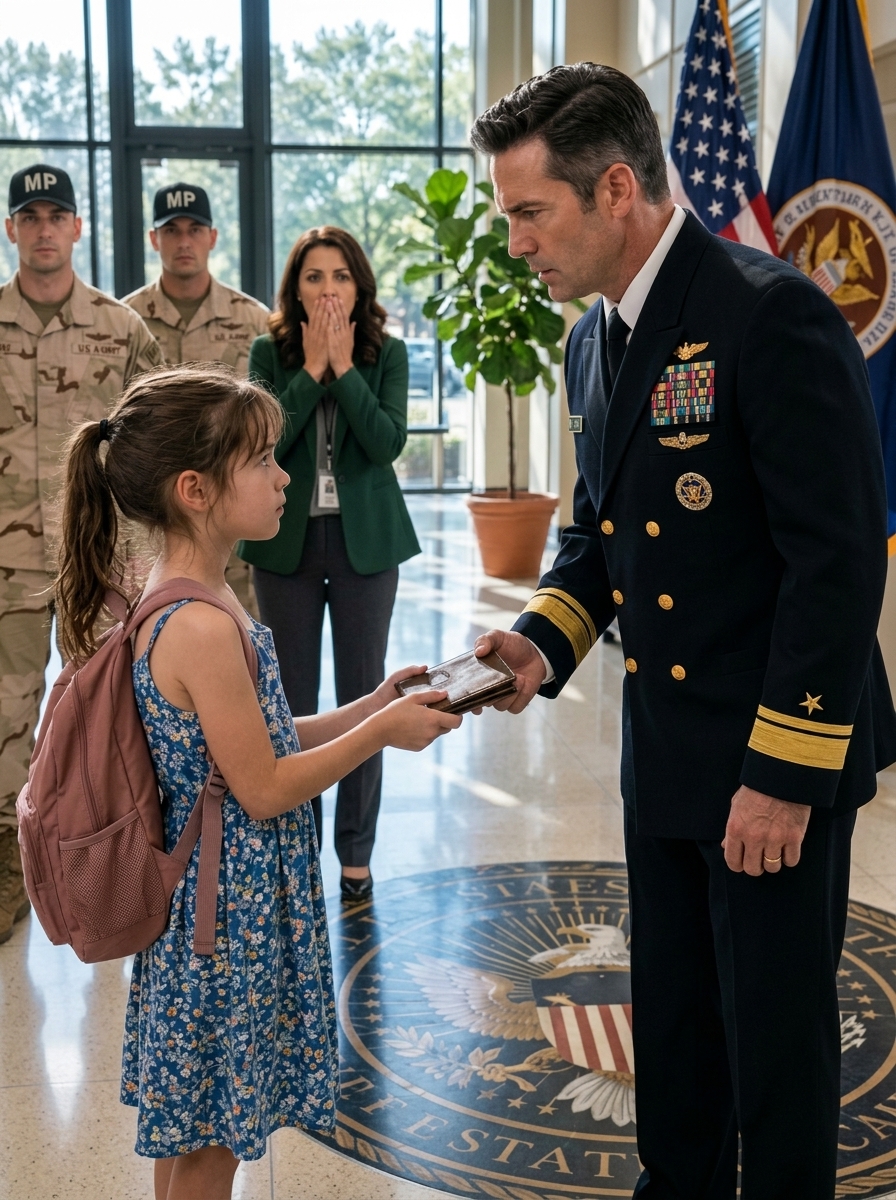
He didn’t immediately take it.
“You came all the way here to return this?”
I nodded.
“Yes, sir.”
His eyes moved over my old shoes.
My backpack.
My dress.
Then something caught his attention.
The pink eviction notice.
It had slipped halfway out of my backpack.
His face changed so fast that even an eight-year-old could see it.
He stopped breathing.
Then he reached toward the paper.
“Where did you get that?”
I looked behind me, thinking he meant something else.
Advertisement
“The pink paper?”
“Yes.”
His voice was suddenly quiet.
Terribly quiet.
“It was on our apartment door.”
He pulled the paper free.
His eyes raced across the page.
ALDRIDGE RESIDENTIAL HOLDINGS.
PROPERTY 17-B.
AUTHORIZED AGENT: M. VOSS.
General Graves went completely still.
“What’s your name?”
“Ruby.”
His hand tightened around the notice.
“Your full name.”
“Ruby Bennett.”
His eyes snapped to mine.
“Your mother’s name?”
“Claire Bennett.”
The wallet slipped from his other hand.
It hit the polished floor.
No one moved.
Advertisement
For three seconds, I thought General Graves might collapse.
Then he turned toward the military police.
“Secure this building.”
One officer blinked.
“Sir?”
“Lock every door.”
His voice exploded through the lobby.
“No one leaves!”
People froze.
The receptionist went pale.
I took one frightened step backward.
“I didn’t steal anything.”
General Graves looked at me.
Something in his expression softened.
“No, Ruby.”
He crouched until we were nearly eye level.
“You didn’t do anything wrong.”
“Then why are they locking the doors?”
Advertisement
He looked at the eviction notice again.
“Because the man whose name is on this paper is inside this building.”
My mouth went dry.
General Graves stood.
“Sergeant, nobody enters or exits until Army CID arrives. I want Colonel Malcolm Voss located immediately.”
A soldier answered.
“Yes, sir.”
Voss.
The name meant nothing to me.
Not yet.
General Graves turned back to me.
“Ruby, I need you to tell me something.”
I nodded.
“How long have you lived at 17-B Aldridge Street?”
Advertisement
“My whole life.”
His face tightened.
“And your father?”
I stared at the floor.
“I don’t have one.”
His voice softened.
“What do you mean?”
“He died before I was born.”
Something flickered in his eyes.
“What was his name?”
I shrugged.
“Mom doesn’t talk about him very much.”
“Ruby.”
He swallowed.
“Was his name Daniel?”
My head lifted.
That frightened me more than the locked doors.
Because I knew that name.
Mom kept one photograph in a wooden box under her bed.
Advertisement
A young man in an Army uniform.
Dark hair.
Gray eyes.
Standing beside my mother.
On the back, written in faded blue ink, were two words.
Claire + Daniel.
“Yes.”
General Graves turned away.
He covered his mouth.
The most powerful man in the building suddenly looked like someone had punched him in the chest.
Then he whispered something I wasn’t supposed to hear.
“My son.”
That was the moment my world cracked open.
Daniel wasn’t just my dead father.
Daniel Graves had been General Nathaniel Graves’s only son.
Advertisement
And according to the General…
my mother and I were never supposed to be living in poverty.
We were never supposed to be evicted.
We weren’t even supposed to be strangers to him.
General Graves brought me upstairs to a conference room.
Someone gave me orange juice and crackers.
I was too nervous to eat.
He sat across from me holding the pink notice like it was evidence from a crime scene.
Maybe it was.
“Ruby, I need to speak with your mother.”
Advertisement
I shook my head immediately.
“You’re not going to arrest her?”
“No.”
“Promise?”
He looked me directly in the eyes.
“I promise.”
I gave him Mom’s phone number.
She answered on the fourth ring.
“Ruby?”
General Graves put the phone on speaker.
“Ms. Bennett, my name is Nathaniel Graves.”
Silence.
Not normal silence.
The kind of silence where something inside a person stops moving.
Then Mom whispered one word.
“No.”
General Graves closed his eyes.
“Claire—”
“No.”
Her voice became sharper.
May you like

My Brother-in-Law Threw Me Out of My Own Beach House—He Had No Idea I Was a U.S. Army Colonel
“Why are you calling me?”
“Your daughter is here.”
“What?”
The fear in her voice made me grab the phone.
“Mom, I’m okay!”
“Ruby? Where are you?”
“Fort Aldridge.”
“What are you doing at Fort Aldridge?”
“I found a wallet.”
There was another silence.
Then Mom said, “Put him back on.”
I handed the phone over.
General Graves spoke carefully.
“Claire, Ruby returned my wallet. I saw an eviction notice in her backpack.”
“Give her bus money and send her home.”
Advertisement
“Claire.”
“Send my daughter home.”
“The eviction notice is signed by Malcolm Voss.”
Mom stopped breathing.
I heard it.
So did General Graves.
His expression hardened.
“Claire, please come here.”
“I have nothing to say to you.”
“I believe we’ve both been lied to.”
Her answer came almost instantly.
“I stopped believing you eight years ago.”
Then she hung up.
General Graves stared at the phone.
Eight years ago.
The year I was born.
He called again.
She didn’t answer.
Advertisement
Finally, he sent an Army vehicle to bring her—not under guard, not under arrest, but because he was afraid she would run.
Forty minutes later, my mother walked through the conference room door.
Her nursing-home uniform was wrinkled.
Her hair was pulled into a messy bun.
She looked exhausted.
Then she saw General Graves.
Everything inside her changed.
She pulled me behind her.
“Stay away from my daughter.”
General Graves stood slowly.
“Claire.”
“You don’t get to say my name.”
Advertisement
“I thought you were gone.”
Mom laughed once.
There was no humor in it.
“You thought I was gone?”
“I sent letters.”
“I never received them.”
“I was told you returned every one.”
“By whom?”
General Graves didn’t answer.
He didn’t have to.
They both said the name at the same time.
“Voss.”
My mother sat down.
For eight years, she had believed Nathaniel Graves hated her.
General Graves had believed she wanted nothing to do with him.
Both stories had come from one man.
Advertisement
Colonel Malcolm Voss.
Twelve years earlier, Malcolm Voss had been a financial officer overseeing several programs connected to military family housing and emergency relief.
Daniel Graves had been a young Army captain.
And according to my mother, Daniel had discovered something he wasn’t supposed to see.
Money was disappearing.
Small amounts at first.
Then larger transfers.
Housing renovation funds.
Emergency assistance.
Death benefits.
Donations intended for families of deployed soldiers.
The money was being moved through shell companies.
One of those companies was called Aldridge Residential Holdings.
Advertisement
The same name printed on our eviction notice.
Daniel spent four years quietly collecting evidence.
He didn’t immediately tell his father.
He wanted proof.
And there was another reason.
At the time, General Graves trusted Malcolm Voss completely.
They had served together.
Voss had attended family holidays.
He knew Daniel since Daniel was a teenager.
Daniel was afraid his father would refuse to believe that a close friend was stealing from military families.
Then Daniel met my mother.
Claire Bennett.
Advertisement
They fell in love.
They married quietly.
And shortly afterward, Mom discovered she was pregnant with me.
Daniel decided he couldn’t stay silent anymore.
He planned to take everything to investigators.
He never got the chance.
One rainy night, eight years ago, Daniel’s car went through a guardrail.
He died before the ambulance arrived.
Mom survived because she wasn’t in the car.
She had been scheduled to ride with him.
Morning sickness kept her home.
Two days after Daniel died, Malcolm Voss came to see her.
Advertisement
He told her General Graves blamed her.
He said Daniel had been distracted because of their marriage.
He said Nathaniel believed she had manipulated his son.
Then came the threat.
“If you try to use that pregnancy to get access to the Graves family,” Voss told her, “Nathaniel will destroy you. He’ll take the child if he has to.”
Mom had been twenty-three.
Pregnant.
Terrified.
Buried in grief.
And she believed him.
General Graves turned white as she spoke.
“I never said any of that.”
Advertisement
“I know that now.”
“Why didn’t you call me yourself?”
“I did.”
Mom’s eyes filled.
“Eleven times.”
Nathaniel stared at her.
“What?”
“Your office told me you refused my calls.”
He turned toward the door.
His voice hardened.
“Get me my communications archives from that year.”
A major standing outside nodded and disappeared.
Mom continued.
She had also written letters.
Every one came back marked RETURN TO SENDER.
She showed him photographs she’d kept.
Envelopes.
Dates.
General Graves recognized his headquarters address.
Advertisement
Someone had intercepted them before they ever reached him.
Voss.
But that still didn’t explain our apartment.
General Graves opened a locked cabinet and removed an old file.
He placed it on the table.
PROPERTY 17-B, ALDRIDGE STREET.
Mom stared.
General Graves opened the folder.
Inside was a deed.
Eight years earlier, weeks before Daniel died, Nathaniel had purchased the apartment through a family trust.
Not for himself.
For Daniel.
Daniel had told him he wanted a secure home before the baby was born.
Nathaniel signed the documents.
The property was supposed to transfer to Daniel and Claire upon the birth of their child.
If Daniel died, the ownership automatically passed to Claire and the child.
My mother stared at the page.
“We were told it was a rental.”
“It wasn’t.”
General Graves looked at me.
“The apartment belongs to you and your mother.”
I almost laughed because it sounded impossible.
We had been paying rent for eight years.
Rent on a home we already owned.
General Graves turned to my mother.
“How much?”
“What?”
“How much rent have you paid?”
Mom whispered, “Almost a hundred thousand dollars.”
The General’s jaw clenched.
That money had gone to Aldridge Residential Holdings.
A company linked to Malcolm Voss.
But there was more.
A lot more.
The original property documents included something called the Graves Family Survivor Trust.
Daniel had deposited money into it before his death.
Nathaniel added more after the accident.
By the time I turned eight, the account should have contained more than $600,000.
For education.
Housing.
Medical care.
My future.
The account was empty.
Someone had spent every dollar.
And my name was on every transaction.
RUBY GRAVES BENEFICIARY TRUST.
My name.
My Social Security information.
My father’s name.
My birth date.
Dozens of documents made it look as if money had been legally withdrawn for my benefit.
School tuition.
Medical procedures.
Private childcare.
Housing upgrades.
None of it had ever happened.
I attended public school.
Mom had no health insurance for almost two years.
My childcare had been an elderly neighbor named Mrs. Diaz.
And our apartment ceiling leaked whenever it rained.
Someone had been stealing from me since the day I was born.
Then the door opened.
A military police officer entered.
“Sir, we located Colonel Voss.”
General Graves stood.
“Bring him here.”
The officer hesitated.
“He was attempting to leave through the east service exit.”
Mom’s hand grabbed mine.
A few minutes later, Malcolm Voss entered.
I recognized him immediately.
Not from photographs.
Not from television.
From our apartment building.
Three days earlier, a tall gray-haired man had stood outside our door while Mom argued with the property manager.
I had been sitting at the kitchen table doing homework.
I heard his voice.
“Seven days,” he said. “No extensions.”
Mom begged for another month.
The man answered, “This property needs to be empty.”
I pointed.
“That’s him.”
Every face turned toward me.
Voss looked at me.
For the first time that day, he seemed afraid.
“You came to our apartment.”
He recovered quickly.
“I inspect several properties.”
General Graves stared at him.
“You told me you sold your interest in Aldridge Residential ten years ago.”
Voss said nothing.
“You told Claire I hated her.”
Silence.
“You intercepted her calls.”
Nothing.
“You stole money from my granddaughter.”
Voss finally laughed.
“Your granddaughter?”
The word was loaded with contempt.
And that was his mistake.
Because he knew.
He knew exactly who I was.
Before anyone had told him.
General Graves noticed too.
“So you knew Daniel had a daughter.”
Voss’s smile disappeared.
Army CID investigators arrived soon after.
Voss stopped talking.
But the biggest piece of evidence wasn’t inside Fort Aldridge.
It was inside our apartment.
My mother remembered something Daniel had told her the week before his death.
If anything ever happened to him, she was not supposed to leave the apartment until she found “the box behind the blue wall.”
At the time, there hadn’t been a blue wall.
Years later, when I was five, Mom let me choose a color for my bedroom.
I chose blue.
She had completely forgotten Daniel’s words.
Until that moment.
CID accompanied us home.
Our apartment looked different when investigators entered carrying cameras and evidence bags.
They measured the wall.
Tapped along the drywall.
One section sounded hollow.
Behind it was a metal box wrapped in old plastic.
My mother began crying before they even opened it.
Inside were financial ledgers.
Printed bank transfers.
Copies of contracts.
A small digital recorder.
An original property deed.
And a letter.
On the front, Daniel had written:
DAD.
General Graves’s hands shook when he opened it.
He read silently at first.
Then his voice broke.
“Dad, if you’re reading this, something happened before I could finish what I started.”
Nathaniel stopped.
He pressed his lips together.
Then continued.
“I know you trust Malcolm. I did too. But he’s been moving money through family housing programs for years. I have enough to prove some of it, not all of it. If Claire or our child is ever threatened, this is why.”
Mom covered her mouth.
General Graves kept reading.
“I know we fought. I know you think I’m reckless. But becoming a father changed something in me. I finally understand why you spent your whole life trying to protect me.”
Nathaniel’s eyes filled with tears.
“I hope one day you meet your grandchild.”
He couldn’t finish the next sentence.
So my mother did.
“And when you do, tell them their father tried to do the right thing even when it was dangerous.”
The room went completely silent.
I had spent my entire life with only one photograph of my father.
Now I had his voice.
His handwriting.
His words.
And proof that he had thought about me before I was born.
The recorder was even worse.
Or better.
I’m still not sure.
Investigators found several conversations Daniel had secretly recorded.
One was with Malcolm Voss.
Daniel confronted him about the stolen money.
Voss denied everything.
Then Daniel mentioned files he had copied.
Voss’s voice changed.
“You have a child coming, Daniel. Think carefully about what matters.”
Daniel answered, “That’s exactly why I’m doing this.”
Another recording mentioned Daniel’s car.
Daniel told my mother that someone had been inside it while he was at work.
The official accident report claimed mechanical failure had caused him to lose control.
But the original maintenance inspection found in the metal box showed something else.
The brake line had been damaged.
Deliberately.
Eight years after my father’s death, the accident was reopened as a criminal investigation.
Everything happened quickly after that.
Search warrants.
Bank records.
Computers seized.
Properties frozen.
Investigators found shell companies connected to Voss and two civilian partners.
They found more than four million dollars that had been diverted from housing and family assistance programs over twelve years.
They found forged signatures.
Fake invoices.
My trust account.
The false transfer of our apartment.
And messages discussing our eviction.
That part made my mother physically sick.
Voss had recently learned that an internal audit was going to review old Aldridge housing properties.
Our apartment still contained a title problem he couldn’t completely erase.
He needed us gone before investigators examined it.
That’s why the eviction suddenly arrived.
He wasn’t trying to collect rent.
He was trying to remove the last people connected to Daniel.
And once the apartment was empty, it was scheduled for renovation.
The wall would have been demolished.
The box would have disappeared.
Seven more days.
That was all he needed.
Seven days.
Then an eight-year-old girl found a wallet under a bus bench.
Malcolm Voss was eventually charged with multiple federal crimes connected to fraud, theft, forged records, obstruction, and the conspiracy surrounding my father’s death.
Others were arrested too.
The investigation lasted much longer than the dramatic part people remember.
Real justice usually does.
There are hearings.
Paperwork.
Delays.
Lawyers.
More delays.
But our eviction disappeared immediately.
So did the rent.
Because we weren’t tenants.
We were owners.
General Graves personally stood in our tiny kitchen the following afternoon while my mother stared at eight years of rent receipts spread across the table.
“You should never have paid any of this,” he said.
Mom looked at him.
“And you should have known your granddaughter existed.”
He lowered his head.
“I should have.”
For a moment I thought she might tell him to leave.
Instead, she started crying.
Then he did too.
Eight years of anger couldn’t disappear in one afternoon.
Neither could twelve years of lies.
But something started.
Slowly.
General Graves didn’t suddenly become Grandpa Nathaniel.
At first, he was just General Graves.
Then he became Nathaniel.
Then one afternoon he came to my school because I had a presentation about family history.
I stood in front of my class holding my father’s photograph.
When I finished, Nathaniel was standing in the hallway wiping his eyes.
A few months later, I called him Grandpa by accident.
He froze.
I thought I had done something wrong.
Then he smiled.
It was the first time I had ever seen that serious television general look completely defenseless.
Our lives changed financially too.
The stolen trust money was eventually recovered.
The apartment title was restored.
Mom paid off her debts.
But she refused to become someone different just because money finally appeared.
She kept working.
She bought a newer used car instead of something expensive.
And she made me keep the same backpack until the zipper finally broke.
She also made me pay Nathaniel back for the bus ride.
Not because he asked.
Because she said principles shouldn’t disappear when life gets easier.
Years later, I asked General Graves about the wallet.
I had always wondered why he had been carrying nine hundred dollars in cash.
He laughed.
“It was for a retirement gift.”
“Seriously?”
“Seriously.”
“So if I’d stolen it, you would have lost nine hundred dollars.”
“Yes.”
“And if I returned it, you found your granddaughter.”
He looked at me for a long moment.
Then he shook his head.
“No, Ruby.”
He reached into an old desk drawer.
Inside was the same black wallet.
Worn now.
Scratched around the edges.
“You returned far more than this.”
He pulled out a folded piece of paper.
The original pink eviction notice.
He had kept it.
“You gave me back the truth.”
My throat tightened.
He continued.
“You gave your mother her home.”
He paused.
“You gave your father his name back.”
Then his voice became quieter.
“And you gave an old man eight years with his granddaughter that he almost never had.”
I looked at that pink paper.
For most people, it would have been garbage.
For us, it had been the thread that unraveled twelve years of lies.
And sometimes I still think about that afternoon beneath the rusty bus bench.
Nine hundred dollars had felt like everything.
To an eight-year-old girl whose mother was facing eviction, it practically was.
I remember staring at those bills.
Thinking about rent.
Food.
Electricity.
Thinking about how easily I could put the wallet inside my backpack and walk away.
No one would know.
Except me.
If I had taken that money, we might have survived another month.
Maybe two.
But I would never have walked into Fort Aldridge.
General Nathaniel Graves would never have seen the pink eviction notice.
My mother would never have learned the apartment already belonged to us.
My father’s letter would still be buried behind my bedroom wall.
Malcolm Voss might have gotten the seven days he needed.
The wall would have come down.
The evidence would have disappeared.
And I might have grown up believing my father died in an ordinary accident.
Believing my grandfather never wanted me.
Believing my mother and I were poor because we had simply been unlucky.
Instead, one decision changed everything.
My mother had always told me that doing the right thing matters most when nobody is watching.
For years, I thought she was teaching me how to be honest.
I didn’t understand that she was teaching me something much bigger.
Sometimes doing the right thing doesn’t reward you immediately.
Sometimes it costs you.
Sometimes it makes you hungry.
Sometimes it forces you to spend your last few dollars on a bus ride.
Sometimes everyone around you thinks you’re foolish.
But truth has a strange way of finding doors that money can’t open.
I was eight years old.
I had less than three dollars left in my backpack.
My mother was seven days away from losing what we thought was our rented apartment.
And I walked into a military headquarters carrying nine hundred dollars that didn’t belong to me.
I thought I was returning a wallet.
Instead, I uncovered a twelve-year conspiracy.
I found the truth about my father.
I found the home that had always belonged to us.
And most importantly…
I found my grandfather.
All because, when nobody was watching, I decided not to keep nine hundred dollars that wasn’t mine.