I felt nauseated.
But Meadow wasn’t finished.
“They were in your bed.”
My fingers tightened around hers.
“What happened when they saw you?”
Tears rolled sideways toward her ears.
“Dad got really mad.”
“How mad?”
“He said I ruined everything.”
My mouth went dry.
“He grabbed me.”
She squeezed her eyes shut.
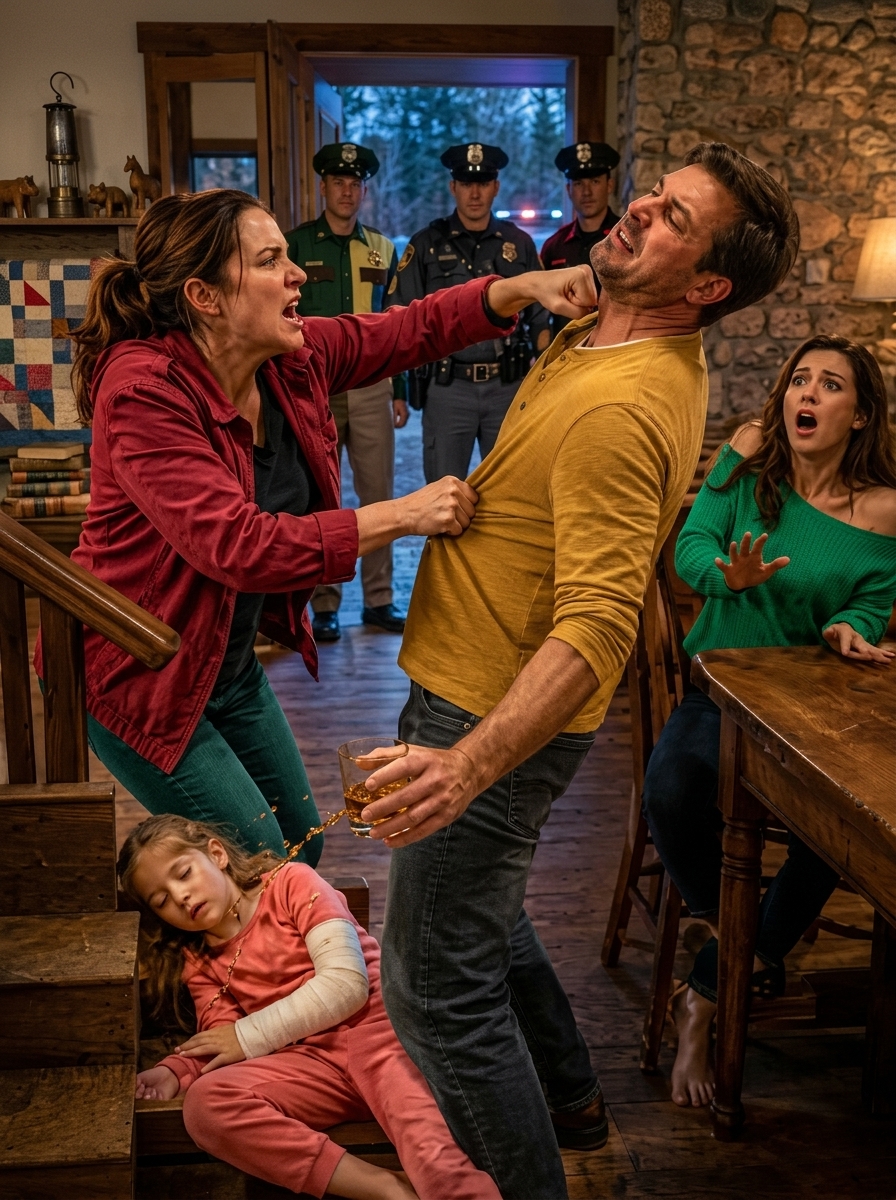
“And he threw me down the stairs.”
The room became silent except for the monitor beside her bed.
One beep.
Then another.
Then another.
I felt every lesson the military had taught me come rushing back.
Advertisement
Do not react before you understand the situation.
Do not contaminate evidence.
Do not scare a witness.
Do not let rage make decisions for you.
But this was not a battlefield.
This was my daughter.
And for the first time in my life, calm hurt more than panic.
“Did anyone tell you what to say?”
Meadow nodded.
“Dad said to tell everybody I fell when I was playing dress-up.”
“Did Aunt Serena hear him?”
Another nod.
“She said I needed to stop crying because people would ask questions.”
Advertisement
I looked away for half a second.
That was all I allowed myself.
When I looked back, I kept my voice steady.
“Meadow, look at me.”
She did.
“I believe you.”
Her face crumpled.
“I believe every single word.”
She started crying harder.
“I didn’t mean to ruin your marriage.”
I nearly lost control then.
I bent over her carefully and pressed my forehead against hers.
“You did not ruin anything.”
“But Dad said—”
“Your dad made choices. Aunt Serena made choices. You did nothing wrong.”
Advertisement
She stared at me.
Children remember sentences spoken at moments like that.
So I chose every word carefully.
“You saw something adults wanted to hide. You told the truth. And I am proud of you.”
Her breathing slowly settled.
Then she whispered something I hadn’t expected.
“They’re still there.”
I pulled back.
“What?”
“At home.”
“Who?”
“Dad and Aunt Serena.”
My blood went cold.
“They were drinking.”
“When?”
“When the ambulance came.”
She swallowed.
“Dad had the brown bottle from the cabinet.”
Advertisement
Whiskey.
Dennis’s favorite.
“He told the ambulance man you were coming.”
I closed my eyes.
One second.
That was all.
He had thrown our daughter down the stairs.
Called 911.
Invented an accident.
Sent her away in an ambulance.
Then stayed home with my sister and poured himself another drink.
Some anger burns.
Mine froze.
A nurse entered the room quietly.
“Mrs. Hawthorne?”
I turned.
“There are two police officers outside. The physician contacted law enforcement because of the injuries and some concerns regarding the history provided.”
Advertisement
Good.
I kissed Meadow’s forehead.
“I’m going right outside.”
Her hand tightened around mine.
“Mom?”
“Yes?”
“Don’t let them be mad at me.”
That sentence hurt more than everything else.
I bent down again.
“They do not get to be mad at you.”
I brushed her hair away from her forehead.
“They get to answer for what they did.”
The officers were waiting beside the nurses’ station.
I gave them facts.
Not theories.
Not rage.
Facts.
My daughter said she discovered her father Dennis Hawthorne and my sister Serena together in my bedroom.
Advertisement
She said Dennis became angry.
She said he threw her down the stairs.
She said both adults instructed her to claim she had fallen while playing.
She said Dennis and Serena were currently inside my house drinking whiskey.
Then I gave them what could be verified.
“Meadow arrived at 2:17.”
“Yes.”
“She told me what happened at approximately 2:43.”
One officer wrote the time down.
“The doctor documented the injuries?”
“Yes.”
“My house has security cameras.”
His pen stopped.
Advertisement
“Where?”
“One covers the stairwell.”
Both officers looked up.
“The other covers the back entrance. They upload to cloud storage.”
“Can you access the footage?”
“Yes.”
I pulled out my phone.
My hands remained perfectly steady.
The security app opened.
I entered my password.
1:54 p.m.
I selected the stairwell camera.
At first, nothing.
Empty stairs.
The edge of the upstairs hallway.
A family photograph on the wall.
Meadow at the county fair.
Dennis holding her on his shoulders.
May you like

WAITRESS SPENT HER LAST $12 TO SAVE A HUNGRY BOY—THEN A MAFIA BOSS STORMED INTO HER DINER
Me smiling beside them.
The perfect Hawthorne family.
Then movement appeared.
Meadow stumbled into view at the top of the staircase.
Dennis came after her.
Even through the tiny phone speaker, I heard his voice.
“Get back here.”
Meadow turned.
“I’m telling Mom.”
Dennis reached her.
The camera didn’t show the bedroom.
It didn’t need to.
It showed his arm.
Her small body.
The sudden motion.
Meadow disappeared.
A horrible series of impacts followed.
I stopped breathing.
The officer beside me whispered, “Jesus.”
Advertisement
Dennis rushed down after her.
He knelt beside her.
For one irrational second, part of me expected to see the father I thought I had married.
A terrified parent.
A man screaming for help.
Instead, he grabbed Meadow’s chin.
His words came through clearly enough.
“You fell.”
Meadow cried.
“You understand me?”
Then Serena appeared at the top of the stairs.
Barefoot.
Wearing one of my robes.
She looked down at my child.
At her niece.
And said, “Dennis, call somebody before this gets worse.”
Advertisement
Not help her.
Not what have we done?
Before this gets worse.
Dennis disappeared toward the kitchen.
Serena crouched beside Meadow.
Meadow whimpered, “I want my mom.”
Serena looked toward the camera.
Then toward the hall.
“You’re going to tell them you were playing dress-up.”
One officer reached for his radio.
The other asked me for permission to copy the footage.
“You can have everything.”
I forwarded the clips immediately.
We checked the back-door camera next.
At 2:09, paramedics arrived.
Advertisement
At 2:14, Meadow was carried out.
At 2:15, Serena stepped onto the back porch holding a glass.
At 2:19, after the ambulance had left, Dennis came outside.
He lit a cigarette.
Serena handed him the whiskey.
They went back inside.
The officer stared at the screen.
“Mrs. Hawthorne, stay here with your daughter.”
“No.”
He looked at me.
“That’s my house.”
“It may become a crime scene.”
“I understand.”
“We don’t want a confrontation.”
“Neither do I.”
Advertisement
I held his gaze.
“But you may need the homeowner to identify devices, rooms, camera equipment, or property. I will follow instructions.”
The officers exchanged a look.
Twenty-six minutes later, three patrol cars turned quietly onto my gravel driveway.
No sirens.
No lights.
Our farmhouse looked exactly the way it had that morning.
White siding.
Blue shutters.
Two flower baskets hanging from the porch.
Meadow’s bicycle lying beside the garage.
A chalk rainbow on the walkway.
Through the kitchen window, I saw Dennis.
Advertisement
He was holding a glass of whiskey.
Serena sat at my kitchen table.
Barefoot.
Laughing.
Laughing.
While my daughter lay in a hospital bed.
The lead officer approached the front door.
Knocked.
Dennis opened it.
His smile disappeared.
“Officers?”
Then he saw me behind them.
The blood drained from his face.
“Tori.”
I said nothing.
“What are you doing here?”
The officer stepped forward.
“Dennis Hawthorne?”
“Yes.”
“We need to speak with you regarding your daughter.”
Dennis immediately changed.
His shoulders dropped.
Advertisement
His expression softened.
Concerned father.
The performance was almost impressive.
“Oh, God. Meadow. Is she okay? I was just getting ready to head to the hospital.”
I looked at the whiskey in his hand.
He followed my eyes.
“I needed something to calm down.”
Behind him, Serena stood.
She was wearing jeans now.
My robe was gone.
“Victoria.”
I looked at my sister.
She actually tried to cry.
“It was horrible.”
I still said nothing.
Dennis shook his head.
“She fell. I told the paramedics exactly what happened.”
Advertisement
The officer asked, “You witnessed the fall?”
“Yes.”
Serena answered too quickly.
“So did I.”
That was their first mistake at the door.
They had rehearsed.
But they had not rehearsed enough.
“What was she doing?” the officer asked.
Dennis glanced at Serena.
“Playing.”
Serena said, “Dress-up.”
Dennis recovered.
“Yes. Dress-up.”
“What was she wearing?”
Silence.
Dennis’s jaw tightened.
“I don’t know. Kid stuff.”
The officer’s tone never changed.
“We have security footage from inside the residence.”
Everything stopped.
I watched Dennis.
Advertisement
Not Serena.
Dennis.
People tell you the truth with their faces before their mouths catch up.
His eyes flicked toward the stairs.
Then toward me.
“What footage?”
“The stairwell.”
Serena sat down.
Dennis laughed once.
A short, ugly sound.
“Oh, come on. Cameras don’t show context.”
The officer asked him to step outside.
That was when Dennis looked directly at me.
“Tori, tell them this is ridiculous.”
I said nothing.
“Meadow was upset.”
Nothing.
“She misunderstood something.”
Still nothing.
His mask began to crack.
Advertisement
“You know how dramatic she gets.”
That sentence did it.
Not because it surprised me.
Because my daughter had been lying in a hospital apologizing for being thrown down a staircase, and the man responsible was standing in front of our home calling her dramatic.
I stepped closer.
The officer shifted, ready to intervene.
I stopped several feet away.
“Do not ever use my daughter’s name to protect yourself again.”
Dennis stared at me.
Serena started crying.
“Victoria, please.”
I turned to her.
She recoiled.
Good.
“You were there.”
“It was an accident.”
“The camera recorded you telling her to lie.”
Her mouth closed.
Dennis snapped, “Serena, don’t say anything.”
The officer immediately looked at him.
That was mistake number two.
Dennis realized it too late.
Within minutes, he was in handcuffs.
Then Serena.
Our neighbors began appearing on porches.
Curtains moved.
Phones came out.
This was a small Nebraska town.
News traveled faster than emergency vehicles.
Dennis Hawthorne was not just my husband.
He coached youth baseball.
Ran charity auctions.
Helped repair the church roof.
Delivered groceries to elderly neighbors during snowstorms.
People called him one of the best fathers in town.
Serena organized school fundraisers.
Baked cupcakes for Meadow’s class.
Posted photographs online with captions about family being everything.
Watching them led separately toward patrol cars felt unreal.
Dennis twisted around before an officer put him inside.
“Tori!”
I stopped.
“You’re destroying this family!”
There it was.
Not I’m sorry.
Not tell Meadow I love her.
Not I made a terrible mistake.
You’re destroying this family.
I looked at him.
“No, Dennis.”
I glanced toward the upstairs window.
“You did that before I got here.”
Then the car door closed.
I returned to the hospital.
Meadow was awake.
The first thing she asked was, “Did Dad get mad?”
I sat beside her.
“Dad isn’t coming here tonight.”
“And Aunt Serena?”
“Neither is she.”
Meadow studied my face.
“Are you mad at me?”
“No.”
“Not even a little?”
“Not even for one second.”
She started crying again.
This time, I cried with her.
The next forty-eight hours blurred together.
Scans.
Doctors.
Police interviews.
A child advocate.
Social workers.
Questions repeated gently so nobody could later claim Meadow had been coached.
Every time she told the story, the important details remained the same.
She had come home early because a neighbor brought her back from an afternoon playdate when the neighbor’s son became sick.
Meadow entered through the mudroom.
She heard voices upstairs.
She thought I had come home early.
She climbed the stairs.
Opened my bedroom door.
And found Dennis and Serena.
Dennis panicked.
Meadow ran.
He chased her.
She screamed that she would tell me.
Then came the stairs.
Then the lie.
Police took the digital video recorder.
They photographed the staircase.
They collected the whiskey bottle.
They documented my robe in the upstairs bathroom.
And once investigators obtained access to Dennis’s phone, the affair stopped being something anyone could dismiss as a momentary mistake.
Months of messages.
Hotel reservations.
Deleted photographs recovered from cloud backups.
Conversations about how easy it was to meet at my house when I was handling emergency calls.
Messages joking about my schedule.
Messages from Serena telling Dennis that Meadow “adores me enough not to suspect anything.”
That one nearly made me physically sick.
Because betrayal has layers.
First, Serena betrayed me.
Then she used my daughter’s love for her as camouflage.
The town reacted exactly the way small towns react when the truth threatens something comfortable.
Some people believed Meadow immediately.
Others didn’t.
Not at first.
I heard the whispers.
Dennis would never.
Serena loves that little girl.
Victoria works too much.
Maybe Meadow saw something and became confused.
Maybe the fall really was an accident.
Maybe Victoria’s military background makes her intense.
Maybe the marriage had problems.
Maybe.
Maybe.
Maybe.
People love maybe when the truth requires them to admit they trusted the wrong person.
Then portions of the camera footage were described during the preliminary hearing.
The whispers changed.
Dennis’s lawyer tried to argue that Meadow had been frightened and that he had reached for her to stop her from falling.
The prosecutor paused.
Then replayed his words from the recording.
“You fell. You understand me?”
Silence filled the courtroom.
Dennis stared at the table.
Serena’s attorney tried another approach.
Serena had not pushed Meadow.
Serena had panicked.
Serena was emotionally overwhelmed.
Serena had made a terrible judgment call.
The prosecutor asked a simple question.
“Did she comfort her injured niece?”
No.
“Did she tell paramedics the truth?”
No.
“Did she accompany the seven-year-old child to the hospital?”
No.
“Did she contact the child’s mother?”
No.
“Did she remain in the home afterward and consume alcohol with the person accused of throwing the child down the stairs?”
Yes.
Serena cried.
I did not.
Not then.
My tears belonged to Meadow.
Not Serena.
Three weeks after the incident, I returned to the farmhouse with an officer while Dennis remained away under court restrictions.
The house smelled stale.
I walked upstairs slowly.
The family pictures were still hanging along the staircase.
Meadow at four.
Meadow on her first day of kindergarten.
Dennis teaching her to ride a bicycle.
Serena holding her at Christmas.
I stood at the top step for a long time.
Then I entered my bedroom.
The sheets had been removed as evidence.
The room felt contaminated anyway.
Not physically.
Emotionally.
I stared at the bed.
For years, I had believed betrayal would look dramatic.
Lipstick on a collar.
A secret hotel key.
A message arriving at midnight.
Instead, mine looked like a child standing in a hospital gown asking whether her father was angry with her.
I removed my wedding ring.
Placed it on the dresser.
And never wore it again.
I filed for divorce the next morning.
Dennis responded through his attorney.
He wanted access to the house.
He wanted financial records.
He wanted property discussions.
He wanted to know whether I intended to sell.
He wanted a dozen things.
He did not ask about General Pickles.
That sounds small.
It wasn’t.
Meadow had asked about that stuffed dinosaur every night in the hospital.
A nurse eventually drove with me to retrieve it from the house because Meadow refused to sleep without him.
Her father never asked.
The criminal case moved forward.
So did Meadow.
Slowly.
Healing is not dramatic.
There was no morning when she woke up and suddenly became the child she had been before.
She became quieter around staircases.
She stopped sleeping alone.
The sound of a glass dropping in the kitchen made her freeze.
For months, she asked whether the doors were locked.
She stopped wearing her purple rain boots.
One evening, I found them beneath her bed.
“Why don’t you wear these anymore?”
She shrugged.
“Dad bought them.”
I sat on the floor beside her.
“Do you want new ones?”
Another shrug.
Then she whispered, “Can we get yellow?”
The next day, we bought the brightest yellow rain boots I could find.
She wore them out of the store.
No rain.
No clouds.
Just sunshine.
I cried in the parking lot where she couldn’t see me.
The hardest day came when Serena asked to speak at a court hearing.
My sister looked smaller than I remembered.
No makeup.
Hair pulled back.
Orange county-issued clothing beneath restraints.
For one second, I saw the little girl who used to crawl into my bed during thunderstorms.
The sister whose first bicycle I taught her to ride.
The woman who held Meadow minutes after she was born and whispered, “I’m going to spoil you forever.”
Then Serena looked at me.
“I never wanted Meadow hurt.”
I said nothing.
She cried harder.
“I loved her.”
That was the moment I finally spoke.
“Then why did she have to protect herself from you?”
Serena had no answer.
Because sometimes love is not measured by what people say after everything collapses.
It is measured by what they do when protecting someone costs them something.
Telling the truth would have cost Serena her affair.
So she chose the affair.
And Meadow paid the price.
Dennis maintained for months that the fall had been accidental.
Then his attorney received the full evidence package.
Video.
Audio.
Medical reports.
Paramedic statements.
Meadow’s interviews.
Phone records.
Messages between Dennis and Serena.
The whiskey.
The contradictory statements.
His story began changing.
He hadn’t thrown her.
He had grabbed her.
Then he had pushed past her.
Then she lost her balance.
Then maybe he pushed harder than he intended.
Each version moved one inch closer to the truth.
Truth does that.
It waits.
People exhaust themselves running from it.
Eventually, there is nowhere left to go.
When the case finally reached its resolution, I sat in the courtroom with Meadow’s victim advocate beside me.
Meadow was not there.
I refused to make her watch adults argue over something she had already survived.
Dennis stood before the judge.
For the first time since I had known him, he looked ordinary.
Not the town hero.
Not the perfect husband.
Not Coach Dennis.
Not the man shaking hands at fundraisers.
Just a man forced to answer for his own decisions.
When the court addressed the seriousness of what had happened, Dennis stared straight ahead.
Serena sat behind him with her attorney.
I expected to feel victory.
I didn’t.
There is no victory in discovering your husband hurt your child because she caught him betraying you with your own sister.
There is only accountability.
And survival.
Outside the courthouse, reporters waited.
So did people from town.
I walked past them.
One woman called my name.
I recognized her.
Her son had played on Dennis’s baseball team.
She had once told me I was lucky to have such a devoted husband.
Now she touched my arm.
“I’m sorry I doubted Meadow.”
I looked at her.
“Tell her yourself someday.”
She nodded.
That mattered to me.
Because children notice when adults doubt them.
They should also be allowed to see adults correct themselves.
The divorce was finalized months later.
I kept the veterinary clinic.
I sold the farmhouse.
People were surprised.
“You built a life there,” they told me.
Exactly.
That was why we had to leave.
Meadow deserved a home that didn’t contain a staircase she was afraid to climb.
We moved twelve miles away to a smaller house with a wide porch, an enormous oak tree, and bedrooms all on one floor.
The first evening, Meadow walked through every room.
Opened every closet.
Checked every window.
Then she came back into the living room.
“No stairs.”
“No stairs.”
She smiled.
A real smile.
The kind I had been waiting months to see.
“Can I paint my room purple?”
“You can paint it neon green if you want.”
She looked horrified.
“Purple.”
“Purple it is.”
We painted it together.
Mostly.
She painted the wall.
I painted myself.
General Pickles supervised from a cardboard box.
Eventually, she started asking normal seven-year-old questions again.
Then eight-year-old questions.
Could horses sleep standing up?
Why couldn’t we adopt every dog at my clinic?
Could dinosaurs have had best friends?
If she ate broccoli twice, did that cancel out ice cream?
Little by little, fear stopped being the loudest thing in our house.
One night, almost a year after the hospital call, I was finishing paperwork at the kitchen table when Meadow walked in wearing her yellow boots and pajamas.
“Going somewhere?”
“No.”
She climbed into the chair across from me.
“Mom?”
“Yes?”
“Do you still miss Dad?”
I put down my pen.
I could have lied.
Children deserve better.
“Sometimes I miss who I thought he was.”
She considered that.
“Is that different?”
“Yes.”
“How?”
I looked at my daughter.
“You can miss a memory without wanting the person who hurt you back.”
Meadow nodded slowly.
Then she asked the question I think she had been carrying for months.
“If I never opened your bedroom door, would you still be married?”
I felt my heart tighten.
I moved around the table and knelt beside her.
“Maybe.”
Her face fell.
I lifted her chin gently.
“But listen to the rest.”
She looked at me.
“If you hadn’t opened that door, it would not have made Dad loyal. It would only have meant we didn’t know the truth yet.”
She was silent.
“You did not cause what happened.”
“But everything changed after.”
“Yes.”
“Because of me?”
“No.”
I shook my head.
“Everything changed because Dennis and Serena made choices that forced the truth into our lives.”
I paused.
“You told the truth after they hurt you. That is different.”
She stared down at her boots.
Then whispered, “I thought you would be mad because Aunt Serena was your sister.”
I wrapped my arms around her.
“You are my daughter.”
She leaned against me.
“There was never a choice.”
That night, after Meadow went to bed, I stood alone on the porch.
The Nebraska sky stretched black and endless above the fields.
For years, I had thought strength meant remaining composed.
Doing the job.
Holding the family together.
Forgiving mistakes.
Not letting people see you fall apart.
I had been wrong.
Sometimes strength is walking away.
Sometimes it is believing a frightened child when the truth destroys the life you thought you had.
Sometimes it is standing in a hospital corridor with your heart breaking and choosing evidence over rage.
Sometimes it is selling the house.
Changing the locks.
Signing the divorce papers.
Showing up for therapy.
Buying yellow rain boots.
And sometimes strength is accepting that the people who hurt you may continue telling a version of the story where they are the victims.
Dennis said I ruined his reputation.
Serena said I refused to forgive.
People repeated both versions for a while.
I stopped answering.
Because Meadow knew the truth.
The police knew.
The doctors knew.
The cameras knew.
And eventually, everyone who mattered knew.
A few weeks after her eighth birthday, Meadow came home carrying a drawing from school.
She handed it to me while I was making dinner.
It showed two people standing beside a purple house.
One tall.
One small.
A yellow dog that we did not actually own stood beside them.
Above the picture, in large crooked letters, she had written:
MY FAMILY.
I stared at it longer than I meant to.
“Where’s General Pickles?” I asked.
She gasped.
“I forgot him!”
She grabbed a crayon and added a tiny green dinosaur near my feet.
“There.”
“Much better.”
She taped the drawing to the refrigerator.
Then ran outside to play.
I stood in the kitchen alone.
And finally cried.
Not because of Dennis.
Not because of Serena.
Not because of the marriage, the trial, the hospital, or the house we had sold.
I cried because after everything they had done, Meadow still knew what family was.
Family wasn’t the person with your last name.
It wasn’t the person who stood beside you at Christmas.
It wasn’t the man strangers praised as the perfect father.
It wasn’t the sister who called herself your best friend.
Family was the person who believed you when telling the truth was terrifying.
The person who stayed.
The person who protected you when protecting you cost something.
Dennis and Serena thought my daughter’s fear would silence her.
They thought their reputations would protect them.
They thought our little town would believe the charming father and beloved aunt before it believed a bruised seven-year-old girl.
And most of all, they thought that once I discovered the affair, the assault, and the lies all at once, I would collapse beneath the weight of it.
For a while, I did.
Just never in front of them.
I broke in hospital bathrooms.
In my truck.
In the shower.
At two in the morning when Meadow finally slept.
I broke while packing our old house.
While deleting wedding photographs.
While changing emergency contacts at school.
While telling my parents that their younger daughter would never again be alone with my child.
I broke many times.
Then I got up.
Because Dennis had made one catastrophic mistake.
He believed hurting Meadow would protect his secret.
Instead, Meadow became the reason I stopped protecting him.
And Serena made the same mistake.
She believed being my sister meant there would always be some part of me willing to excuse her.
But blood does not erase choices.
And forgiveness does not require access.
Today, when Meadow runs through my veterinary clinic in bright yellow boots, patients smile when they see her.
Sometimes she helps me carry towels.
Sometimes she sits beside frightened dogs while they wait for treatment.
She tells them, “My mom fixes animals.”
I always correct her.
“I help them heal.”
One afternoon, she looked up at me.
“What’s the difference?”
I thought about it.
Then I smiled.
“Fixing means making something exactly the way it was before.”
She nodded.
“And healing?”
“Healing means it can be different afterward and still be okay.”
Meadow considered that seriously.
Then she wrapped both arms around my waist.
“I think we healed.”
I looked down at my daughter.
At the child who had once whispered I’m sorry from a hospital bed because two adults had convinced her their cruelty was somehow her responsibility.
At the child who survived the fall.
The lies.
The fear.
The loss of a father she thought she knew.
The loss of an aunt she adored.
And somehow still found room for laughter.
“Yes,” I whispered.
“I think we did.”
Dennis once believed throwing my daughter down those stairs would keep her quiet.
Serena believed helping him lie would protect the life they wanted.
Instead, that staircase became the place where every lie they had built began collapsing.
One camera.
One terrified little girl.
One sentence whispered from a hospital bed.
And the truth they thought they had buried came roaring into the light.
They thought my daughter would be too scared to speak.
They thought I would be too shattered to fight.
They underestimated both of us.