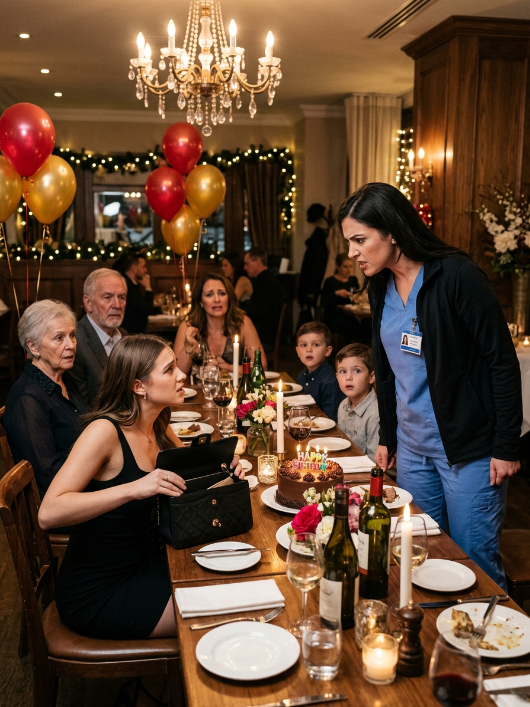
At my mom’s birthday, my family abandoned my 12-year-old daughter at a homeless shelter because “they didn’t have space for her.” Then drove to a luxury restaurant to celebrate with my sister’s family. I didn’t shout. I took action. The next day, their lives started falling apart…
It was supposed to be a normal Saturday. Cake, family photos, polite laughter. Instead, it turned into the day my trust in my family cracked wide open.
I’d been on shift at St. Luke’s Hospital since before sunrise. Twelve hours into the week, still running on caffeine and muscle memory.
I told myself that at least I’d make it to my mom’s birthday dinner afterward.
I’m a nurse. Being tired is practically part of the uniform.
During my lunch break, I called Mom from the staff lounge.
“Happy birthday,” I said, balancing a paper cup of coffee on my knee.
She sounded busy, talking over the noise of my sister’s voice in the background. Tiffany, four years younger, always the one in charge of parties and opinions, was saying something about table settings and balloons.
They’d promised to pick up my daughter, Mia, and bring her along.
“Don’t worry,” Tiffany had said the night before. “We’ll get her ready. Bring the present. You just survived your shift.”
It sounded helpful.
At the time, I was grateful.
By early afternoon, one of my patients was discharged sooner than expected. My supervisor looked at me over her glasses.
“Go, Allison. You’ve earned an early exit.”
For once, I didn’t argue.
I washed my hands, clocked out, and drove straight to the restaurant, a glass-front place across town, where Tiffany had booked a private room.
I wanted to surprise them. For once, I wouldn’t arrive late and tired. I’d walk in while the candles were still lit.
The hostess led me through a blur of noise and perfume to the long table by the window.
There they all were. My parents at the center, Tiffany glowing in something sparkly, her husband Eric checking his phone, their two kids, Brianna and Jacob, already halfway through dessert.
But no Mia.
I smiled automatically.
“Where’s Mia? Did she go to the restroom?”
Silence.
Just long enough to make my stomach tighten.
Then Brianna smirked.
“She’s volunteering.”
I blinked.
“She’s what?”
More laughter. The kind that tells you you’re the only one not in on the joke.
My dad lifted his wine glass.
“Your sister thought it would be good for Mia to help at the shelter today. Teach her perspective.”
I stared at Tiffany.
“You took her to the shelter alone?”
Tiffany’s smile didn’t move.
“Relax, Allison. She’s perfectly safe. I volunteer there every week. She’s staying a little while, learning gratitude.”
“She’s twelve.”
“I said she’s almost thirteen. Don’t be dramatic.”
Tiffany’s tone had that syrupy calm that always meant she’d already decided she was right.
“She’s been acting out lately. I thought she could use a reality check.”
My mom added gently, “Tiffany’s just helping. You’re always so busy, dear.”
I reached into my bag, pulled out my phone, and called Mia.
A ringtone chimed from Tiffany’s purse.
She sighed, fished out the phone, and handed it over.
“She doesn’t need to be glued to this all day.”
That was the moment everything shifted.
“You left my daughter with strangers and took her phone.”
Eric chuckled.
“Technically, they’re not strangers. They know Tiffany.”
I pushed my chair back hard enough to make the silverware jump.
“Allison,” Mom said quietly, warning in her voice. “Please don’t cause a scene.”
“Too late,” I said.
Humor’s my default setting when everything’s about to implode.
“Scene caused.”
I walked out before anyone could stop me.
Outside, the air hit like a furnace. My hands shook as I tried to fit the key into the ignition.
The drive blurred. Traffic, red lights, my heartbeat pounding in my ears.
Every minute felt stolen from me as safety.
The shelter sat at the edge of downtown, a tired brick building with a faded sign that read, “Family Resource Center.”
When I pushed through the glass door, a woman behind the front desk looked up, startled.
“Can I help you?”
“My daughter was dropped off here. Mia Thompson. Someone said she was volunteering.”
The woman’s face softened.
“You’re her mother?”
“Yes.”
“Thank goodness. We were told you’d be here hours ago. She’s been waiting in the playroom.”
Hours ago.
The words landed like a stone.
The hallway smelled of detergent and crayons. Somewhere, a toddler was crying.
The woman led me through a narrow doorway into a common room lined with cots.
Mia sat on one of them, backpack on her knees, trying not to cry.
When she saw me, she let out a shaky breath and ran straight into my arms.
“You came,” she whispered.
“I’ll always come,” I said, holding her tight. “Always.”
She pulled back just enough to look at me.
“Aunt Tiffany said I had to learn how lucky I am. She said if I like boys at twelve, I’ll end up here.”
It took a second to understand her words.
“Like boys?”
She nodded, cheeks red.
“There’s this boy from school, Tyler. Brianna likes him, too. I told her I think he’s nice. That’s all.”
That’s all.
I swallowed the anger rising like heat in my throat.
“You did nothing wrong.”
She bit her lip.
“I was scared. I didn’t know if you knew.”
I took her hand.
“I know now.”
The staff woman gave a polite nod, clearly relieved the reunion was happening. I thanked her, signed a form I barely read, and led Mia outside.
The evening sky was the color of smoke. She climbed into the car without a word, still gripping my hand.
Halfway home, she whispered, “Mom, did I do something bad?”
I kept my eyes on the road.
“No. You were honest. Some people just don’t handle honesty well.”
She nodded, staring out the window.
I wanted to promise her everything would be fine, that families don’t do this to each other, but the words stuck because now I knew they did.
When we reached home, she went straight to her room.
I stood in the hallway, still holding her phone, the one Tiffany had confiscated, and stared at the black screen.
My reflection looked unfamiliar.
Tired, yes.
But also something else.
Certain.
I didn’t shout.
I didn’t even cry.
I just knew what came next.
Something shifted in me that night.
And nothing would ever be the same again.
Sleep never came that night. Every time I closed my eyes, I saw Mia sitting on that narrow cot, her backpack on her knees, waiting for someone who should have never left her there in the first place.
By 2:00 a.m., I gave up pretending.
I made tea I didn’t drink and sat in the dark, watching the window fill with the first gray of morning.
You tell yourself moments like that are one-offs. Family loses its mind for a day. Things get sad and you patch it up because that’s what families do.
Except I’d been patching things for decades.
It didn’t come out of nowhere.
It never does.
Tiffany was born when I was four. I remember the hospital hallway and the pink blanket everyone cooed over.
The attention shifted instantly.
Spotlight to nightlight.
Even as kids, she glowed and I organized.
I kept track of her homework, her toys, her stories. She was the performer. I was the stagehand.
Mom used to say, “Allison, you’re so reliable.”
It sounded like a compliment until I realized reliable meant invisible.
Tiffany grew into a storm of charm, singing, laughing, convincing anyone of anything. She could spill juice on the carpet and somehow make it my fault for handing her the wrong cup.
She had a talent.
Chaos with perfect timing.
I went the opposite way.
College, nursing school, the predictable life.
While she chased every passing idea, art school, travel blogging, a wellness brand that lasted two months, I was changing bandages and saving for retirement.
Different planets, same parents orbiting one sun.
Tiffany.
When our grandmother died, the will surprised everyone. She skipped our parents entirely and left the family house, the one we grew up in, to us half each.
No one said it out loud, but I knew why.
Grandma had seen the pattern long before I did.
At first, it didn’t change anything.
Tiffany stayed right there with Mom and Dad in the only house she’d ever known. Later, when she married Eric, he moved in, too.
I was the one who left, found a small apartment closer to the hospital, and built a life that didn’t echo with their noise.
They still called it our family home.
I called it the house I paid for without living in.
Her wedding was the kind of event you see in lifestyle magazines. Lace, fireworks, live band, the works.
I remember watching her glide down the aisle, all sparkle in spotlight, everyone toasting Tiffany’s beautiful new beginning.
Mia wasn’t born yet. I was still years away from motherhood.
Back then, I thought maybe the imbalance would fade once we were adults.
Spoiler: it didn’t.
Eric was nice enough at first. Charming, corporate, well-dressed, the kind of man who treats waiters like props.
They had Brianna, then Jacob, and the spotlight simply grew.
By the time Mia arrived, the next generation was already rehearsing the same script.
Brianna’s dance recitals were national emergencies.
Mia’s A+ report card barely earned a “That’s nice, dear.”
You’d think I’d be used to it, but there’s something about watching your child learn she’s second place that makes the old wounds ache fresh.
I swallowed it.
I always did.
The money started small.
“Just until Friday,” Tiffany would say, batting lashes that should have come with a warning label.
One hundred here, five hundred there. Startups, late fees, a photography course she needed to build her brand.
Every time I helped, I told myself it was temporary, that someday she’d grow up.
Spoiler: she didn’t.
Mom always smoothed it over.
“You’ve always been good with money, Allison. She’s trying. Keep paying. It keeps her happy.”
The amounts grew.
When one of her ventures flopped spectacularly, some beauty subscription box that cost more to ship than it made, she called, crying about debts.
I wired three grand before I even asked the total.
I stopped counting after a while, but the receipts didn’t.
They lived in a folder in my desk. Little ghosts with numbers on them.
Then came the $20,000 call.
She wanted to launch an online series about empowering women to live authentically.
I asked how empowering debt collectors felt about that.
She didn’t laugh.
That was the day I drew the line.
“If I help again,” I told her, “it has to be official. I’m not your bank. We’ll make it a loan, and your half of the house secures it.”
She hesitated, but desperation makes people agreeable.
We signed papers at my kitchen table. I had them notarized the next day.
She promised to repay within a year.
I kept the file locked away and told no one, not even Mom.
Especially not Mom.
Years passed.
Nothing changed.
Tiffany kept reinventing failure as creative evolution.
Every new idea came with a fresh apology and another empty promise.
The house grew louder. Her kids, my parents, the constant whirl of her projects, but somehow it never echoed with gratitude.
I visited less.
Whenever I did, Mom would gush about Tiffany’s latest business. Eric would offer wine, thin-lipped and polite, as if I were an employee being tolerated at a company party.
Even Mia noticed.
“They don’t like us much, do they?” she’d whispered once in the car.
I told her families were complicated.
She said, “That’s just a fancy word for unfair.”
Smart kid.
By the time of Mom’s birthday, Tiffany still hadn’t repaid a cent. The interest alone could have bought me a vacation I’d never take.
But I hadn’t pushed.
I told myself peace was worth more than principle.
I was wrong.
Now, sitting in the dark beside my sleeping daughter, that lie finally stopped working.
Every scene replayed. The laughter at the restaurant, Tiffany’s smirk, the empty seat where Mia should have been.
They didn’t just leave her behind.
They agreed to it.
They turned a family celebration into her punishment, her humiliation on the same day they toasted my mother’s life.
And maybe they thought I’d forgive them the way I always had.
They underestimated the quiet ones.
We don’t explode.
We calculate.
I got up, went to my desk, and opened the old folder.
Receipts, transfers, signatures, the whole history of being useful.
They thought I’d never use it.
Maybe I thought so, too.
But that night, with the house silent and Mia’s breathing steady beside me, I realized something simple and terrifying.
The only thing holding this family together had been my willingness to lose.
And I was done losing.
I closed the folder, slid it back into the drawer, and whispered to no one in particular, “Every debt leaves a record.”
Then I turned off the light, already knowing that by morning everything would begin to change.
The lawyer flipped through my folder like he was reading a crime scene report.
Receipts, transfers, the notarized loan agreement. Years of me paying for peace.
“I never planned to use this,” I said. “It was supposed to be symbolic.”
He adjusted his glasses.
“It’s enforceable. Signed, dated, notarized. You could recover the debt or the property.”
“Recover the property,” I repeated.
It sounded cleaner than take the house.
He outlined the process. A 30-day demand letter, then foreclosure if Tiffany didn’t pay.
When he asked if I wanted to proceed, I signed.
My hand didn’t shake.
That scared me more than anything.
The letter arrived the next day, official and heavy.
I read it twice, folded it, and left it on the counter beside the kettle.
For a minute, I considered tearing it up.
Then I remembered Mia’s voice.
Did I do something bad?
Click.
Gone into the mailbox.
Tiffany called two days later, screaming, “Are you out of your mind? You’re suing me?”
“Not yet,” I said. “The letter gives you thirty days.”
Mom’s voice came faintly behind her.
“You’re overreacting.”
Dad added, “We’re a family, Allison.”
Tiffany pushed louder.
“This is about what happened with Mia, isn’t it? You’re punishing us.”
“I’m holding you accountable.”
“She’s twelve. We were teaching her consequences, showing her what happens when girls her age start with boys.”
“She’s a child, Tiffany. Not a cautionary tale.”
She went quiet, then hissed, “You’ll regret this.”
“Maybe,” I said, and hung up.
Afterward, I sat at my desk, staring at the phone until silence felt like oxygen.
Old photos spread across the table. Mia in her school uniform, Tiffany at her wedding, our parents smiling on that same porch.
I reopened the folder.
Numbers, signatures, a timeline of exploitation.
I whispered, “I’m not stealing anything. I’m collecting receipts.”
Sleep avoided me again.
Around midnight, Mia padded into the living room, blanket trailing behind her.
“Couldn’t sleep?” I asked.
She shook her head, climbed beside me, and started scrolling her phone.
Then she froze.
“Mom, look.”
On the screen was a photo from the birthday party.
Brianna, my sister’s daughter, just a few months older than Mia, grinning beside that same thirteen-year-old boy, Tyler.
Matching bracelets, heart emoji, caption: Best birthday ever.
My stomach turned.
“When was this posted?”
“Yesterday.”
So that was it.
Not morals, not protection.
Just jealousy wearing a halo.
Tiffany hadn’t been teaching Mia a lesson.
She’d been teaching her own daughter how to win.
I printed the photo and slid it into the folder on top of the receipts.
Proof of hypocrisy, not legal evidence, but something better.
Clarity.
In the morning, I called the lawyer.
“Send the follow-up,” I said. “We proceed.”
He didn’t ask why.
Maybe he heard the steadiness in my voice, the kind that replaces fear when anger finally burns out.
The fallout came fast.
Voicemails from Mom started gentle.
“We love you. Don’t do this.”
Then sharper.
“This isn’t who you are.”
Dad tried logic.
“You’ll tear the family apart.”
Eric threatened to get his own lawyer.
Tiffany alternated between apologies and insults like emotional roulette.
I didn’t respond.
Each morning, I checked my inbox. Legal updates, certified mail confirmations.
Each night, I listened to Mia breathing down the hall, reminding myself who this was for.
One evening, I drove past the house.
Lights glowed in the windows. Laughter leaked through the glass.
From the street, it looked peaceful, like a picture of a family who’d never done anything wrong.
I could have stopped.
Let them apologize just enough to make me fold again.
Instead, I kept driving.
They used to say I was too serious, too cold.
Turns out those traits make decent armor.
For years, they taught me to keep quiet, to forgive.
They mistook restraint for weakness.
But there’s a difference between forgiving and forgetting.
And some debts don’t disappear.
They come due.
The first time I saw Tiffany’s video, I almost laughed.
She sat in her car, mascara tracks glistening, voice trembling just enough to sound rehearsed.
“My own sister,” she began, “is trying to steal our family home. She forged documents, twisted my kindness, and now she’s destroying everything we built.”
Her thumbnail was titled, “My Sister’s Betrayal,” in dramatic red letters.
Classic Tiffany.
Tragedy with a filter.
The comments came fast. Family, friends, old co-workers, strangers with opinions.
I read them all, mostly out of morbid curiosity.
Half said she was brave for speaking her truth. The other half asked for my side of the story.
I didn’t answer.
Instead, I called my lawyer.
“Can this affect the case?”
“Not unless the judge is subscribed to her channel,” he said.
That made me laugh for real. Short, sharp humor as blood pressure medicine.
The next day, she doubled down with another video. Tearful, more dramatic, maybe even better lighting.
Then Mom posted a Facebook status.
Family is forever, no matter what some people think.
Dad shared it with a thumbs up.
Subtlety was never our family’s strength.
Mia saw it first.
“Do you want me to report it? I could click the report video button,” she asked, thumb hovering.
“No,” I said. “Let them talk. It’s cheaper than therapy.”
But something in me wanted the truth on record.
Not shouted, but logged.
So, I wrote a post.
Three sentences.
No hashtags.
Since this was made public, my 12-year-old daughter was left at a shelter by her own family. I have every record, every transfer, every signature. Truth doesn’t need theatrics.
Then I put my phone face down and walked away.
By the next morning, the comment section was a battlefield.
Half of them had turned.
People remembering Tiffany’s old projects that never quite paid back investors or the time she’d used charity money for marketing.
Screenshots surfaced, stories spread, and suddenly my silence looked like strength.
It wasn’t.
It was exhaustion in better packaging.
Three nights later, the doorbell rang.
Mia was upstairs reading. Rain hammered the porch.
When I opened the door, Tiffany stood there with our parents behind her like bad backup dancers.
Her hair was flat, her confidence flatter.
“We need to talk,” she said.
I stepped aside, but didn’t say come in.
They shuffled into the living room, dripping rain onto my rug. Mom clutched her purse like a lifeline. Dad hovered by the window.
Tiffany looked around, taking in my furniture like she couldn’t believe she was on the wrong side of ownership for once.
“I just spoke to a lawyer,” she said. “He said you could actually take the house.”
“Could,” I said.
“Will.”
“Allison, please,” Mom started, voice trembling. “We understand. You’re angry, but this has gone far enough.”
“Has it?”
Dad tried the reasonable tone.
“We all made mistakes.”
I laughed.
“Yes. Some of us made the kind you can serve with legal paperwork.”
Tiffany bristled.
“It was a lesson, that’s all. You’re blowing it out of proportion.”
“You left a twelve-year-old in a homeless shelter.”
“She wasn’t alone.”
“She was terrified,” I snapped, louder than I meant to.
Then I lowered my voice.
“You didn’t teach her a lesson. You showed her who you are.”
They stared at me, silent for once.
Then Mom started crying. Tiffany looked away, jaw tight.
“You got your point across,” Dad said finally. “You don’t need to ruin us.”
“I’m not ruining anyone,” I said. “I’m collecting what I already paid for.”
No one spoke after that.
The sound of the rain filled the silence like applause that no one wanted to hear.
They left a few minutes later, murmuring about getting their own lawyer.
When the door closed, I stood there for a long time just listening to the rain.
Mia appeared on the stairs.
“Was that them?”
“Yeah.”
“Did they apologize?”
“Not really.”
She nodded like she expected that answer.
“Can we order pizza?”
“Perfect timing,” I said.
Three months later, the courtroom smelled like air conditioning and nerves.
Tiffany sat across the aisle, arms crossed, makeup flawless again. Her new performance outfit.
Mom avoided eye contact. Dad looked ten years older.
Eric wasn’t there.
Apparently, even he had limits.
My lawyer spoke first, calm and precise.
He laid out the timeline, the transfers, the notarized contract, every single number.
When Tiffany finally testified, she said the money was a gift.
The judge raised one eyebrow.
“A gift with a notarized repayment schedule?”
That was the only time I smiled.
It took fifteen minutes for the decision.
The totals equaled more than half the property’s value.
Judgment.
Title transferred entirely to me.
The lawyer slid the certified document across the table.
“It’s yours now.”
For a second, I just stared at it.
I expected victory to feel bigger, louder, maybe.
Instead, it felt like turning off a machine that had been humming for years.
When I went to the house, it was already empty.
Boxes gone, furniture gone, family gone.
Only the faint smell of candles and paint remained.
I walked through each room.
The hallway where Tiffany once staged her fashion shows. The bedroom we’d shared as kids. The kitchen where Mom used to hum while ignoring every red flag she’d ever raised.
In the corner of the living room sat a forgotten photo frame, our family smiling at Tiffany’s wedding.
I left it there.
In the kitchen, I ran my hand over the counter.
Smooth now.
No fingerprints left.
“Paid in full,” I whispered.
A year later, peace looked a lot like distance.
I hadn’t spoken to any of them since court.
I heard things through cousins, always the best unpaid reporters.
Mom and Dad downsized to a one-room studio near the freeway. They said it was temporary.
It never is.
Tiffany’s life unraveled faster.
Eric left. He blamed her for losing the house.
Her credit tanked. Landlords stopped returning calls.
The kids mostly lived with him now.
And when someone mentioned seeing her at the homeless shelter, the same one she once called her volunteer project, I didn’t even know what to feel, except maybe justice.
Her channel still exists technically.
Last video, fourteen views, half of them probably hers.
Mia, on the other hand, is thirteen now.
Confident, happy, and yes, she’s seeing that Tyler, the same boy she wasn’t supposed to like.
Apparently, he found out the whole story, how she spent hours at a shelter because of him, and texted, “Guess I owe you a date.”
Now, it’s their favorite joke.
The universe has a sense of humor after all.
I still keep the folder in the drawer, not as proof, just reminder.
So, that’s where it ends.
Too far, not far enough.
You tell me.
If you came here from Facebook because of this story, please go back to the Facebook post, hit like, and leave exactly “Powerful” in the comments. That small action matters more than it seems. It supports the storyteller and gives them real motivation to keep bringing more stories like this to readers who care.