The moment my mother told me I was “dead to the family” over a $2,500 BMW repair bill, something inside me didn’t break.
It became quiet.
That was worse.
For years, I had imagined that if my family ever pushed me too far, I would scream. I would cry. I would finally unload every resentment I had swallowed since childhood.
Instead, I sat at the dining room table staring at the invoice between us and felt something colder than anger.
Clarity.
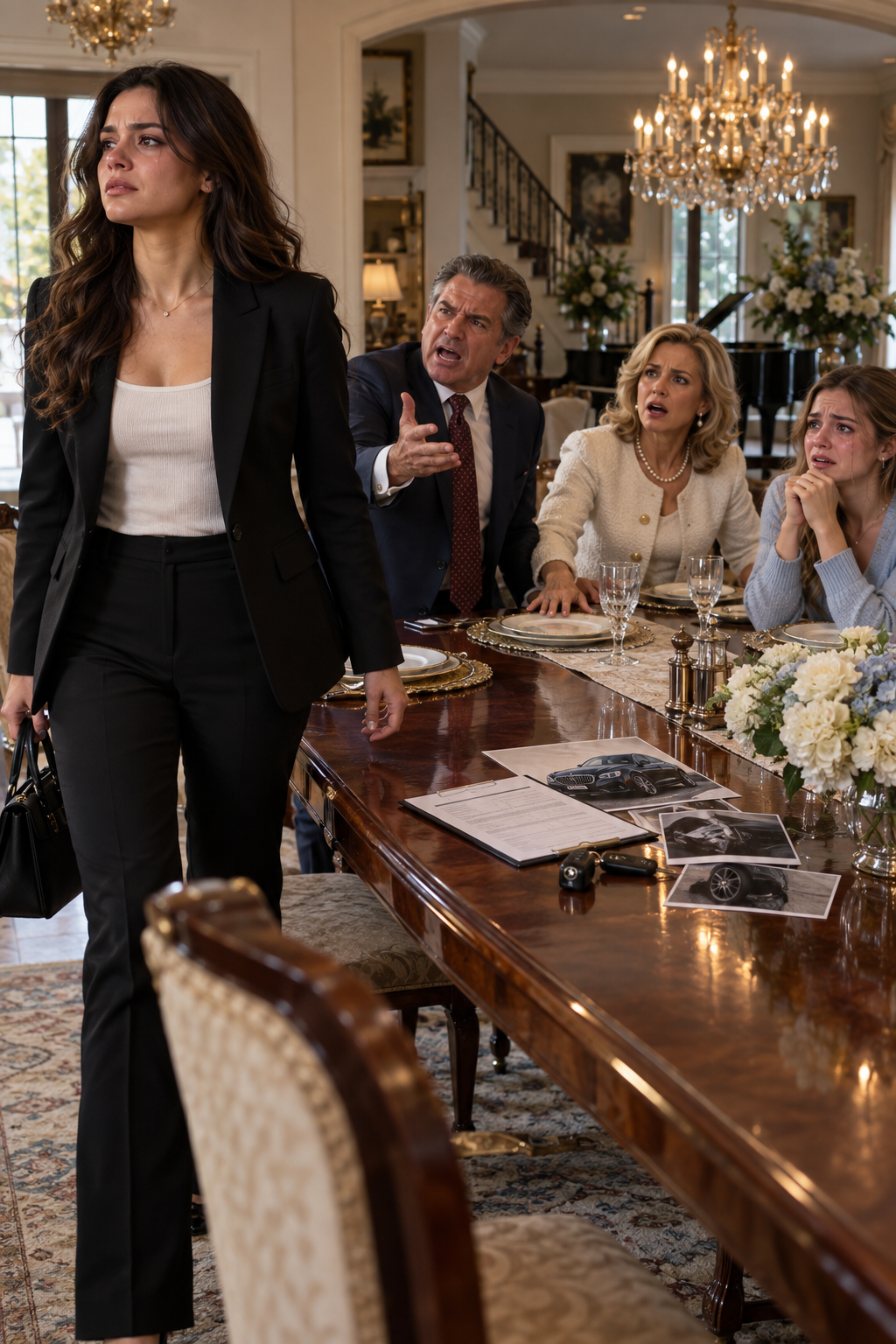
My twenty-two-year-old sister Chloe was crying across from me, mascara streaking down her cheeks. Beside her, my mother had one hand pressed dramatically against her chest. My father sat at the head of the table like a judge preparing to deliver a sentence.
“Your sister needs her car for her internship,” Dad said. “You make good money. She doesn’t. You’re paying the bill.”
I glanced at the repair invoice.
BMW transmission replacement.
$2,500.
Then I looked at Chloe.
“You went to Miami last weekend.”
Her lips parted.
“What does that have to do with anything?”
“You spent almost your entire paycheck.”
“That was already planned.”
“So was your car payment.”
Mom slammed her palm against the table.
“Enough!”
The silverware jumped.
Several relatives who had come for Sunday dinner stared at their plates.
I had seen this pattern before.
Chloe made a mistake.
My parents found a reason it wasn’t really her fault.
Then somehow, I became responsible for fixing it.
When she overdrafted her checking account, I covered it.
When she damaged her previous car, I helped with the deductible.
When she fell behind on rent because she had bought concert tickets and designer shoes, I paid one month so she wouldn’t be evicted.
This would have been the third financial rescue in eight months.
“I’m not paying it,” I said.
Mom went still.
“What?”
“I said no.”
Dad slowly leaned forward.
His expression changed from irritation to disbelief.
“Maya, don’t turn this into something ugly.”
“I’m not. I’m just saying no.”
Chloe’s tears came harder.
“You know I need that car.”
“You also knew that last week.”
“God, why do you always act like you’re better than me?”
“I don’t.”
“Yes, you do!”
Dad pointed toward me.
“She’s your sister.”
“I know exactly who she is.”
The room fell silent.
Mom’s face hardened.
Then came the sentence that would change my life.
“This is your final choice, Maya. Either transfer the money to Chloe tonight, or pack your things and get out. If you walk through that door, consider yourself disowned. You will be dead to this family.”
There were twelve people in the room.
Not one defended me.
Not one even looked surprised.
That hurt more than the ultimatum.
Apparently, everyone had already decided what my role was.
The dependable daughter.
The responsible daughter.
The daughter who could always be guilted into sacrificing a little more.
They were waiting for me to fold.
I pushed back my chair.
The legs scraped loudly against the hardwood floor.
Dad’s eyebrows rose.
Mom whispered, “What are you doing?”
I stood.
My hands were steady.
“Then I’m out.”
Chloe stopped crying.
Dad actually laughed.
“You’re being dramatic.”
“No,” I said. “For the first time, I think I’m being honest.”
I walked into the hallway and took my coat.
Mom followed me.
“You walk out now, don’t expect us to come begging.”
“I won’t.”
“You’ll regret this.”
“Maybe.”
“Maya!”
I put my hand on the doorknob.
For one second, I wanted her to stop me for the right reason.
Not because she wanted money.
Not because I was useful.
I wanted her to say, You’re my daughter. Stay.
She didn’t.
So I opened the door.
The night air hit my face.
And I left.
I drove for twenty minutes before realizing I had no destination.
I was thirty years old, had a good corporate technology job, enough savings for emergencies, and still felt like a runaway teenager.
My phone buzzed beside me.
I ignored it.
Then it buzzed again.
I expected another message from Mom.
Or Dad.
Or Chloe demanding I come back and stop being selfish.
Instead, it was a notification from a banking app I barely remembered installing.
Account activity detected.
I frowned.
At a red light, I opened it.
The screen loaded.
My breath stopped.
$186,430.17
I stared at the number.
Then I laughed once, nervously.
It had to be a mistake.
I pulled into an empty pharmacy parking lot and opened the account details.
The account was under my full legal name.
Date opened: twelve years earlier.
Trust administrator: Eleanor Whitmore.
My grandmother.
My chest tightened.
Grandma Eleanor had died three years earlier.
She had been the one person in my family who never treated me like an obligation machine.
When I was sixteen and worked weekends at a grocery store, she had told me, “Never let anyone confuse your generosity with ownership.”
At the time, I hadn’t understood.
Now her words felt different.
I scrolled lower.
There were years of deposits.
Some small.
Some large.
Interest.
Dividend payments.
And one locked document that had become accessible that evening.
The file was titled:
FOR MAYA — OPEN ONLY AFTER RELEASE CONDITION IS MET
My thumb hovered over it.
I tapped.
The first sentence appeared.
Maya, if you are reading this, your parents have finally forced you to leave their home over money.
My heart slammed against my ribs.
I read it again.
Then again.
“How?” I whispered.
The letter continued.
I wish I could tell you I am surprised. I am not.
There are things about your family that you deserve to know. But I have delayed telling you because truth given too early can be weaponized by the wrong people.
I swallowed.
The account you are viewing is yours. Every dollar in it belongs legally and solely to you.
Your parents do not know the release condition.
They believe the money is gone.
My skin prickled.
Then came the paragraph that made my entire body cold.
Your parents have taken money from you before. Far more than $2,500.
I stayed in that parking lot for nearly an hour.
According to Grandma’s letter, when I was born, my grandfather had created an education and inheritance trust for me.
The original amount had been substantial.
My grandparents had intended it to cover college, a first home, and future financial security.
But after Grandpa died, my parents convinced Grandma that they needed temporary access.
Tuition.
Medical bills.
Household emergencies.
That was what they claimed.
Grandma had allowed limited withdrawals.
Then she discovered something.
The withdrawals weren’t going toward me.
They were financing my parents’ lifestyle.
Vacations.
Credit cards.
A kitchen remodel.
Dad’s failed business investment.
And, years later, expenses related to Chloe.
Grandma froze the trust.
She created a separate protected account and began rebuilding what had been lost.
But the strangest part was the condition.
The money would not fully release to me until one of three things happened:
I turned thirty-five.
I purchased a home independently.
Or—
my parents attempted to force me from the family home because I refused to give them or Chloe money.
I stared at that sentence.
Grandma had predicted this exact moment.
My phone rang.
Mom.
I let it ring out.
Immediately, Dad called.
Then Chloe.
Then Mom again.
Finally, a text appeared.
Mom: You have until midnight to come home and fix this.
I almost laughed.
Instead, I saved Grandma’s letter and drove to my best friend Rachel’s apartment.
Rachel opened the door wearing pajama pants and holding a glass of wine.
One look at my face and she said, “Oh God. What happened?”
“My family disowned me.”
She blinked.
“Come in.”
“Also, apparently I have $186,000.”
She lowered the wine.
“Come in faster.”
I told her everything.
The BMW.
The ultimatum.
The account.
Grandma’s letter.
Rachel listened without interrupting.
When I finished, she stared at me.
“Maya.”
“What?”
“Your grandmother built a financial escape hatch.”
I looked down.
“I think she did.”
“No. She absolutely did.”
My phone buzzed again.
This time, Chloe.
You’re ruining my life over money. I hope you’re happy.
Rachel read it over my shoulder.
“She went to Miami.”
“I know.”
“She owns a BMW.”
“I know.”
“She is accusing you of ruining her life because you won’t buy her a transmission.”
“I know.”
Rachel drank half the wine.
“I dislike your family.”
I laughed for the first time all night.
Then another message appeared.
Dad.
We need to talk about your grandmother.
My laughter stopped.
I didn’t respond.
The next morning, I called an attorney.
Her name was Danielle Price, and she specialized in trusts and estates.
I emailed her the account documentation and Grandma’s letter.
Two days later, I sat across from her in an office overlooking downtown.
Danielle adjusted her glasses.
“The account is legitimate.”
“So the money is really mine?”
“Yes.”
“And my parents can’t touch it?”
“Not without committing several crimes.”
“That sounds reassuring.”
“It should.”
Then she became serious.
“However, I found something else.”
She slid a document toward me.
“What is that?”
“An accounting report.”
I scanned the page.
There were dates going back almost twenty years.
Withdrawals.
Transfers.
Beneficiary funds.
My stomach turned.
“How much?”
Danielle hesitated.
“Your grandparents originally allocated approximately $412,000 to your trust.”
I looked up sharply.
“But there’s only $186,000.”
“Your grandmother replenished a portion after freezing access.”
“How much did my parents take?”
“Based on available records? Roughly $238,000.”
The office seemed to tilt.
Two hundred thirty-eight thousand dollars.
My parents had spent years making me feel guilty for not giving enough.
Meanwhile, they had already taken nearly a quarter of a million dollars that had belonged to me.
“What did they spend it on?”
“Some records are unclear.”
“And the clear ones?”
Danielle handed me another page.
Mortgage payments.
Dad’s business debts.
A Caribbean vacation.
Home renovation expenses.
Private school tuition.
I paused.
“Private school?”
“Yes.”
“But I went to public school.”
Danielle didn’t answer.
She didn’t have to.
Chloe had attended private school for four years.
My throat tightened.
There were more.
Dance programs.
A used car.
College housing.
Medical expenses.
All tied to Chloe.
My inheritance had funded my sister’s childhood.
I sat back.
Suddenly, every family argument I had ever experienced felt different.
My parents didn’t merely think I should support Chloe.
They had been using me to support her since before I was old enough to understand money.
“There’s something else,” Danielle said quietly.
I looked up.
She placed an envelope on the desk.
“Your grandmother instructed her attorney to release this if you ever discovered the withdrawals.”
My name was written on the front.
In Grandma’s handwriting.
That night, I opened the envelope alone in Rachel’s guest room.
Inside were photographs.
Dozens of them.
My mother.
My father.
Grandma.
A woman I didn’t recognize.
And a baby.
On the back of one photograph, Grandma had written:
Maya, six weeks old. With Rebecca.
Rebecca?
I kept looking.
There was another picture.
The unfamiliar woman held the baby against her chest, crying.
My hands shook.
Underneath the photographs was another letter.
There is one truth I hoped your parents would tell you themselves.
I stopped breathing.
They never did.
I read the next line.
Linda and Thomas are not your biological parents.
I dropped the letter.
For several seconds, I couldn’t move.
Then I picked it up again.
My eyes blurred.
According to Grandma, my biological mother had been named Rebecca Hale.
She had been my mother Linda’s younger half-sister.
Rebecca had become pregnant at nineteen.
The father disappeared.
She struggled financially and emotionally, but according to Grandma, she adored me.
When I was six months old, Rebecca was killed in a car accident.
Linda and Thomas adopted me.
Grandma wrote that they had initially loved me deeply.
But after Chloe was born eight years later, something shifted.
I became “Rebecca’s daughter” whenever money was tight.
Chloe became “their real child.”
Grandma had witnessed it gradually.
Small preferences.
Then larger ones.
Different rules.
Different expectations.
Different futures.
Suddenly, my entire childhood made terrible sense.
Why I had started working at sixteen while Chloe received spending money.
Why I had been expected to earn scholarships.
Why Chloe’s private school was “necessary,” while my college expenses were treated as a burden.
Why my parents spoke about sacrifice whenever I asked for anything.
Why Grandma always watched me with a sadness I couldn’t understand.
I didn’t sleep.
The next morning, I texted my mother.
We need to meet. Just you, Dad, and me.
She responded in less than a minute.
We met at a quiet restaurant.
My mother arrived first.
Dad came five minutes later.
Neither apologized.
Mom folded her arms.
“So you’re ready to be reasonable?”
I placed Grandma’s photograph on the table.
Rebecca holding me.
My mother went white.
Dad stopped walking.
For the first time in my life, I saw fear in both of their faces.
I said one word.
“Rebecca.”
Mom sat down slowly.
“Maya—”
“Don’t.”
Her eyes filled with tears.
“You weren’t supposed to find out like this.”
“How was I supposed to find out?”
No answer.
“At forty? Fifty? Never?”
Dad sat across from me.
“We were going to tell you.”
“When?”
He looked away.
I laughed bitterly.
“Grandma told me about the trust too.”
Dad’s face tightened.
Mom whispered, “Oh God.”
“Two hundred thirty-eight thousand dollars.”
“Maya, it wasn’t like that.”
“How was it?”
“We were struggling.”
“So you stole from me?”
“We raised you!” Dad snapped.
Several people turned toward us.
He lowered his voice.
“We fed you. Clothed you. Gave you a home.”
“You adopted an orphaned baby. You don’t get reimbursed for parenting her by draining her inheritance.”
Mom began crying.
“We made mistakes.”
“You funded Chloe’s private school with my money.”
“We wanted the best opportunities for her.”
The sentence hit me harder than she intended.
I leaned back.
“And not for me?”
Mom realized what she had said.
“No, Maya, that isn’t what I meant.”
“Yes, it is.”
Dad rubbed his forehead.
“Your grandmother poisoned you against us.”
“No. Grandma left documents.”
“This family is complicated.”
“Actually, it’s becoming very simple.”
Dad’s eyes narrowed.
“What do you want?”
That question told me everything.
Not Are you okay?
Not Can you forgive us?
What do you want?
Like this was a negotiation.
I stood.
“I want nothing from you.”
Mom grabbed my wrist.
“Maya, please.”
I gently pulled away.
“For the first time, I believe you.”
She looked confused.
“When you said I was dead to the family.”
I walked out.
The next six months changed me.
I rented a modest apartment.
I went to therapy.
I worked.
I saved.
I learned the strange freedom of making choices without asking how my family would react.
And I began looking for a house.
Not a mansion.
Not something flashy.
I wanted sunlight.
A porch.
A kitchen with enough room to cook while music played.
A small garden.
A place that felt safe.
Eventually, I found it.
A three-bedroom craftsman at the end of a quiet street, with oak floors, blue shutters, and a maple tree in the front yard.
The first time I walked inside, I knew.
This was home.
I used part of Grandma’s money for the down payment and financed the rest responsibly.
On closing day, I stood in the empty living room holding my keys and cried.
Not because I owned a house.
Because nobody could throw me out of it.
Then, unexpectedly, Chloe came to see me.
She showed up on a rainy Thursday evening.
No BMW.
No designer handbag.
Just jeans, sneakers, and swollen eyes.
“I took the bus,” she said.
I almost closed the door.
Then she whispered, “Please.”
I let her in.
She sat at my kitchen table.
For a long time, neither of us spoke.
Finally she said, “They lied to me too.”
I folded my arms.
“About what?”
“Everything.”
She slid a folder toward me.
Inside were bank records.
Loan documents.
Credit card statements.
My name appeared repeatedly.
I frowned.
“What is this?”
“I found them in Dad’s office.”
My pulse quickened.
“They opened credit cards using your information.”
I stared at her.
“What?”
“Years ago. Some were closed. Some weren’t.”
My hands went cold.
“There’s debt in my name?”
“Not anymore. Grandma found out and forced them to pay it back before she died.”
I looked at Chloe.
“How do you know?”
“She kept copies.”
“Why are you telling me?”
Her chin trembled.
“Because I found something else.”
She pushed a sealed envelope across the table.
It had my grandmother’s handwriting on it.
But it wasn’t addressed to me.
It said:
FOR CHLOE — WHEN YOU ARE READY TO TELL MAYA THE TRUTH
I looked up slowly.
“What truth?”
Chloe began crying.
Not performatively.
Not like at dinner.
This was different.
Raw.
Terrified.
“I knew about the account.”
I froze.
“What?”
“Not the amount. But I knew Grandma had money protected for you.”
“How?”
“She told me.”
“When?”
“Before she died.”
I stood.
“You knew?”
“Maya—”
“You sat at that table and let Mom and Dad throw me out over $2,500 while knowing they had stolen from me?”
“I didn’t know everything then!”
“But you knew enough.”
“I was scared.”
“Of what?”
Her tears fell harder.
“Of losing them.”
I laughed.
“So you let me lose them instead.”
She flinched.
I pointed toward the door.
“Leave.”
“Maya, please read the letter.”
“I said leave.”
“There’s something in it you need to know.”
“I don’t care.”
“Yes, you do.”
She looked me directly in the eyes.
Then said the sentence I never expected.
“Grandma didn’t create the escape condition because of Mom and Dad.”
I stopped.
Chloe swallowed.
“She created it because of me.”
After Chloe left, I stared at the envelope for almost an hour.
Then I opened it.
Grandma’s letter began differently this time.
My dear Chloe,
You have spent much of your life being protected from consequences. That was not kindness. It was damage disguised as love.
I kept reading.
Grandma wrote that Chloe had learned early that my parents would choose her.
And she had used it.
As a teenager, she blamed me for things she had done.
She manipulated our parents into paying her expenses.
She lied about money.
Grandma had confronted her repeatedly.
But the final paragraphs changed everything.
There is something Maya does not know.
And perhaps you do not fully understand it either.
Rebecca was not Maya’s mother.
I stopped.
What?
I reread the sentence.
My hands began trembling.
Rebecca was yours.
I felt the room disappear.
No.
Impossible.
I continued.
Grandma explained.
Rebecca had not died six months after giving birth to me.
She had died eight years later.
The baby in the photographs was not me.
It was Chloe.
My entire body went numb.
Grandma’s next line shattered everything I believed.
Maya is Linda and Thomas’s biological daughter. Chloe is Rebecca’s daughter.
I read it again.
Then again.
The ages.
The photographs.
The dates.
I ran to the folder Danielle had given me.
There it was.
I had never checked the dates closely because I had been too devastated.
The photograph labeled “Maya, six weeks old” had no date.
But the trust records did.
The adoption records Grandma referenced were dated twenty-two years ago.
Not thirty.
Chloe’s age.
My mother and father had not adopted me.
They had adopted Chloe.
Why would Grandma’s first letter lie?
Then I reached the final page.
If Maya is reading this too, then everything has happened exactly as I feared.
Linda and Thomas may tell Maya that she is Rebecca’s daughter. They have used this lie before.
My chest tightened.
They discovered years ago that guilt was the easiest way to control Maya. If she believed she owed them for raising a child who was not theirs, she would be less likely to demand accountability.
I covered my mouth.
They had lied during the restaurant confrontation.
They had watched me discover evidence that Chloe was adopted…
…and simply told me I was the adopted one.
Because they knew I would believe it.
Because it made their theft seem almost justifiable.
Because it transformed them from parents who stole from their daughter into heroes who had supposedly rescued an orphan.
I felt sick.
Then I reached Grandma’s final revelation.
And everything changed again.
The trust was always Maya’s because it did not come from Rebecca.
It came from Linda.
My mother.
When Maya was born, Linda’s biological father left her a substantial inheritance. Thomas persuaded her to place most of it in Maya’s name for tax and estate reasons.
Years later, when they began using it, Linda told herself she was merely taking back her own money.
I sat frozen.
So the truth was even uglier.
My parents hadn’t stolen from an adopted child.
They had stolen from their biological daughter, then convinced themselves they were entitled to it.
And when confronted, they rewrote my identity to escape shame.
My phone rang.
Chloe.
I answered.
Neither of us spoke.
Finally I said, “You’re Rebecca’s daughter.”
She sobbed.
“Yes.”
“Did Mom and Dad tell you?”
“Last night.”
“Why?”
“Because I confronted them.”
I closed my eyes.
“And the BMW?”
Silence.
Something in that silence made me sit upright.
“What about the BMW, Chloe?”
She inhaled shakily.
“The transmission wasn’t broken.”
My blood went cold.
“What?”
“There was no repair.”
I whispered, “The invoice?”
“Fake.”
The room spun.
“Why?”
“I owed someone money.”
“How much?”
“Twenty-five hundred.”
“For what?”
She began crying again.
“I found Dad’s gambling account.”
I said nothing.
“He’d been using me to move money because Mom watches their joint accounts. I helped him a few times. Then one transfer disappeared. He blamed me.”
My heartbeat thundered.
“So the dinner…”
“He told me if I didn’t get the money from you, he would tell Mom I stole it.”
I stood slowly.
“You all staged it.”
“Mom didn’t know the invoice was fake. Dad did.”
I could barely speak.
“And Grandma somehow predicted I’d be thrown out over money because she knew this family would eventually do exactly this.”
“Yes.”
Then Chloe whispered:
“But there’s one more thing.”
I almost laughed.
“Of course there is.”
“I asked Dad why he was so desperate for $2,500.”
“And?”
“He wasn’t.”
I frowned.
“He wanted you to refuse.”
“What?”
“He knew about Grandma’s release condition.”
Everything inside me stopped.
That was impossible.
Grandma had explicitly said my parents didn’t know.
“He found one of her old legal drafts after she died,” Chloe continued. “He knew if they forced you out over money, the trust might release.”
“But why would he want that?”
Her answer came softly.
“Because he thought he was still listed as your emergency financial beneficiary.”
I sank into the chair.
“He thought once the money released, he could pressure you into moving it.”
“Yes.”
“So the entire dinner…”
“Dad engineered it.”
The fake BMW bill.
The public confrontation.
The ultimatum.
My father had tried to activate my inheritance.
Then manipulate me into handing it over.
But Grandma had anticipated even that.
I suddenly remembered one line in her document.
Your parents do not know the release condition.
Except maybe she had wanted them to think they did.
I called Danielle immediately.
She answered on the third ring.
I explained everything.
There was a long pause.
Then she said, “Maya, I was wondering when you would find this part.”
My stomach dropped.
“What part?”
“Your grandmother left one final instruction.”
“What instruction?”
“If anyone attempted to deliberately trigger the trust release for personal gain, the release activated a secondary clause.”
My pulse raced.
“What clause?”
Danielle spoke carefully.
“The $186,430 was never the full inheritance.”
I gripped the phone.
“What?”
“That account was a test.”
I couldn’t breathe.
“Then where is the rest?”
Danielle almost sounded amused.
“In the ownership documents for the house your parents currently live in.”
Silence.
I thought I had misunderstood.
“What?”
“Your grandmother purchased their mortgage from the lender eleven years ago through a holding company after your father defaulted. Your parents have been making payments to that company ever since.”
My mouth went dry.
“Who owns the company?”
“You do.”
I stood in my new kitchen, staring through the window at the maple tree outside.
Danielle continued.
“As of the moment your father deliberately triggered the trust clause for financial gain, all remaining controlling assets transferred to you.”
“How much?”
“Between the investment portfolio and the property interest…”
She paused.
“Just over $1.8 million.”
I couldn’t speak.
Then she added:
“And Maya?”
“Yes?”
“Your parents’ house is fully paid off.”
I frowned.
“What does that mean?”
“It means the holding company owns it outright.”
My heart began pounding again.
“Which means…”
Danielle finished the sentence.
“The home your parents threw you out of belongs to you.”
Three weeks later, I returned to that house.
Not to move back.
Never.
My parents were waiting in the dining room.
The same table.
The same chandelier.
The same chairs.
But everything felt smaller.
Dad looked exhausted.
Mom looked frightened.
Chloe sat near the window.
This time, she sat beside me.
I placed a folder on the table.
Dad stared at it.
“What is that?”
“The deed.”
His face changed.
Mom whispered, “Maya…”
I looked around the room.
The place where they had humiliated me.
Threatened me.
Told me I was dead to them.
Then I slid another document across the table.
Dad read it.
His shoulders collapsed.
“You can’t do this.”
“I can.”
“You’re evicting your own parents?”
“No.”
He looked up.
I smiled faintly.
“I’m selling the house.”
Mom began crying.
“Where are we supposed to go?”
I looked at her.
For one terrible second, I heard her voice from that night.
Pack your things. Walk through that front door.
But revenge suddenly felt empty.
Grandma hadn’t left me this gift so I could become them.
So I placed one final document on the table.
“I sold the house this morning.”
Dad closed his eyes.
“But,” I continued, “I purchased a small condo nearby in Mom’s name only.”
Mom stared at me.
“What?”
“You’ll have somewhere to live.”
Dad looked up sharply.
“In her name?”
“Yes.”
“Why not both of us?”
“Because your gambling debts aren’t becoming her homelessness.”
He went pale.
Mom turned slowly toward him.
“What gambling debts?”
And there it was.
The secret he had still managed to keep.
Until that moment.
Chloe gave me a stunned look.
I hadn’t known whether to tell Mom.
But Grandma’s final lesson had become clear.
Truth does not destroy families. Lies do.
Dad began talking.
Explaining.
Defending.
Blaming.
For once, I didn’t listen.
I stood.
Chloe stood with me.
Mom remained seated, staring at the man she suddenly realized she did not know.
At the doorway, Dad called my name.
“Maya.”
I turned.
His face looked older than I remembered.
“You’re really going to walk away from us?”
I thought about the $2,500.
The fake invoice.
The stolen inheritance.
The false adoption story.
The years of guilt.
The house.
Grandma.
Then I looked at Chloe.
My sister.
Not by blood.
Not completely.
But maybe, for the first time, by choice.
I answered quietly.
“No.”
Dad looked relieved.
Then I finished.
“I walked away months ago. Today, I’m just closing the door.”
And I did.
A year later, Chloe stood barefoot in my backyard helping me hang string lights for a summer dinner.
She had sold the BMW.
Bought a used Honda.
Started therapy.
And, to my surprise, finished her internship without needing anyone to rescue her.
Mom lived in the condo.
Dad lived somewhere else.
They were divorcing.
I spoke to Mom occasionally.
Carefully.
With boundaries.
Dad and I had no relationship.
Maybe one day.
Maybe never.
I had stopped believing forgiveness required access.
As the sun set behind my little craftsman house, Chloe handed me an envelope.
“What’s this?”
“Something Danielle found in Grandma’s final files.”
I laughed.
“If this woman has one more secret, I’m filing a complaint with the afterlife.”
Chloe smiled.
“Open it.”
Inside was a single handwritten note.
No legal documents.
No revelations.
Just Grandma’s handwriting.
Maya,
If you are reading this from a home that feels like yours, then the money did what I hoped it would do.
But I need you to understand something.
The inheritance was never the gift.
I swallowed.
The gift was the moment you finally learned that love requiring you to abandon yourself is not love.
My eyes filled.
Then I read the final line.
You did not become free when the account opened. You became free when you said, “Then I’m leaving.”
I pressed the note against my chest.
Behind me, Chloe called, “Are you crying?”
“No.”
“You’re definitely crying.”
“Go hang the lights.”
She laughed.
And as evening settled over the house I had once only dreamed of owning, I realized Grandma had been right.
The $186,000 had changed my finances.
The $1.8 million had changed my future.
The truth had changed my family.
But the most important thing I had gained that night wasn’t money.
It wasn’t a house.
It wasn’t revenge.
It was the knowledge that I could lose everyone who demanded that I betray myself—and still build a life filled with people who never would.
For years, my family had convinced me that being needed meant being loved.
Now I knew better.
Sometimes the most expensive thing you can give someone isn’t money.
It’s unlimited permission to keep hurting you.
And sometimes the most valuable thing you can ever say is one simple sentence.
Then I’m leaving.