Eight thousand feet below us, Afghanistan was nothing but black ridgelines and scattered silver where moonlight touched stone.
Rourke leaned close enough for me to smell coffee on his breath.
“Nothing personal.”
I looked directly into his eyes.
“It became personal when you named the price.”
His smile disappeared.
Then they threw me out.
For half a second, there was no sound.
No helicopter.
No shouting.
No fear.
Just sky.
Then gravity took me.
The Black Hawk vanished above me.
Advertisement
The mountains rushed up from below.
I had no parachute.
But Rourke had made one mistake.
He thought the only thing keeping me alive inside that helicopter had been the equipment they took from me.
It wasn’t.
Training is equipment.
Terrain is equipment.
And three minutes before they grabbed me, I had looked through the open door and memorized exactly what lay beneath our flight path.
The eastern ridge.
A shelf of loose shale.
A steep slope dropping into scrub pine.
Advertisement
And beyond it, if the pilot had held course, an old snowmelt channel cutting diagonally through the mountain.
I twisted in the air.
Not because I thought I could beat gravity.
Because I needed to choose where gravity finished the job.
The slope came at me like a wall.
I hit feet-first.
Pain detonated through my legs.
Then my right hip.
Then my shoulder.
The impact threw me sideways.
I bounced.
Rolled.
Hit stone.
Something cracked near my ribs.
I kept rolling.
Advertisement
Branches tore at my face.
My helmet vanished.
I smashed through a low pine, spun twice, and dropped into a narrow erosion channel filled with loose gravel.
The world stopped.
For several seconds, I couldn’t breathe.
I stared at the stars.
My left ear rang.
Warm blood ran down the side of my neck.
My right ankle screamed every time I moved it.
But I moved it.
Then my knee.
Then my fingers.
Then my neck.
Alive.
I actually laughed once.
Advertisement
It sounded terrible.
Then I heard the helicopter circling.
My laughter died.
Of course.
Men willing to throw a Ranger from an aircraft weren’t going to assume gravity had completed the paperwork.
I crawled.
Every movement sent fire through my ribs.
Above me, the helicopter swept across the ridge.
A search light cut through the darkness.
Not wide.
Controlled.
Looking.
I dragged myself beneath an overhang where floodwater had eaten away the mountain.
Loose rock pressed into my back.
I pulled my emergency knife from my boot.
Advertisement
They had taken my rifle.
My sidearm.
My radio.
My primary blade.
But nobody had checked the inside seam of my boot.
Rourke had underestimated paranoia.
Danny Kim called it preparedness.
The helicopter passed overhead.
Then again.
I heard a burst of gunfire farther up the slope.
Three controlled bursts.
They were shooting into places where they thought I might have landed.
The irony almost made me smile.
They wanted the mountains to erase me.
Instead, the mountains had hidden me.
Advertisement
After ten minutes, the Black Hawk moved east.
I waited another twenty.
Then I checked what I had left.
Knife.
Tourniquet.
Water pouch.
Two protein bars.
A tiny signal mirror.
Compass button sewn beneath my belt.
And one thing Rourke didn’t know about.
A flat encrypted locator chip Danny had forced me to sew inside my jacket lining three weeks earlier.
“Backup to the backup,” he had said.
I had mocked him for it.
Now I pressed the concealed activation point twice.
Advertisement
Nothing happened.
No light.
No sound.
That was the point.
If the system still worked, one person on that base would know I was alive.
Danny.
I started walking.
Calling it walking was generous.
I limped downhill through darkness while one arm stayed tight around my ribs.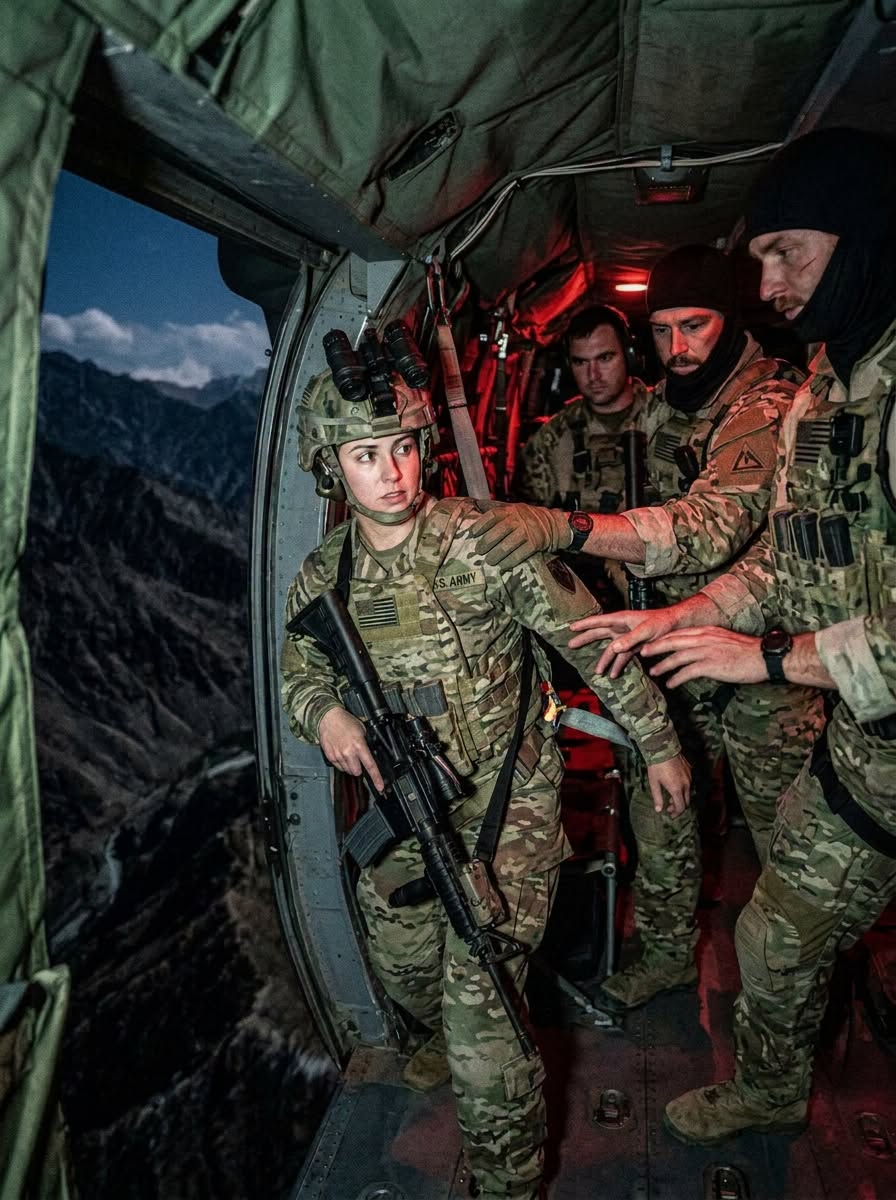
Every instinct told me to head toward the American base.
I did the opposite.
If Rourke and four others were dirty, I had no idea who else was involved.
And there was only one fact I trusted.
May you like

My 3-Year-Old Grandson Stopped My Wedding and Exposed the Terrifying Truth About My Bride
My Sister Called My Job Low-Class—Then Her Navy SEAL Fiancé Recognized Me as the Blizzard Hero
My Mother-in-Law Threw Me Out of My Own House—The Next Morning, a U.S. Army Convoy Was at Her Door
Somebody at Chapman had placed me on that helicopter.
Major Harrison.
By dawn, I reached a dry riverbed six kilometers south of the drop zone.
I hid beneath a sandstone ledge as sunlight spilled over the mountains.
That was when I saw the smoke.
Not from the direction of the base.
From a village west of me.
Darzabad.
I knew the village.
Twelve mud-brick homes.
One mosque.
One water pump that broke every summer.
And one family that had once hidden my team for nine hours after an operation went bad.
Advertisement
I also knew someone else connected to Darzabad.
Ahmad Rashidi.
His cousin owned half the livestock there.
Which meant going there was either the smartest decision available to me…
or suicide.
I went anyway.
By midmorning, I reached the edge of the village.
A boy spotted me first.
He froze.
Then ran.
Within seconds an old man stepped from behind a wall holding an ancient rifle.
His name was Farid.
He had been forty-eight when I met him.
He looked seventy now.
Advertisement
His eyes dropped to the blood on my uniform.
Then to the missing weapon.
“What happened, Ghost Walker?”
“Americans tried to kill me.”
He stared at me.
That sentence was not one I had ever expected to say.
Finally, Farid lowered the rifle.
“You should come inside.”
His wife cleaned the cut near my ear.
His oldest son wrapped my ankle.
Nobody asked unnecessary questions.
Mountain people understood that sometimes the explanation was more dangerous than the wound.
Then Farid said something that changed everything.
Advertisement
“Rashidi is here.”
My hand went toward the knife.
Farid raised one palm.
“Not as you think.”
“There aren’t many ways to interpret that name.”
“He came yesterday. Frightened.”
“Rashidi doesn’t get frightened.”
“He is now.”
A door opened behind me.
And Ahmad Rashidi walked into the room.
For eleven months, I had tracked that face across three provinces.
Forty-three years old.
Gray in his beard.
Thin scar beneath the left eye.
The man intelligence reports called an insurgent facilitator, bomb maker, and black-market financier.
Advertisement
The man blamed for weapons moving through routes I had been shutting down.
He looked at me.
Then at my uniform.
Then at the blood.
“You finally found me.”
I stood despite the pain.
“Sit down.”
He almost smiled.
“You have no gun.”
“I don’t need one for this room.”
Farid stepped between us.
Rashidi held up both hands.
“I did not order the bombings.”
I felt something cold move through me.
“You have ten seconds before I stop caring why Farid trusts you.”
Advertisement
“Your people paid for them.”
Silence.
Rashidi reached slowly beneath his vest.
I moved.
He stopped.
“Paper.”
“Two fingers.”
He used two fingers.
Pulled out a folded plastic pouch.
Set it on the floor.
I opened it.
Inside were photocopies of manifests.
Fuel deliveries.
Medical aid.
Construction equipment.
Food shipments.
Everything looked ordinary until I saw the handwritten codes beside certain vehicle numbers.
I recognized them.
Routes I had closed.
Convoys I had intercepted.
Warehouses I had raided.
Rashidi pointed at the pages.
Advertisement
“Your soldiers say I am smuggler because I move goods. Sometimes I move goods. Everyone here does. But weapons came inside your supply chain.”
I looked up.
“Whose?”
He tapped one line.
HARRISON.
My stomach tightened.
Major Harrison.
Rashidi kept talking.
Three years earlier, a network had started using legitimate military contractors to move weapons, narcotics, and cash between protected locations.
Local commanders were bribed.
Drivers were paid.
Intelligence reports were altered.
Targets disappeared before raids.
And whenever an Afghan intermediary became inconvenient, he was labeled insurgent.
Advertisement
Then removed.
Rashidi had cooperated because refusal meant his family died.
Later, he began keeping records.
Insurance.
“Why didn’t you give this to us?”
“I tried.”
“When?”
“Seven months ago.”
“To whom?”
He looked at me.
“Major Harrison.”
That explained why Rashidi had stayed alive.
Not because Harrison couldn’t find him.
Because Harrison needed him controlled.
And I had spent months dismantling Harrison’s business without knowing his name was attached to it.
Then Rashidi said, “There is more.”
Of course there was.
Advertisement
Men don’t throw soldiers out of helicopters for paperwork alone.
He told me about a transfer scheduled for that night.
Not weapons.
Money.
Cash from multiple smuggling corridors.
Enough to pay regional partners and close the entire network before an incoming audit team arrived from Kabul.
“How much?”
“Fourteen million dollars.”
I thought of Rourke.
Fifty thousand each.
Five men willing to murder for a quarter million total while someone above them moved fourteen million through the mountains.
They weren’t partners.
Advertisement
They were disposable labor.
I looked at Rashidi.
“Where?”
He told me.
A collapsed Soviet mining complex east of Asadabad.
I knew it.
Two tunnels.
One service road.
One narrow ridge.
And a dry riverbed behind the lower entrance.
I knew something else.
If Harrison believed I was dead, he would move that money tonight.
Before anyone could connect my disappearance to his operation.
I needed evidence.
Not suspicion.
Not the word of a wanted Afghan facilitator.
Evidence strong enough that Harrison couldn’t bury it.
Rashidi studied me.
“You are thinking of going there.”
“Yes.”
“You can barely stand.”
“I only need to stand long enough.”
At 1400 hours, my hidden locator vibrated once.
One short pulse.
Danny.
He was alive.
And he had seen my signal.
Thirty minutes later, Farid’s youngest son returned from the road carrying a piece of folded cloth.
Inside was a paper note.
Four words.
HARRISON SAYS YOU DESERTED.
I closed my eyes.
There it was.
They had already written the story.
Staff Sergeant Norah King became unstable during an operation.
Abandoned the aircraft.
Possibly compromised.
Missing in hostile territory.
Every hour I remained invisible made their lie stronger.
On the bottom of the note Danny had added coordinates.
A meeting point.
I reached it after sunset.
Danny was waiting inside the ruins of an abandoned goat shelter.
When he saw me, his mouth fell open.
“Jesus Christ.”
“Not quite.”
He grabbed me by the shoulders, then stopped when I winced.
“They said you pulled a weapon inside the bird. Harrison said Rourke’s team tried to restrain you and you jumped.”
“Very creative.”
“I knew it was garbage.”
“How?”
Danny stared at me.
“You hate flying.”
Despite everything, I laughed.
Then he got serious.
“They wiped the mission recordings.”
That didn’t surprise me.
“The aircraft camera?”
“System malfunction.”
“Comms?”
“Corrupted.”
“Flight manifest?”
“Edited. Your name was removed after takeoff.”
I looked at him.
“That fast?”
“Harrison had people waiting.”
“How many?”
“I don’t know.”
That was the problem.
We couldn’t simply return to Chapman waving accusations.
So I showed Danny Rashidi’s documents.
His face changed as he read.
When he reached Harrison’s name, he stopped breathing for a second.
Then he whispered, “Son of a bitch.”
“Rashidi says fourteen million moves tonight.”
Danny folded the documents.
“So we grab Harrison?”
“No.”
His eyebrows rose.
“No?”
“If we grab Harrison now, he says Rashidi forged everything. Then everyone underneath him disappears.”
“So what’s the plan?”
“We let him finish the crime.”
Danny stared at me.
Then smiled.
“That is a terrible plan.”
“It gets worse.”
Three hours later, we were overlooking the old mine.
Rashidi had brought us through a shepherd route from the north.
Farid stayed behind.
He had already risked enough.
Below us, vehicles arrived one by one.
Two civilian trucks.
Three military utility vehicles.
Then an armored SUV.
Men unloaded metal cases.
Not boxes.
Cases.
Uniform dimensions.
Heavy enough to require two men each.
Danny watched through optics.
“Those aren’t medical supplies.”
“No.”
Then Rourke stepped out of the SUV.
Briggs.
Cooper.
Matthews.
Voss.
All five.
My body went cold.
Not from fear.
Recognition.
The men who threw me into the mountains were standing less than four hundred yards away counting cash.
Danny shifted beside me.
“I can put Rourke down from here.”
“No.”
“He threw you out of a helicopter.”
“I noticed.”
“We may have different definitions of restraint.”
“We need Harrison.”
As if summoned by the name, another vehicle arrived.
Major Harrison got out.
No body armor.
No helmet.
Just field uniform and a pistol.
A man walking into a criminal exchange with the confidence of someone who believed everyone dangerous had already been bought.
He shook Rourke’s hand.
Rashidi leaned toward me.
“There.”
A second man stepped from the vehicle.
Civilian clothes.
Beard.
Gold watch.
I recognized him from intelligence photographs.
Colonel Farooq Rahman.
Afghan border security.
One of the officials who had repeatedly complained that my interdictions damaged “regional cooperation.”
Now I understood why.
Danny quietly activated a recorder.
Video.
Directional audio.
Redundant storage.
Everything.
Below us, Harrison opened one of the cases.
Cash.
Stacks and stacks.
Rourke said something.
The microphone caught only fragments.
“King… handled… no body…”
Harrison’s expression changed.
He grabbed Rourke by the vest.
“You don’t have a body?”
Rourke shoved his hands away.
“She fell eight thousand feet.”
“You don’t have a body?”
“We searched.”
Harrison looked furious.
And suddenly I realized something.
Rourke hadn’t returned because he cared whether I survived.
He had returned because Harrison required proof.
Good.
Let them be afraid.
Then Harrison said the sentence we needed.
“If King is alive, every route, every account, every officer tied to this operation is exposed.”
Danny looked at me.
Recorded.
Clear.
Rourke lowered his voice.
“We’ll find her.”
“No,” Harrison replied. “You’ll finish her.”
Danny’s jaw tightened.
I touched his arm.
“Still want to shoot him?”
“More than before.”
“Keep recording.”
Then Harrison turned toward Rahman.
“Once tonight’s transfer is complete, Rashidi disappears too.”
Beside me, Rashidi became perfectly still.
There was his death sentence.
Captured in Harrison’s own voice.
We had enough.
Almost.
Then Voss looked toward the ridge.
Directly at us.
I froze.
He raised binoculars.
Danny whispered, “Did he see movement?”
A second later Voss shouted.
Everyone below scattered.
So much for almost.
Gunfire cracked across the mountain.
Stone exploded near my face.
Danny rolled behind cover.
Rashidi dropped into the dry channel.
I crawled backward and shouted, “Separate! Lower entrance!”
We moved.
Fast.
Or as fast as a woman with bruised ribs and a damaged ankle could move while half a dozen men tried to kill her.
Rounds snapped above us.
I dropped behind a boulder.
Danny returned fire long enough to stop the pursuit.
Then a voice echoed from the darkness.
“King!”
Rourke.
Of course.
“Should’ve checked the ground!”
I shouted back, “Should’ve checked my pulse!”
His answer was gunfire.
I moved downhill.
My ankle nearly folded.
Pain flashed white.
I kept going.
The old mining site had one advantage Harrison’s people didn’t understand.
They knew the road.
I knew the mountain.
Five years earlier, during a survey mission, I had crawled through the collapsed drainage tunnel beneath the southern wall.
Nobody used it anymore because the entrance looked sealed.
It wasn’t.
I led Danny and Rashidi through a crack barely wide enough for our shoulders.
Behind us, footsteps approached.
Voss.
Briggs.
Maybe Cooper.
We emerged inside the mine’s lower chamber.
Metal cases stood everywhere.
Cash.
Documents.
Weapons.
Phones.
Everything Harrison had intended to remove before dawn.
Danny stared around us.
“This is the whole operation.”
“No. It’s the part he couldn’t digitize.”
I found a folding table covered in ledgers.
Names.
Payments.
Unit identifiers.
Contractors.
Dates.
Rashidi began taking photographs.
Danny transmitted what he could through a secure emergency channel he had accessed before leaving Chapman.
Not back to Harrison’s chain of command.
Higher.
Joint operations.
Inspector General.
Military police.
Anyone who could receive the evidence before somebody killed us.
A transmission bar crawled across his device.
Twenty percent.
Thirty.
Then the lights went out.
Darkness swallowed the chamber.
Harrison’s voice came from the tunnel.
“Staff Sergeant King.”
I turned toward the sound.
“You have caused an extraordinary amount of trouble.”
I tightened my grip around the pistol Danny had given me.
“Funny. I was going to say the same thing.”
“You don’t understand what you walked into.”
“That usually means the explanation is embarrassing.”
His voice sharpened.
“This war runs on compromises.”
“Does it run on fourteen million dollars too?”
Silence.
Good.
He didn’t know how much we had recorded.
Harrison continued.
“You think you shut down smuggling routes. You didn’t. You disrupted relationships that kept larger threats contained.”
“You sold weapons.”
“We controlled who received them.”
“You paid killers.”
“We bought influence.”
“You murdered soldiers?”
Silence again.
Then Rourke spoke from somewhere to Harrison’s left.
“Don’t answer her.”
Too late.
Danny’s device showed sixty-eight percent transmitted.
I needed time.
“So what was I, Harrison?”
“A liability.”
“Because I found Rashidi?”
“Because you never knew when to stop digging.”
“Seventeen operations.”
“Yes.”
“Three caches.”
“Yes.”
“The cash house.”
Harrison laughed softly.
“That nearly cost us two years of work.”
There it was.
More confession.
More evidence.
Seventy-nine percent.
Then gunfire erupted.
The table shattered.
Danny pulled me behind a steel support.
Rashidi crawled toward the rear tunnel.
Briggs entered from our right.
I saw his silhouette.
I fired once into the dirt beside him.
He dropped back.
Not because I missed.
Because I wanted him alive.
Every living conspirator was another witness.
Rourke wasn’t interested in witnesses.
He came around the far side fast, weapon raised.
Danny fired.
Rourke vanished behind machinery.
The transmission reached ninety-one percent.
Then Danny’s device went black.
“No.”
He hit the power.
Nothing.
A round had clipped the battery.
“Did it send?”
“Ninety-one.”
“Enough?”
“Depends which nine percent mattered.”
Harrison heard us.
“You’re finished, King.”
Then Rashidi shouted from the rear chamber.
“No.”
A diesel engine roared.
The mine’s emergency generator coughed to life.
Lights flickered on.
And everyone saw everything.
Harrison stood twenty meters away.
Rourke beside him.
Briggs behind a loader.
Matthews near the entrance.
Voss had a weapon pointed toward Danny.
Cooper was missing.
Rashidi stood at the generator controls.
I aimed at Harrison.
He aimed at me.
Nobody moved.
Then Cooper walked into the chamber.
But his rifle wasn’t pointed at me.
It was pointed at Rourke.
Rourke turned slowly.
“What are you doing?”
Cooper’s face looked gray.
“I didn’t sign up for this.”
Rourke laughed once.
“You took the money.”
“I took money to move cargo. You said King was compromised.”
“You helped put her out of the bird.”
Cooper swallowed.
“Because you said she’d sold us out.”
I studied him.
Fear.
Guilt.
Realization.
Harrison had compartmentalized the betrayal.
Not all five had known the full story at the beginning.
Rourke had.
Maybe Voss.
Maybe Briggs.
But Cooper had been told I was the traitor.
Now he was standing in a room full of evidence proving otherwise.
Harrison aimed at Cooper.
“You’re making another mistake.”
Cooper answered, “No, sir. I think I finally found the first one.”
Harrison fired.
Cooper moved.
The round struck his shoulder.
Everything exploded.
Danny tackled me behind the support.
Rashidi killed the lights again.
Briggs shouted.
Rourke fired blindly.
Voss cursed.
Matthews ran toward the entrance.
Then sirens sounded outside.
Not local vehicles.
Military.
Multiple.
Danny looked at me in the darkness.
His transmission had worked.
At least enough of it.
Harrison realized it too.
He ran.
Not toward the road.
Toward the drainage tunnel.
My route.
I followed.
Every step hurt.
Every breath hurt.
But this had started with Harrison putting me on a helicopter.
It was going to end with him looking me in the face.
We emerged onto the mountainside under a pale moon.
Harrison was twenty yards ahead.
He slipped on loose stone.
Recovered.
Kept running.
“Harrison!”
He turned and fired.
The shot went wide.
I dropped behind rock.
“You don’t have anywhere left to go!”
His laugh echoed down the slope.
“You still think this is about me?”
I stopped.
He was buying time.
Or telling the truth.
“Who is above you?”
Harrison backed toward the ridge.
“You think one major built this? You think one colonel kept those routes open? You have no idea what you touched.”
“Then give me names.”
“And live long enough to testify?”
He laughed again.
“I know how this ends.”
“So do I.”
Searchlights swept across the mine behind us.
Voices shouted through loudspeakers.
Harrison looked back.
For the first time all night, he seemed afraid.
Then he did something I didn’t expect.
He lowered his weapon.
“I can give you the list.”
I kept mine trained on him.
“Start talking.”
“Not here.”
“You’re out of negotiating room.”
“There’s an account ledger in Chapman.”
“Where?”
“My office.”
“Where?”
“Floor safe beneath the map cabinet.”
I watched his hands.
“Combination?”
He gave it to me.
Then said, “There are names in that ledger that will make this look small.”
Before I could answer, a rifle cracked from somewhere above us.
Harrison jerked.
His eyes widened.
Then he collapsed.
I dropped instantly.
Another round struck stone beside me.
Sniper.
Not Rourke.
Not anybody from the mine.
Someone else.
Someone who had been watching.
I crawled behind cover and shouted into the darkness.
Nothing.
Searchlights shifted toward the ridge.
A helicopter thundered overhead.
The shooter disappeared.
Harrison was still breathing when I reached him.
Barely.
Blood spread across his uniform.
I pressed my hand against the wound.
His eyes found mine.
“See?”
His voice was almost gone.
“You were never hunting Rashidi.”
“Who fired?”
He smiled weakly.
“You were hunting us.”
Then he died.
By sunrise, the mine belonged to military police.
Rourke was arrested alive after trying to escape through the northern tunnel.
Briggs surrendered.
Matthews was captured near the road.
Voss was found hiding beneath one of the trucks.
Cooper survived surgery.
Rashidi surrendered voluntarily after receiving written protection as a material witness.
And me?
I spent fourteen hours in a field hospital discovering the list of things I had broken.
Two ribs.
One ankle fracture.
Severe bruising.
A concussion.
A shoulder that looked like someone had attacked it with a hammer.
Danny stood beside the bed while an investigator finished asking questions.
When the room finally emptied, he handed me a coffee.
“You look terrible.”
“You always know what to say.”
“They found the safe.”
I sat straighter.
“And?”
His expression changed.
“It was empty.”
Of course.
The sniper hadn’t only killed Harrison.
Someone had reached Chapman before investigators.
“Security footage?”
“Missing six minutes.”
“Who entered the office?”
“They don’t know.”
I took the coffee but didn’t drink.
Danny sat down.
“There is something else.”
He placed a sealed evidence bag in my lap.
Inside was a small digital recorder.
Black.
Scratched.
I recognized it.
Rourke had been carrying one during the helicopter flight.
“Where did you get this?”
“Cooper.”
My pulse quickened.
Danny explained.
Rourke recorded certain conversations as insurance.
Not because he was smart.
Because he trusted nobody.
Cooper knew.
During the chaos inside the mine, he took the recorder from Rourke’s vest before military police reached them.
Investigators had copied the contents.
The final recording had been made six hours before our helicopter took off.
Harrison’s office.
Three voices.
Rourke.
Harrison.
And a third man.
Unknown at first.
Then investigators enhanced the audio.
The third man gave the order.
Not to intimidate me.
Not to transfer me.
Not to arrest me.
To remove me.
Permanently.
Danny looked at me.
“You want to know who it was?”
I already knew the answer would hurt.
“Play it.”
He pressed the button.
Static filled the room.
Then Harrison’s voice.
“She’s asking questions.”
Rourke answered.
“Then reassign her.”
A third voice cut in.
“No.”
Calm.
American.
Older.
A voice I had heard hundreds of times over secure briefings.
A voice belonging to a man who had once pinned a commendation on my uniform.
“King doesn’t reassign. She digs. If she connects Rashidi to the supply chain, the entire program collapses.”
My hand tightened around the recorder.
Danny said nothing.
The voice continued.
“Make it look like an operational loss.”
I closed my eyes.
Brigadier General Thomas Weller.
Deputy commander for regional operations.
The man who had personally approved six of my missions.
The man who had praised my results.
The man who had known exactly what I was finding.
Rourke asked one question on the recording.
“And if she survives?”
Weller answered without hesitation.
“She won’t.”
The recording ended.
For several seconds, neither Danny nor I spoke.
Then I started laughing.
Not because it was funny.
Because five men had thrown me from a helicopter thinking the fall would end the problem.
Instead, it had stripped away every layer hiding the truth.
Rashidi had led me to Harrison.
Harrison had led me to the mine.
The mine had exposed Rourke.
Rourke’s recorder had exposed Weller.
And Weller had made the same mistake all of them made.
He thought I was dangerous because I knew the mountains.
He was wrong.
I was dangerous because I didn’t stop once I knew someone was lying.
Three days later, General Weller was detained before boarding an aircraft out of Afghanistan.
Within two weeks, investigators froze accounts connected to the smuggling network.
Contractors disappeared from payrolls.
Officers were suspended.
Several Afghan officials were arrested by their own government.
The fourteen million dollars from the mine became evidence.
So did the ledgers.
The recordings.
The manifests.
And every order connected to my final flight.
Rourke eventually accepted a plea agreement and testified.
Briggs followed.
Matthews followed Briggs.
Voss held out longest.
Cooper testified first.
People later asked whether I forgave him.
That was the wrong question.
Forgiveness wasn’t mine to hand out like a medal.
He had still helped put his hands on me.
He had still stood inside that helicopter.
But when he finally understood what he had become part of, he chose to stop it.
That truth belonged in the record too.
Rashidi entered a protected cooperation program.
He wasn’t innocent.
He had smuggled.
He had paid armed groups.
He had made choices that hurt people.
But the story the network built around him had hidden something larger.
He hadn’t been the spider at the center of the web.
He had been another insect trapped inside it.
As for me, the doctors said I wouldn’t return to full duty for months.
Danny visited almost every day.
On the sixth visit, he brought my old helmet.
Cracked nearly in half.
Search teams had recovered it from the mountain below the flight path.
He set it on the table beside my bed.
“You keeping it?”
I ran my fingers over the split shell.
“No.”
“Why not?”
“Bad memories.”
Danny grinned.
“I thought you were sentimental.”
I looked at him.
Then at the helmet.
Then out the hospital window toward mountains glowing orange beneath the evening sun.
For years, I had believed survival meant getting home from the mission.
I was wrong.
Sometimes survival meant getting home with the truth.
Sometimes it meant crawling out of a place where everyone expected to find your body.
And sometimes it meant forcing men with stars, medals, titles, and spotless records to answer the one question they were certain nobody would live long enough to ask.
Why?
Rourke had answered it in the helicopter.
Fifty thousand each.
Harrison had answered it in the mine.
Fourteen million dollars.
Weller had answered it on the recorder.
Power.
Protection.
A system profitable enough that anyone threatening it became disposable.
Including me.
Months later, when I was finally cleared to walk without a brace, I returned to the airfield.
A Black Hawk sat on the tarmac.
Its rotors were still.
The crew chief recognized me and hesitated.
Everyone on base knew the story by then.
The Ranger thrown into darkness without a parachute.
The woman who came back.
The investigation that followed.
He nodded toward the aircraft.
“You okay around these?”
I looked through the open side door.
For one instant, I remembered the cold air.
Rourke’s hands.
The empty sky beneath my boots.
Then I stepped inside.
“Start her up.”
The crew chief smiled.
Minutes later, the helicopter lifted over the mountains.
I sat beside the open door.
No one held my vest.
No knife touched my harness.
No traitor stood behind me.
Below us, ridges stretched toward the horizon.
Somewhere out there was the slope that should have killed me.
I never found the exact spot.
I didn’t need to.
The mountain had already given me everything I needed from it.
A landing.
A hiding place.
And one more chance.
Danny’s voice came through my headset from across the cabin.
“You good, Ghost Walker?”
I looked down at the valleys.
Then ahead.
“Never better.”
He laughed.
The helicopter banked east.
And for the first time since that night, I didn’t think about falling.
I thought about what happened after.
Five decorated soldiers had watched me go over the edge believing they had erased a problem.
They hadn’t.
They had created a witness.
They had created evidence.
They had created an investigation that reached higher than any of them imagined.
Most of all, they had given the wrong Ranger a reason to keep digging.
They threw me from a helicopter without a parachute.
They expected the mountains to bury me.
Instead, the mountains sent me back.
And when I returned, I brought their entire operation down with me.