“Audrey.”
I kept loading the dishwasher.
“What?”
“Look at me.”
I looked at him.
His expression frightened me.
“You’re disappearing.”
I forced a laugh.
“I’m standing right here.”
“No. You’re not.”
“Michael—”
“You apologize before you speak. You look at Garrick before answering questions. You stopped calling our family. You left your career. You moved onto his family’s property. Now every sentence out of his mother’s mouth cuts you down, and you pretend it’s normal.”
“Marriage requires compromise.”
“This isn’t compromise.”
Advertisement
My jaw tightened.
“You don’t understand my marriage.”
“Maybe not. But I understand you.”
Garrick entered the room seconds later.
The argument that followed lasted nearly an hour.
By the end of the night, Garrick accused Michael of disrespecting our marriage and trying to control me.
Two days later, he demanded I choose.
“My wife can’t keep running to her brother every time she’s unhappy.”
I told myself Garrick was right.
I told Michael we needed space.
Michael stared at me for a long time.
Advertisement
Then he reached into his coat and handed me a small prepaid phone.
“What is this?”
“Keep it.”
“I’m not taking a secret phone.”
“Audrey.”
His voice softened.
“Don’t use it unless you need it.”
“I won’t.”
“I hope you’re right.”
I started to hand it back.
He closed my fingers around it.
“If that day ever comes, call me.”
I hid the phone behind a loose strip of decorative molding beside the bathroom vanity.
For five years, I never touched it.
Advertisement
Then I found the lump.
Everything moved quickly after that.
Imaging.
Biopsy.
Oncology appointments.
Words I never expected to hear applied to me.
Malignant.
Aggressive.
Surgery.
Margins.
Reconstruction.
Treatment plan.
When the surgeon recommended a double mastectomy, Garrick sat beside me with his arms folded.
I asked the doctor questions.
Garrick asked when I could resume housework.
The surgeon paused.
“Her recovery needs to be taken seriously.”
“Of course.”
“She will have drains. Limited arm movement. She should not lift, push, pull, mow, vacuum, or do strenuous activity until cleared.”
Advertisement
Garrick nodded.
The morning of my surgery, he barely spoke during the drive.
The operation lasted almost seven hours.
When I woke in recovery, pain radiated across my chest.
There were tubes beneath my clothing.
Bandages.
Compression garments.
IV lines.
For several minutes, I couldn’t understand where I was.
Then a nurse leaned over me.
“You’re okay, Audrey. Surgery is finished.”
I started crying.
Not loudly.
Just silent tears sliding into my hair.
I asked for Garrick.
The nurse hesitated.
Advertisement
“He stepped out.”
He returned nearly an hour later carrying coffee.
The nurse reviewed my discharge instructions the following day.
“These medications are prescribed exactly as directed. Do not suddenly stop them because someone is uncomfortable with pain medication.”
She looked directly at Garrick.
He nodded.
“Understood.”
“Drain sites stay clean. Use sterile supplies. Watch for redness, fever, unusual swelling, drainage changes, foul odor, severe pain, or bleeding.”
He nodded again.
“She is not to do strenuous chores.”
“Got it.”
Advertisement
I should have asked the nurse to make him repeat it.
Because the moment we arrived home, Garrick handed the entire discharge folder to Miriam.
“You deal with this stuff better than I do.”
She placed it on the kitchen counter without opening it.
My recovery became a kind of imprisonment.
The first morning, I woke because I needed help emptying a drain.
I called Garrick.
He appeared in the doorway looking irritated.
“What?”
“I need help.”
“With what?”
“The drain.”
Advertisement
His face tightened.
“That’s disgusting.”
“Garrick, the nurse showed you.”
“Call Mom.”
Miriam came in wearing gloves as though she were handling hazardous waste.
She looked at the fluid in the bulb and grimaced.
“Women survived childbirth and surgery for centuries without all this drama.”
“This isn’t drama.”
“Don’t snap at me.”
“I’m not snapping. I’m in pain.”
“Pain is partly attitude.”
After that, I tried to manage alone.
Food became another form of control.
If I didn’t come to the kitchen when Miriam decided lunch was ready, she put the plate away.
May you like


My Husband Demanded We Split Everything 50/50—Then He Learned His Company Was Partly Mine
“You need discipline,” she said.
If I asked Garrick to bring water upstairs, he sighed.
If I slept during the day, Miriam accused me of laziness.
If I took the medication exactly as prescribed, she watched me.
By the second week, I noticed pills missing.
At first, I assumed I’d miscounted.
Then Miriam said, “You certainly reach for that bottle often.”
“It’s prescribed.”
“Doctors prescribe poison every day.”
“I just had major surgery.”
“So did women in my generation. They didn’t turn themselves into addicts.”
Advertisement
I should have called my doctor immediately.
But by then, years of living with Garrick had done something to my judgment.
I still thought I needed permission.
That afternoon, the pain became unbearable.
It started as a hard, burning pressure beneath my right-side dressing.
Then I felt a sharp pull near the drain.
I stood from the bed and nearly blacked out.
Something was wrong.
I made it to the bathroom by holding the wall.
My hands shook as I opened the medicine cabinet.
Advertisement
The prescription bottle was there.
I twisted the cap.
Behind me, the bathroom door opened.
I had locked it.
I turned.
Miriam stood there holding an old brass key.
“What do you think you’re doing?”
I stared at the key.
“Why do you have that?”
“This is my son’s house.”
“No. It’s our bathroom.”
She stepped closer.
“Give me the bottle.”
“No.”
The word surprised both of us.
Her eyes narrowed.
“What did you say?”
“I said no.”
I held the medication against my chest.
Advertisement
“This was prescribed by my surgeon.”
“You’re dependent on it.”
“I’m taking it exactly as directed.”
“That’s what addicts say.”
“Miriam, move.”
She lunged forward.
I couldn’t protect myself without pulling at my incisions.
She ripped the bottle from my hand.
“Give it back.”
“No.”
“Miriam.”
She unscrewed the cap.
My stomach dropped.
“Don’t.”
She tilted the bottle over the toilet.
White pills scattered into the bowl.
“No!”
I moved toward her and pain exploded through my chest.
My knees hit the floor.
Advertisement
Miriam flushed.
I watched the water spin.
Every pill disappeared.
For a moment, all I could hear was the toilet refilling.
Then I looked up at her.
She stood over me.
“God doesn’t allow drug addicts in a Christian household.”
I couldn’t believe what I was hearing.
“This was cancer surgery.”
“Stop using cancer as an excuse for everything.”
Footsteps approached.
Garrick appeared.
Relief hit me so fast I almost cried.
“Garrick.”
He looked from me to his mother.
“What’s going on?”
Advertisement
“She flushed my medication.”
Miriam folded her arms.
“She was abusing it.”
“I wasn’t.”
I held out my hand.
“Call the hospital.”
Garrick didn’t move.
“Please.”
He rubbed his jaw.
“Maybe Mom’s right.”
Something inside me went silent.
Not broke.
Went silent.
I looked at the man I had married.
“What?”
“You’ve been taking a lot.”
“Because I had both breasts surgically removed fourteen days ago.”
“Don’t get dramatic.”
I looked down.
The dressing on my right side had begun turning red.
Advertisement
“My drain shifted.”
Neither answered.
“Garrick, look at me.”
He finally did.
“I’m bleeding.”
On the bathroom counter sat several unopened packets of sterile gauze, gloves, antiseptic supplies, and dressings from the hospital.
I reached toward them.
“Please hand me the sterile gauze.”
Garrick picked up the supplies.
For one second, I thought he was going to help.
Instead, he walked to the trash can.
And dropped them in.
Every packet.
Every sterile dressing.
Every sealed supply.
“Garrick!”
He pushed them farther down into the garbage.
Advertisement
“The lawn needs mowing.”
I stared at him.
“What?”
“You heard me.”
“It’s a hundred degrees outside.”
“One hundred six,” Miriam corrected coldly.
“I can barely stand.”
Garrick leaned against the doorframe.
“You’ve avoided responsibilities long enough.”
“My surgeon said no strenuous activity.”
“Your surgeon doesn’t live here.”
I felt the room tilt.
“I could tear something.”
“Then go slowly.”
“I can’t.”
His eyes hardened.
“Then crawl until you remember how to.”
That sentence ended my marriage.
There was no argument.
Advertisement
No final negotiation.
No possibility that tomorrow would be better.
Something in me became perfectly clear.
These people knew I was injured.
They knew I was recovering from cancer surgery.
They knew I was bleeding.
And they wanted me to suffer.
I lowered my eyes.
For the first time in years, my military training came back not as memory, but instinct.
Do not reveal intention.
Assess.
Wait.
Move when the opportunity appears.
Miriam looked satisfied.
“Give her ten minutes.”
They walked away.
Advertisement
The door stayed open.
I remained on the floor.
My heart hammered.
Pain rolled through my chest in waves.
I could hear them downstairs.
Miriam was saying something about the mower needing fuel.
Garrick laughed.
I dragged myself toward the vanity.
Three feet.
Maybe four.
It felt like a hundred yards.
I reached beneath the cabinet.
My fingers found the edge of the decorative molding.
For five years, I had wondered whether the phone would even work.
I pulled.
The strip came loose.
Behind it was dust.
And a small black prepaid phone.
I pressed the power button.
Nothing.
My throat closed.
Then the screen flickered.
One bar of battery appeared.
The contact list contained a single name.
MICHAEL.
I pressed CALL.
He answered after the first ring.
“This is Hayes.”
I tried to speak.
Nothing came out.
“Hello?”
“Michael.”
Silence.
Then his voice changed completely.
“Audrey?”
I closed my eyes.
“Yes.”
“Tell me where you are.”
He didn’t ask why I’d waited five years.
Didn’t say I told you so.
Didn’t waste one second.
“I’m at the house.”
“Are you safe right now?”
“No.”
“What happened?”
My breath shook.
“They took my medicine.”
“Who?”
“Miriam. Garrick let her.”
“What medicine?”
“Post-surgical pain medication.”
Another wave of pain hit.
I gasped.
Michael’s voice sharpened.
“Audrey, stay with me.”
“They threw away my sterile supplies. My drain moved. There’s blood.”
“Are you alone in the room?”
“Yes.”
“Can you lock the door?”
“They have a key.”
There was movement on his end.
Then Michael spoke to someone else.
“Get emergency medical response to this address now. Coordinate with local law enforcement.”
A voice answered.
“Yes, General.”
I heard papers moving.
Another voice.
Phones ringing.
Michael returned to me.
“Audrey, listen carefully. Do not go outside.”
“Garrick told me to mow the lawn.”
Silence.
I had heard my brother angry before.
This was different.
When he answered, his voice was almost frighteningly calm.
“You are not touching that lawn mower.”
“They’ll come back.”
“Help is coming.”
“Michael—”
“I’m here.”
I started crying.
“I’m sorry.”
“No.”
“I should have called you.”
“No apologies. Not now.”
“They said I’m lazy. Miriam says I’m addicted.”
“Audrey.”
His voice softened.
“You had major cancer surgery two weeks ago.”
I swallowed.
“I know.”
“Do you?”
That question shattered something.
For two weeks, I had been treated as though pain were a moral failure.
As though needing help were weakness.
As though recovery were selfishness.
“I think something tore.”
“Then we deal with that first.”
A shadow crossed the hallway.
I froze.
“Someone’s coming.”
“Keep me on the line.”
Garrick entered.
His expression changed when he saw the phone.
“What is that?”
I didn’t answer.
He stepped closer.
“Audrey.”
Michael heard him.
“Stay where you are,” my brother said loudly through the phone.
Garrick stopped.
His face drained of color.
He knew that voice.
“Is that Michael?”
I looked at him.
For the first time in years, I didn’t look away.
“Yes.”
Garrick lunged for the phone.
Before he reached me, sirens erupted outside.
One.
Then another.
Then several.
Garrick turned toward the window.
“What did you do?”
Miriam shouted from downstairs.
“Garrick!”
Doors slammed outside.
Voices.
Commands.
Then another sound rolled across the property.
Helicopter blades.
The entire house seemed to vibrate.
Miriam ran upstairs.
“What is happening?”
Garrick stared at me.
“You called the Army?”
“I called my brother.”
The front door opened downstairs.
“Police! Medical emergency!”
Footsteps thundered through the house.
Garrick backed away.
Miriam went white.
Two paramedics entered first with law enforcement directly behind them.
Then several people moved into the hall.
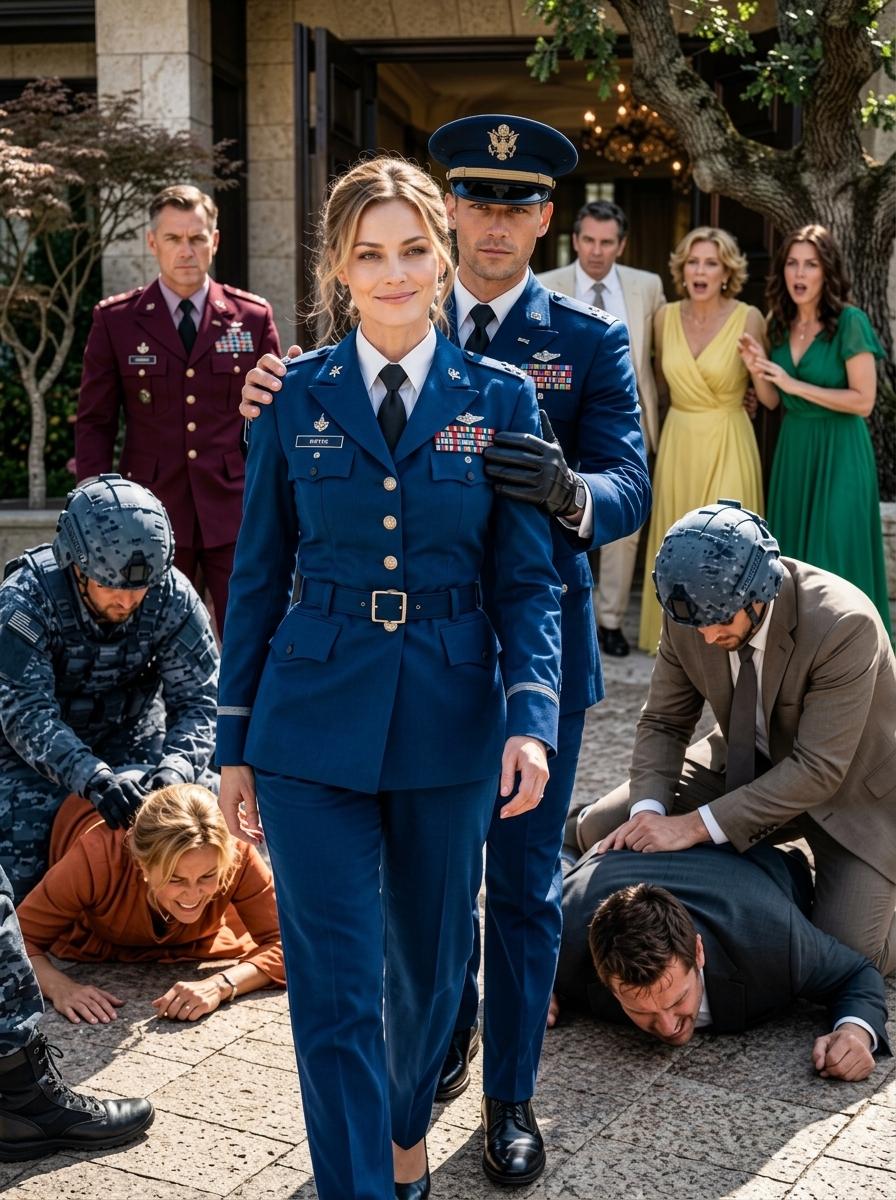
And behind them came Michael.
Full uniform.
Shoulders squared.
Face unreadable.
He looked older than I remembered.
More gray at the temples.
More lines around his eyes.
But still Michael.
His gaze moved through the bathroom.
Me on the floor.
The trash can filled with unopened sterile supplies.
The empty prescription bottle.
The bloody dressing.
Then Garrick.
Then Miriam.
Michael didn’t yell.
That made it worse.
He crossed the room, knelt beside me, and gently took my hand.
For a second, he wasn’t a general.
He was just my older brother.
“I’ve got you.”
I started sobbing.
He squeezed my hand.
“You’re going to the hospital.”
One of the medics examined the dressing.
“We need transport now.”
Garrick suddenly found his voice.
“She’s overreacting.”
Every person in the room stopped.
The medic looked at him.
Michael slowly stood.
“What did you say?”
Garrick swallowed.
“This is a misunderstanding.”
Miriam stepped forward.
“She has always been dramatic. The medication was making her irrational.”
A police officer pointed toward the hallway.
“Ma’am, step back.”
“You don’t understand,” Miriam protested. “We were trying to help her.”
“By throwing away sterile medical supplies?” the officer asked.
“She didn’t need all that.”
The medic looked up sharply.
“Her surgical site may be compromised.”
Miriam’s lips parted.
Michael said nothing.
He simply looked at her.
Then the paramedics lifted me onto a stretcher.
As they carried me out, I saw neighbors standing beyond the gate.
Police vehicles lined the driveway.
A medical helicopter had landed in the open field beside the property because my brother had been nearby at an installation during an official visit and had coordinated the fastest response he could.
What Garrick and Miriam later described as a military invasion was, in reality, something far more dangerous for them.
Witnesses.
Medical records.
Police body cameras.
A documented scene.
And a victim they had failed to isolate.
At the hospital, the surgeons discovered that one drain had partially dislodged and I had developed significant inflammation around the site.
There was concern about infection.
The surgical team cleaned the area, replaced dressings, restarted proper pain management, and placed me under observation.
A nurse photographed the discarded-dressing contamination visible on my clothing as part of the medical record.
A doctor asked me what had happened.
For years, I had protected Garrick.
That night, I told the truth.
All of it.
The pills.
The food.
The locked doors.
The humiliation.
The demand that I mow the lawn.
The discarded supplies.
The isolation.
Five years without my brother.
When I finished, the room was quiet.
Michael sat beside the window.
He hadn’t interrupted once.
The doctor looked at me.
“Audrey, this wasn’t a disagreement about recovery.”
I knew what she meant.
Abuse.
The word felt too large.
Then I remembered Garrick saying, Then crawl until you remember how to.
Maybe it wasn’t large enough.
Police interviewed me at the hospital.
By midnight, an emergency protective order was being discussed.
Garrick called twelve times.
I didn’t answer.
Miriam called seven.
Then text messages began.
First Garrick:
YOU’VE HUMILIATED ME.
Then:
CALL OFF YOUR BROTHER.
Then:
THIS HAS GONE TOO FAR.
Not once did he ask if I was medically stable.
Miriam sent:
A GOOD WIFE DOES NOT BRING POLICE INTO HER HOME.
Then another:
YOU WILL ANSWER TO GOD FOR DESTROYING THIS FAMILY.
Michael read that one over my shoulder.
He handed the phone back.
“Want me to block them?”
I stared at the screen.
Five years earlier, Garrick had made me cut Michael out of my life.
Now Michael was asking permission before touching my phone.
The difference nearly broke me.
“Yes.”
He blocked both numbers.
The next morning, a detective returned.
The police had photographed the bathroom trash.
They had recovered sealed sterile supplies.
They had documented the prescription bottle.
The pharmacy confirmed the prescription was legitimate and recent.
The surgical discharge instructions specifically prohibited strenuous activity.
Officers had also recorded Garrick making several statements at the property.
One mattered more than he realized.
When asked whether he knew I was supposed to be resting, Garrick had said:
“She’d been resting for two weeks. At some point she had to stop milking it.”
The detective looked at me.
“Your husband apparently believed that explanation helped him.”
I almost laughed.
Instead, I cried.
Not because Garrick was in trouble.
Because for the first time, strangers were hearing what had happened and reacting as though it was exactly as wrong as I had believed.
Michael stayed with me through everything.
On the second evening, I finally asked the question I had been avoiding.
“Why did you still answer?”
He looked confused.
“The phone.”
“Why did you keep that number active for five years?”
His expression changed.
“Because I told you to call.”
“But five years, Michael.”
“I know.”
“You never changed it?”
“No.”
“Why?”
He leaned back.
“Because I knew you.”
I looked away.
“You knew I’d fail?”
“No.”
His answer came immediately.
“I knew you’d survive long enough to remember yourself.”
That was the moment I realized I wasn’t returning to Garrick.
Not for clothes.
Not for explanations.
Not for closure.
Police later escorted a representative and a family member to retrieve essential belongings.
I didn’t go.
I couldn’t.
Michael arranged for my military photographs to be brought first.
The framed deployment photo Miriam hated arrived wrapped in a blanket.
I held it in my hospital bed.
The woman in that picture looked almost like a stranger.
Straight-backed.
Focused.
Certain.
But she wasn’t gone.
She was buried.
There was a difference.
Within days, my attorney filed for divorce.
Garrick responded exactly as I expected.
He claimed my cancer had made me unstable.
Then he claimed Michael had manipulated me.
Then he claimed the police misunderstood.
Then he claimed Miriam had only disposed of my medication because she was worried about addiction.
Each explanation contradicted the one before it.
The medical records didn’t change.
The photographs didn’t change.
The body-camera footage didn’t change.
The text messages didn’t change.
And neither did the testimony of the paramedics who found me bleeding on the bathroom floor.
The church barbecue happened without us.
I learned later that Miriam had tried to present herself as the victim.
She told several people that her family had been “attacked” because she took a moral stand against drugs.
That story lasted until someone asked a simple question:
Was the medication prescribed following cancer surgery?
Miriam stopped discussing it publicly after that.
Garrick’s world didn’t collapse because Michael was a general.
That was the part Garrick never understood.
Michael didn’t destroy him.
Evidence did.
Garrick had spent years believing control worked as long as nobody outside the house could see it.
Once outsiders could see it, he had nowhere to hide.
Three months later, I stood in front of a mirror in Michael’s guest room.
My hair had begun thinning from treatment.
My chest was scarred.
One shoulder still moved stiffly.
I was thinner.
Tired.
Different.
On the dresser was the photograph from my Army years.
Michael appeared in the doorway.
“You ready?”
I looked at him through the mirror.
“For what?”
“Follow-up appointment.”
I smiled.
“Right.”
He waited.
He never rushed me.
That still felt strange.
I slipped on my jacket.
As we walked toward the front door, I stopped.
“Michael.”
He turned.
“Thank you.”
He shook his head.
“No.”
“I mean it.”
“So do I.”
“For what?”
“You made the call.”
I looked at him.
He continued.
“I didn’t rescue Colonel Audrey Hayes.”
My throat tightened.
“You rescued yourself the moment you decided what they were doing wasn’t acceptable anymore.”
For years, Garrick had taught me that strength meant keeping the peace.
Miriam had taught me that suffering quietly made me a better wife.
Cancer taught me something else.
Life is too short to spend it asking permission to survive.
The divorce was finalized months later.
The legal consequences of that afternoon continued separately, based on the evidence gathered by authorities.
I didn’t attend every proceeding.
I didn’t need to.
My victory wasn’t watching Garrick lose control of the story.
It wasn’t seeing Miriam forced to explain herself.
It wasn’t hearing lawyers repeat their words back to them.
It was waking up one morning and realizing I hadn’t wondered what Garrick thought of me in weeks.
I began reconnecting with old friends.
Former colleagues called.
Some had assumed I wanted distance after leaving the Army.
I told them the truth.
Slowly.
In pieces.
One evening, Michael brought a cardboard box into the living room.
“Found something.”
Inside was my old dress uniform.
I touched the fabric.
My fingers trembled.
“I don’t know who that woman is anymore.”
Michael sat opposite me.
“Sure you do.”
“No.”
“You called me while injured, assessed the threat, concealed your intentions until you had an opening, found a communications device nobody knew existed, and gave enough information for us to get help to you.”
He raised an eyebrow.
“Sounds familiar.”
I laughed for the first time in months.
A real laugh.
It hurt my chest.
I didn’t care.
A year after my surgery, I returned to the cancer center for another follow-up.
The nurse recognized me.
“How are you doing?”
I thought about the question.
My body still carried scars.
Some nerve pain remained.
Certain dates could still pull me backward without warning.
But I was alive.
I had my own home.
My own bank account.
My own phone.
My own decisions.
And Michael was back in my life.
“I’m doing well,” I said.
And for once, it wasn’t something I said to make someone else comfortable.
It was true.
Sometimes people ask me what I remember most about the day everything changed.
They assume it was the helicopter.
Or the sirens.
Or Michael walking through the doorway in uniform.
It wasn’t.
I remember the sound of the toilet flushing.
I remember watching my prescribed medication disappear while Miriam stood over me.
I remember Garrick throwing sterile surgical supplies into the trash.
I remember him telling me to crawl.
And then I remember something else.
The tiny click of an old prepaid phone turning on after five years in the dark.
One bar of battery.
One name.
One call.
For years, Garrick and Miriam had worked to convince me that the strongest version of myself no longer existed.
They were wrong.
She was still there.
Waiting behind a loose piece of molding.
Waiting beneath the fear.
Waiting for me to stop asking whether I was allowed to save myself.
They thought cancer had made me weak.
They thought isolation had made me obedient.
They thought silence meant surrender.
But silence isn’t always surrender.
Sometimes it’s the moment before someone remembers exactly who they are.
And the day Garrick told me to crawl across that lawn was the day I finally stood up.
Not with my body.
Not yet.
But with everything inside me that mattered.
And this time, I never sat back down.