Sarah said that was impossible.
She had signed nothing.
Lydia smiled.
“Then maybe you should pay more attention to what you sign.”
That sentence stayed with me.
Because it changed everything.
This wasn’t simply an abusive husband throwing out his wife.
Someone believed they had paperwork.
And if they believed that paperwork could survive inspection, they had probably prepared it before Sarah went into labor.
I asked, “Did you sign anything recently?”
Sarah frowned.
“Hospital papers.”
“Anything Derek gave you?”
Advertisement
Her eyes shifted.
Then I saw it.
Fear.
“A few weeks ago,” she whispered.
“What?”
“He brought me some insurance forms. He said we needed to update beneficiary information before the baby came.”
“Did you read them?”
“I tried. He kept rushing me. He said we were late sending them in.”
“Did you sign?”
“Two pages.”
I gripped the steering wheel.
“Did you keep copies?”
“No.”
Of course she didn’t.
Because Derek hadn’t wanted her to.
I picked up my phone.
Advertisement
I did not drive to the apartment.
I did not call Derek.
I did not give Lydia the warning she undoubtedly expected.
I called the attorney who had handled the purchase of Sarah’s property six years earlier.
He answered on the fourth ring.
“Colonel Beckett.”
“Mr. Garrison.”
His voice immediately changed.
“Is Sarah all right?”
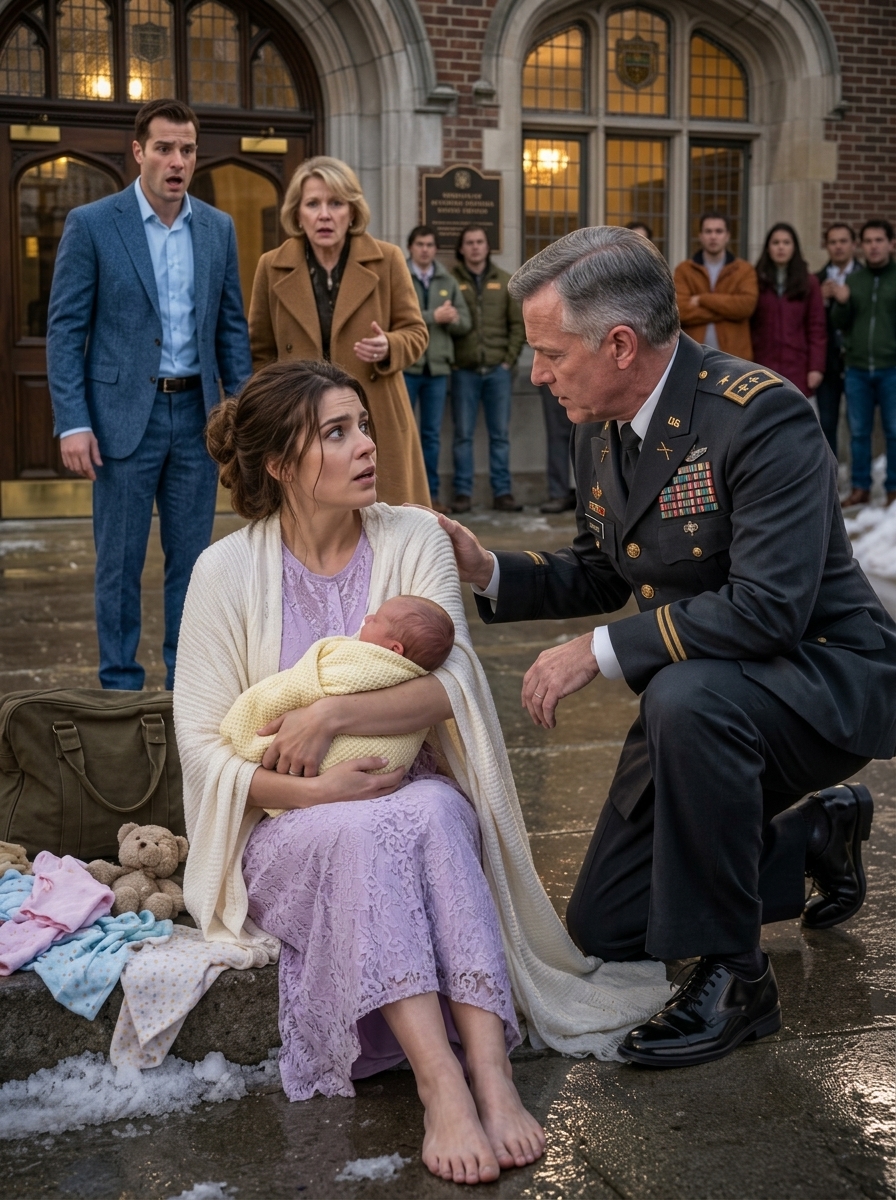
I looked at her wrapped in my coat.
“No.”
Silence.
“I need you in Oak Haven today. Not tomorrow. Today.”
“What happened?”
“Someone may have attempted to steal her apartment using fraudulent documents.”
Advertisement
Another silence.
This one was different.
“Who?”
“Her husband.”
Mr. Garrison exhaled slowly.
“Where are you?”
“Blue Ridge Medical Center.”
“Do not confront anyone.”
“I wasn’t planning to.”
“Good.”
“I’m bringing Sarah somewhere safe.”
“Colonel?”
“Yes?”
“Save every message. Screenshot everything. Don’t delete anything.”
“I already know.”
“I know you do.”
I ended the call.
Sarah stared at me.
“What are you going to do, Uncle?”
I looked through the windshield at the entrance where she had been abandoned less than an hour earlier.
Advertisement
“They didn’t choose the wrong victim.”
She waited.
“They chose the wrong family.”
I drove to a small extended-stay hotel near the federal highway.
Not because Sarah couldn’t go somewhere better.
Because I wanted a location Derek didn’t know.
I booked two adjoining rooms under my name.
Then I called the hospital and requested that Sarah’s discharge circumstances be documented.
A nurse named Emily came down to the lobby after her shift.
The moment she saw Sarah, anger flashed across her face.
Advertisement
“I thought your husband picked you up.”
Sarah shook her head.
Emily looked at me.
“He called twice this morning.”
My attention sharpened.
“What did he ask?”
“He wanted to know exactly when she would be discharged.”
Sarah stared at her.
Emily continued.
“He also asked whether she had received any sedating medication after delivery.”
The room went quiet.
“Why would he ask that?” I said.
“He claimed he needed to know whether she could sign some insurance documents.”
Sarah’s face drained.
Advertisement
I felt something cold settle beneath my ribs.
“Did the hospital give him that information?”
“No. Absolutely not.”
Emily looked toward Sarah.
“But he was unusually persistent.”
There it was.
Planning.
Timing.
Opportunity.
Derek had wanted to know when Sarah would be tired, medicated, overwhelmed, and least able to understand paperwork placed in front of her.
Mr. Garrison arrived ninety minutes later carrying a leather briefcase and an expression I had seen on serious men before serious battles.
He hugged Sarah.
Advertisement
Then he sat at the small hotel table.
“Start from the beginning.”
For nearly an hour, Sarah told him everything.
Derek had become controlling during the pregnancy.
At first, it was subtle.
He wanted to manage household bills because Sarah was “too tired.”
Then he began opening the mail.
He insisted her paycheck be deposited into a joint account.
He told her pregnancy brain made her forgetful.
Whenever she questioned something, he laughed.
Whenever she pushed harder, Lydia appeared.
“You should be grateful my son takes care of everything.”
May you like

Sarah thought they were overbearing.
She never imagined they were preparing to remove her.
Mr. Garrison opened his laptop.
He searched the county property database.
His face changed almost immediately.
“There it is.”
He turned the screen around.
A transfer document had been filed four days earlier.
Sarah leaned closer.
Her name appeared as the transferor.
Derek’s name appeared as the recipient.
The document claimed Sarah had voluntarily transferred the apartment to her husband for consideration of ten dollars and “love and affection.”
Advertisement
Sarah’s signature appeared at the bottom.
She stared at it.
“That’s not my signature.”
Mr. Garrison didn’t answer.
Beneath it was a notary stamp.
He zoomed in.
Then he froze.
I knew that look.
“What?”
“The notary.”
He pointed to a name.
“Melissa Crane.”
Sarah frowned.
“I don’t know anyone named Melissa Crane.”
Garrison opened another database.
His expression hardened.
“Her commission expired eleven months ago.”
I leaned back.
“So the transfer is invalid.”
“Likely fraudulent on multiple grounds.”
“Likely?”
Advertisement
“Thomas, fraud has to be established properly. We don’t get careless just because we’re angry.”
He looked at Sarah.
“But someone filed a deed using a signature you say isn’t yours and a notary credential that appears expired.”
Sarah stared at the screen.
“Derek did this?”
“We don’t know yet.”
I looked at her.
Yes, we did.
We simply hadn’t proved it.
Then her phone rang.
Derek.
She flinched.
Mr. Garrison lifted one finger.
“Don’t answer.”
The call stopped.
Thirty seconds later, another message arrived.
Advertisement
Your uncle needs to stay out of this. Mom says she saw his truck. If you create problems, I’ll tell everyone you’re unstable. Come home alone and we can fix this.
Sarah’s breathing changed.
Garrison photographed the message.
Then another arrived.
And don’t forget who has the paperwork.
Mr. Garrison looked at me.
“He thinks the deed gives him control.”
“Does it?”
“Not for long.”
We contacted local law enforcement.
I expected skepticism.
Domestic property disputes often become messy.
But once Mr. Garrison showed investigators the ownership history, suspicious deed, expired notary information, Derek’s messages, and Sarah’s hospital records, the conversation changed.
Advertisement
An officer named Sergeant Mason asked Sarah if she wanted police present when she returned to the apartment.
She looked at me.
I didn’t answer for her.
That mattered.
For the past months, people had been making decisions around Sarah as though she weren’t there.
So I waited.
Finally she nodded.
“Yes.”
The next morning, we drove to the apartment.
Two patrol vehicles followed.
Mr. Garrison came separately.
Sarah stayed in my truck with the baby until officers confirmed the scene was safe.
Advertisement
Lydia opened the door.
I will remember her expression for the rest of my life.
Not fear.
Annoyance.
She looked at the uniforms.
Then at me.
Then at Mr. Garrison.
“This is private property.”
Garrison’s answer was almost gentle.
“Yes, it is.”
Lydia crossed her arms.
“Then leave.”
He removed a folder from his briefcase.
“I’m afraid you misunderstood.”
She looked toward the officers.
“My son owns this apartment.”
“No.”
“He has a deed.”
“We’ve seen it.”
That made her hesitate.
Advertisement
Only for a fraction of a second.
But I saw it.
“Then you know.”
“What we know,” Garrison said, “is that Sarah Beckett remains the lawful owner unless and until a valid legal transfer establishes otherwise.”
Lydia laughed.
“She signed.”
From inside the truck, I saw Sarah close her eyes.
Garrison asked,
“You witnessed that?”
Lydia opened her mouth.
Stopped.
Then said, “Derek handled the paperwork.”
“Interesting.”
“Why?”
“Because the signature is disputed.”
Lydia’s face tightened.
“The paperwork was notarized.”
Advertisement
“By someone whose commission appears to have expired almost a year ago.”
Silence.
One of the officers shifted position.
Lydia’s confidence cracked.
Barely.
But enough.
Then Sergeant Mason asked a simple question.
“Ma’am, who changed the locks?”
Lydia hesitated.
“The owner authorized it.”
“Which owner?”
“My son.”
Mason nodded.
“So Derek instructed you to change them?”
“I didn’t say that.”
“You just did.”
She looked at me.
“You think your uniform scares me?”
I glanced down.
I wasn’t in uniform.
Advertisement
Only an old Army jacket.
“No.”
I looked at the bags half-buried in snow beside the building.
“I think evidence should.”
That was when Sarah stepped out of the truck.
She carried her son against her chest.
Lydia’s face transformed.
“You’re unbelievable.”
Sarah stopped.
“What?”
“You bring police to your husband’s home?”
Sarah looked at her for several seconds.
Then something changed.
The frightened woman I found outside the hospital wasn’t standing there anymore.
“This isn’t Derek’s home.”
Lydia’s jaw tightened.
Advertisement
Sarah continued.
“It’s mine.”
“You don’t know anything about property.”
“No.”
Sarah glanced at Garrison.
“But my attorney does.”
Lydia lunged verbally.
“You wouldn’t have anything without Derek!”
Sarah almost smiled.
“I owned this place three years before I met him.”
That ended the argument.
Police entered after confirming Sarah’s ownership documentation and circumstances surrounding the lockout.
Inside, the apartment barely looked like Sarah’s anymore.
Her photographs were gone.
Her clothes were gone.
The nursery had been partly emptied.
Lydia’s suitcases sat inside the master bedroom.
Two new pieces of furniture had already arrived.
She hadn’t merely changed the locks.
She had moved in.
Within hours.
This had been planned.
Then Sergeant Mason called from Derek’s home office.
“Mr. Garrison?”
We entered.
He was standing beside a small shredder.
A trash bag beneath it was filled with paper strips.
Most were useless.
But not all.
Beside the shredder lay an envelope.
Sarah picked it up.
Her name was printed across the front.
Inside was a photocopy of the original title documents.
Several pages had highlighted sections.
And at the bottom of one sheet, someone had written in blue ink:
Get signature before delivery.
Sarah stared at the handwriting.
“That’s Derek’s.”
Garrison photographed it.
Then Sarah noticed something else.
A stack of forms sat beneath the desk.
Insurance paperwork.
The same kind Derek had pressured her to sign.
Except attached behind those forms were property transfer pages.
Blank ones.
Pages designed to be inserted where someone might not notice.
Sarah covered her mouth.
“He tricked me.”
Mr. Garrison corrected her quietly.
“He tried to.”
That afternoon, Derek finally arrived.
He came racing into the parking lot in his black SUV.
He jumped out before the engine fully stopped.
“What the hell is going on?”
Then he saw police.
He saw Mr. Garrison.
He saw his mother standing near the entrance.
And finally, he saw Sarah holding their child.
His expression changed.
“Sarah.”
She didn’t answer.
He walked toward her.
I stepped between them.
He stopped.
“This is between me and my wife.”
“No,” Sarah said.
We both looked at her.
She repeated it.
“No.”
Derek blinked.
She took one step forward.
“This became something else the moment you forged my name.”
“I didn’t forge anything.”
“Then who did?”
“My attorney handled it.”
Garrison spoke.
“Name him.”
Derek turned.
“What?”
“Your attorney. Give me the name.”
Derek stared.
Garrison waited.
No answer.
Of course there wasn’t.
Derek tried another direction.
“Sarah signed the papers willingly.”
She looked at him.
“When?”
“Three weeks ago.”
“Where?”
“At home.”
“Who notarized them?”
His face tightened.
“Melissa.”
Sarah said, “Melissa who?”
He hesitated.
That was enough.
Sergeant Mason stepped closer.
“Derek, we’re going to need you to answer some questions.”
Derek ignored him.
He stared at Sarah.
“You have no idea what you’re doing.”
Her son stirred against her chest.
Derek lowered his voice.
“Think about the baby.”
Sarah’s expression changed.
Not weakness.
Disgust.
“I was thinking about the baby when I was sitting barefoot outside the hospital.”
Derek looked around at the gathering neighbors.
“You’re making this dramatic.”
I nearly lost my temper then.
But Sarah didn’t.
She remained frighteningly calm.
“You threw your wife and newborn son into the snow.”
“I didn’t throw anybody anywhere.”
“You changed the locks.”
“My mother did.”
Lydia snapped, “Derek!”
He realized too late what he’d said.
Sarah’s eyes filled with tears.
But this time, she didn’t look broken.
She looked clear.
“You knew.”
Derek said nothing.
“You knew exactly what she was doing.”
“Sarah—”
“You ordered a rideshare because you didn’t want to be there.”
“That’s ridiculous.”
“You checked when I’d be discharged.”
Silence.
“You asked the hospital whether I was medicated.”
His face went pale.
That was the first moment I saw real fear.
Not because Sarah raised her voice.
She didn’t.
But because he realized she knew the timeline.
And once a hidden plan becomes a timeline, it becomes much harder to deny.
Sergeant Mason asked Derek to accompany him for questioning.
Derek refused at first.
Then Garrison mentioned the disputed deed.
The questionable notarization.
The documentation recovered inside the apartment.
And the messages on Sarah’s phone.
Derek looked at his mother.
Lydia looked away.
That told me everything about their relationship.
They were partners while the plan worked.
Now they were calculating who would blame whom first.
Over the next several days, the entire scheme began coming apart.
The supposed notary, Melissa Crane, was eventually located.
She denied witnessing Sarah sign anything.
More importantly, she told investigators that she knew Lydia socially.
Months earlier, Lydia had asked whether an old notary stamp could still be used “for family paperwork.”
Melissa said she told her no.
Then one of Melissa’s old stamps disappeared from a box stored in her garage after a neighborhood gathering.
Investigators now had another thread.
Bank records provided another.
Derek had been struggling financially for almost a year.
Sarah knew about some credit card debt.
She didn’t know about the rest.
Business losses.
Personal loans.
Sports betting charges.
Cash advances.
He owed far more than he had admitted.
The apartment Sarah owned outright had substantial value.
And according to messages recovered from Derek’s laptop, he had already contacted a lender about borrowing against it.
One draft email was dated twelve days before Sarah gave birth.
Once title transfer clears, I can use the property immediately.
That sentence destroyed the last remaining illusion.
This wasn’t about a mother-in-law disliking her daughter-in-law.
This wasn’t even primarily about ending a marriage.
Derek needed an asset.
Sarah had one.
And while she was pregnant, exhausted, and trusting him, he decided to take it.
But the most painful evidence came from Derek’s messages to Lydia.
Sarah never wanted to read them.
Then one evening she changed her mind.
Mr. Garrison had printed only the relevant exchanges.
She sat at the hotel table while I stayed on the other side of the room.
The first message was from Lydia.
Do it while she’s in the hospital. She’ll be too emotional to fight.
Derek replied:
I need her out before she sees the filing.
Lydia:
Then don’t pick her up. Let her figure it out when she gets there.
Another exchange followed.
Derek:
What about the baby?
Lydia:
She’ll come crawling back once she understands she has nowhere else to go.
Sarah stopped reading.
Her shoulders shook.
I wanted to tear the pages apart.
Instead, I waited.
After a minute, she whispered,
“Keep going.”
The final message had been sent the night before the birth.
Derek wrote:
If she threatens custody or support, we’ll say she’s unstable after delivery. She’ll panic. She always panics when she thinks people don’t believe her.
Sarah stared at that line for a long time.
Then she placed the pages down.
“I told him that.”
“What?”
“About not being believed.”
Her voice barely carried across the room.
“When my parents died, there were relatives arguing about money. I was nineteen. Every time I tried to speak, people talked over me. I told Derek years ago that I still panic when people make me feel like my voice doesn’t matter.”
She looked toward the sleeping baby.
“He used that.”
I pulled out the chair beside her.
“Yes.”
She cried then.
Finally.
Not quietly.
Not neatly.
Six months of fear, manipulation, exhaustion, grief, childbirth, betrayal, and humiliation broke through all at once.
I didn’t tell her to stop.
I didn’t tell her to be strong.
Sarah had been strong long enough.
I simply sat beside her.
Three weeks later, a judge issued temporary orders confirming Sarah’s possession of the apartment while the fraudulent transfer was formally challenged and removed from the record.
The lock company returned.
This time, Sarah chose the locks herself.
Every cylinder.
Every code.
Every key.
Derek was prohibited from entering without authorization while the court proceedings continued.
Sarah also filed for divorce.
She requested child support through proper legal channels despite Derek’s threat.
And when Derek attempted to claim she was emotionally unstable, Sarah’s attorney produced medical records.
Nursing notes.
Witness testimony.
Messages.
The rideshare records.
The fraudulent property filing.
His own communications with Lydia.
It is difficult to portray someone as irrational when your own written plan explicitly says you intend to make her look irrational.
The criminal investigation continued separately.
Fraud.
Forgery-related allegations.
Identity misuse.
Possible conspiracy.
The exact charges would ultimately be decided by prosecutors and the evidence they could prove.
I cared less about the labels than I expected.
I cared that Sarah was safe.
Months later, I returned to Oak Haven.
Spring had replaced the snow.
The apartment looked different.
Not because Sarah had changed everything.
Because she had reclaimed it.
The photograph of her parents was back on the dresser.
She had replaced the broken glass but kept the original frame.
The scratch Lydia left along one edge remained.
Sarah said she wanted to keep it that way.
“Why?”
She smiled.
“So I remember it survived.”
Her son was asleep in the nursery.
The same nursery Derek and Lydia had begun dismantling before Sarah even left the hospital.
A small blue blanket rested over the rocking chair.
The one I had brought the day he was born.
I stood in the doorway for a moment.
Sarah came beside me.
“Do you remember what you said in the truck?”
“I’ve said a lot of things in trucks.”
She smiled.
“You said they chose the wrong family.”
“I remember.”
She looked into the nursery.
“I thought you meant you were going to destroy them.”
I shook my head.
“No.”
“What did you mean?”
I looked at her.
“That they thought being alone meant you were defenseless.”
Sarah’s eyes softened.
“But you weren’t.”
She nodded slowly.
Then she said something I will never forget.
“I’m glad you came that day.”
“So am I.”
“No. I mean exactly when you did.”
I looked at her.
She took a breath.
“I wasn’t planning to call you.”
That surprised me.
“Why?”
“Because Derek spent months telling me you thought I was irresponsible.”
My stomach dropped.
“What?”
“He said you’d told him you were disappointed in me. That you regretted helping me buy the apartment. That you thought I couldn’t handle being a mother.”
I stared at her.
“I never said any of that.”
“I know now.”
Another layer.
Another piece of the plan.
Isolation.
Derek hadn’t only prepared documents.
He had prepared Sarah emotionally.
He needed her to believe the one person most likely to defend her had already turned against her.
“So why didn’t you call me?” I asked.
“I almost didn’t.”
She looked through the window.
“When they threw me out, I kept thinking maybe Derek was right. Maybe everybody believed I was weak.”
Her voice lowered.
“Then I went back to the hospital because I didn’t know where else to go.”
“And I happened to arrive.”
Sarah smiled through tears.
“You arrived six minutes later.”
Six minutes.
I thought about that often afterward.
Six minutes between Sarah believing she had no one and discovering she had someone.
Six minutes between Derek’s plan appearing complete and beginning to collapse.
Six minutes.
People like Derek and Lydia depend on silence.
They depend on exhaustion.
They depend on shame.
Most of all, they depend on convincing someone that asking for help would be useless.
That was the part they miscalculated.
Not the deed.
Not the notary stamp.
Not the ownership records.
Me.
They believed Sarah had been isolated enough that nobody would ask questions.
Nobody would check the documents.
Nobody would save the messages.
Nobody would stand beside her long enough for the truth to surface.
They were wrong.
On my last night in Oak Haven, Sarah made dinner.
Nothing fancy.
Roast chicken.
Potatoes.
Vegetables.
Her son slept beside the table in a small bassinet.
Halfway through dinner, Sarah disappeared into the bedroom.
She returned holding something behind her back.
“What is this?”
She handed me a framed photograph.
It had been taken that afternoon.
I was sitting in the rocking chair holding her son.
He was staring up at me.
I looked terrified.
Sarah was laughing in the background.
At the bottom of the frame she had placed a small engraved plate.
It read:
TO THE MAN WHO SHOWED UP.
I stared at those words longer than I expected.
Sarah sat across from me.
“You saved us.”
“No.”
She frowned.
I set the photograph down.
“I helped.”
“That’s the same thing.”
“It isn’t.”
I nodded toward the nursery.
“You saved him when you held him against your chest on that sidewalk even though you could barely stand.”
Then I looked at her.
“You saved yourself when you got back to that hospital.”
Her eyes filled.
“And when you walked into that apartment with the police behind you, you weren’t being rescued anymore.”
I smiled.
“You were taking your life back.”
For a moment, neither of us spoke.
Then the baby began crying.
Sarah laughed softly and stood.
“Your grandnephew has perfect timing.”
“Runs in the family.”
She lifted him from the bassinet.
Outside, spring rain tapped gently against the windows.
The apartment was warm.
The locks belonged to Sarah.
The deed belonged to Sarah.
The home belonged to Sarah.
And the little boy in her arms had no idea how close his mother had come to being convinced she had nothing.
Derek thought taking her key would take away her power.
Lydia thought tossing Sarah’s possessions into the snow would erase her claim to the home.
They believed a forged piece of paper, a locked door, and a frightened new mother were enough to rewrite reality.
But ownership leaves records.
Fraud leaves evidence.
Cruelty leaves witnesses.
And lies become fragile the moment someone refuses to be intimidated by them.
The last time I saw Derek was outside the courthouse months later.
He stood beside his attorney, looking smaller than I remembered.
He noticed me.
For several seconds, neither of us spoke.
Then he said quietly,
“You ruined my life.”
I looked at him.
“No.”
His jaw tightened.
I glanced toward Sarah, who was walking toward her car with her son in her arms.
“You made a plan.”
I turned back to him.
“We just made sure everyone saw it.”
Then I walked away.
Because after nearly thirty years in the Army, I had learned something Derek never understood.
The strongest victory isn’t always the one where you destroy the person standing against you.
Sometimes it’s the one where you simply protect what they tried to take.
Sarah didn’t need revenge.
She needed her home.
Her child.
Her voice.
And the truth.
In the end, she kept all four.