“No.”
“What, then?”
I met his eyes.
“Careful.”
That answer followed me for the rest of the day.
Not because I spread it.
Because Briggs did.
By dinner, he had retold the exchange enough times that I had supposedly threatened him.
By the next morning, I had apparently “lost my temper.”
None of that happened.
But I realized something important.
Briggs wasn’t only trying to provoke me.
He was building a story.
And he wanted enough people to repeat that story until it became more believable than the truth.
Advertisement
So I did the opposite.
I never raised my voice.
Never insulted him.
Never gave him the outburst he clearly wanted.
Instead, I watched.
And remembered.
Every comment.
Every witness.
Every time he crossed from joking into harassment.
Every time someone else copied him because they thought there would be no consequences.
Silence is often mistaken for weakness.
It isn’t.
Sometimes silence is how you collect evidence.
The third day was worse.
Someone left a bright pink plastic tiara inside my locker.
Advertisement
There was a sticky note attached.
PRINCESS MITCHELL.
A few people were waiting nearby when I opened it.
They expected a reaction.
I picked up the tiara.
Examined it.
Then placed it on top of the locker.
“That’s it?” someone asked.
I turned.
A young corporal looked disappointed.
“What were you expecting?”
He shrugged.
“I don’t know.”
“A scene?”
He smiled awkwardly.
“Maybe.”
I closed the locker.
“Sorry.”
I walked away.
Ten minutes later, I saw Briggs wearing the tiara on top of his head in the dining facility while several people laughed around him.
Advertisement
When he saw me, he pointed at it.
“Found your crown, princess.”
I kept walking.
His friends laughed.
But not everybody did.
That mattered.
Because once people stop laughing, they start noticing.
And once they start noticing, the bully loses control of the room.
That afternoon, during a tactical classroom block, Briggs started again.
The instructor was discussing cross-branch communication failures during fast-moving operations.
When the floor opened for questions, Briggs raised his hand.
“Question for Mitchell.”
The instructor looked at him.
Advertisement
“Is your question relevant to the lesson?”
Briggs smiled.
“Absolutely.”
He turned toward me.
“Suppose you’re inserted inland without naval support, comms are down, GPS is unreliable, and your team leader is incapacitated. What’s your immediate priority?”
It was deliberately broad.
Half tactical.
Half hypothetical.
Designed so that almost any answer could be challenged.
I answered anyway.
“Establish security, determine casualties, assess communications options, confirm mission viability, and reestablish command structure based on the situation.”
Briggs leaned back.
“That’s vague.”
Advertisement
“It’s a vague scenario.”
A few heads turned.
He tried again.
“Sounds like you don’t know.”
I looked directly at him.
“You didn’t provide terrain, enemy capability, team composition, mission type, distance to extraction, available communications, or casualty severity.”
Briggs’ smile weakened.
“So yes. The answer is conditional.”
The instructor nodded.
“That is correct.”
The room changed.
It was small.
Almost invisible.
But I felt it.
Briggs felt it too.
From that point forward, his behavior became less playful.
More personal.
Advertisement
He started bumping my shoulder when passing me in hallways.
Started talking about women lowering physical standards.
Started making comments about “real combat.”
Once, he looked at two younger soldiers and said, loudly enough for me to hear, “You know what the problem is now? Everyone gets a participation trophy.”
I kept walking.
But I noticed the younger soldiers didn’t laugh.
That evening, the bracket for the hand-to-hand tournament went up.
The tournament was one of the largest events of the training cycle.
Advertisement
Commanders would attend.
Instructors would evaluate.
Observers from higher headquarters would be present.
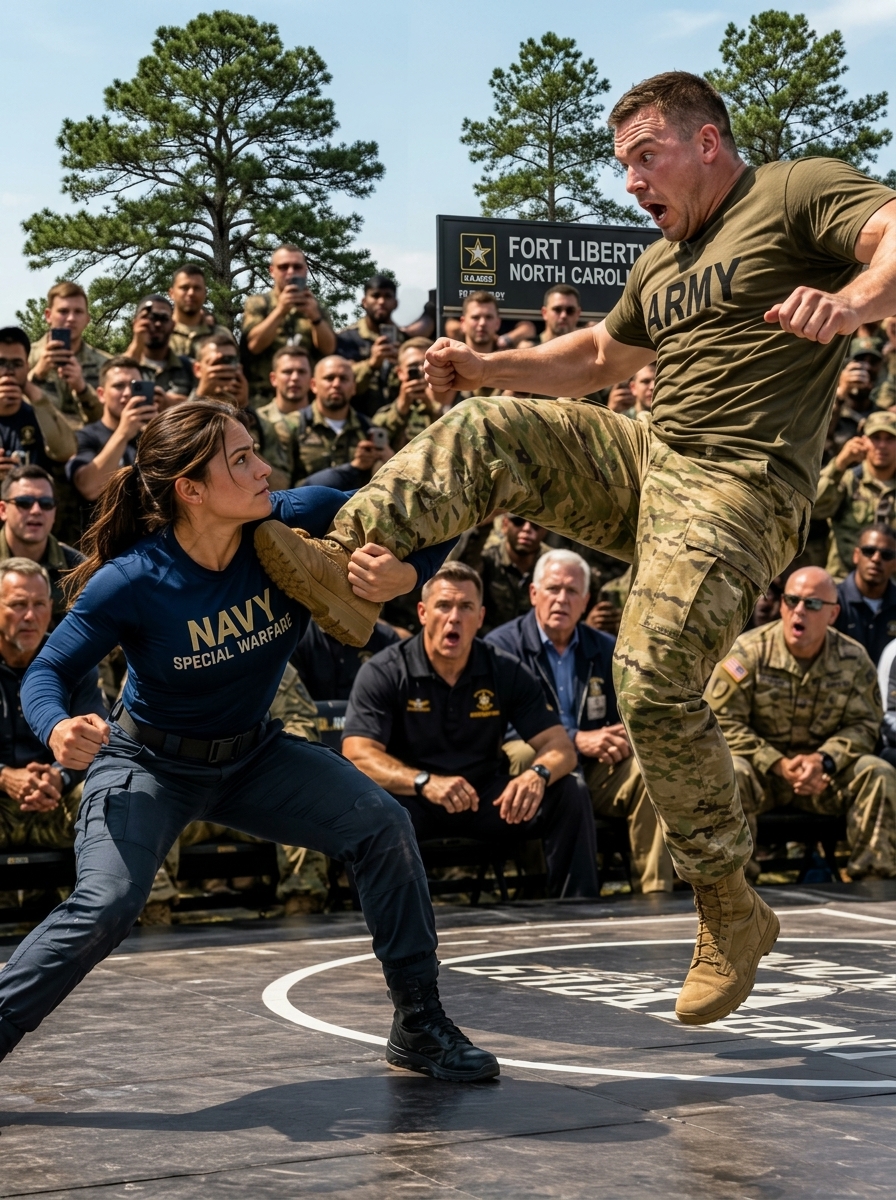
Hundreds of personnel would fill the temporary bleachers surrounding the mat.
The rules were strict.
Controlled strikes.
Takedowns.
Positioning.
Submissions.
Safety first.
The purpose was not to injure anyone.
It was to measure composure, technique, and adaptability under pressure.
I studied the bracket.
My name was on one side.
Briggs’ was on the other.
We would not meet unless we both reached the final.
I heard him before I saw him.
May you like

My Family Tried to Steal My Lake House—Then They Discovered I Was an Army Colonel
“Well, look at that.”
He came up beside me.
His voice was almost cheerful.
“Guess we might get lucky.”
I folded my arms.
“With what?”
“A teaching opportunity.”
“For who?”
He smiled.
“For you.”
I looked back at the bracket.
“Make the final first.”
The grin disappeared.
Only for a second.
But I saw it.
At lunch, I sat with two Navy personnel and an Army lieutenant I had trained with earlier that morning.
Briggs was three tables away.
His voice carried.
Advertisement
“When I embarrass her tomorrow,” he said, “she’ll be on the first flight back to wherever they found her.”
Someone laughed.
Another voice answered.
“Sergeant, isn’t she actually trained?”
Briggs scoffed.
“She weighs what? One-thirty?”
“Something like that.”
He leaned back.
“Physics doesn’t care about feelings.”
I kept eating.
The lieutenant across from me glanced toward Briggs.
Then back at me.
“You hear that?”
“Yes.”
“You going to say anything?”
“No.”
“Why?”
I wiped my hands.
“Because tomorrow gives him a chance to demonstrate his theory.”
Advertisement
The lieutenant stared at me for half a second.
Then smiled.
Later that evening, Commander Daniel Hayes stopped me outside the barracks.
Hayes was the kind of officer people listened to even when he barely raised his voice.
Multiple deployments.
Years in special operations.
No wasted movement.
No wasted language.
He had been watching the training group all week.
Apparently, he had also been watching Briggs.
“Mitchell.”
I stopped.
“Sir.”
He motioned away from the entrance.
We walked several yards toward the edge of the field.
Advertisement
Workers were setting up additional bleachers for the next day’s tournament.
Metal frames clanged in the fading light.
Hayes looked toward them before speaking.
“If you face Briggs tomorrow, he’s going to try to hurt you.”
“I know, sir.”
“I don’t mean beat you.”
“I know.”
He studied me.
“You can withdraw.”
I looked at him.
“Nobody would hold it against you.”
“With respect, sir, I’m not withdrawing.”
“Why?”
The question sounded simple.
It wasn’t.
I looked toward the field.
Advertisement
Toward the barracks.
Toward the people moving between buildings.
Then I answered.
“Because this isn’t only about me anymore.”
Hayes waited.
“Every woman here has spent years dealing with some version of Briggs.”
His face remained neutral.
“Maybe not this loud. Maybe not this obvious. But they know the type.”
I looked back at him.
“If I walk away because he might cross the line, he learns that crossing the line works.”
Hayes said nothing.
“So do all the people watching him.”
Advertisement
A long silence followed.
Then he nodded once.
“Follow the rules.”
“I will.”
“No revenge.”
“I don’t need revenge.”
“Good.”
He turned to leave.
Then stopped.
“And Mitchell?”
“Sir?”
“Make sure he owns whatever decision he makes.”
I understood exactly what he meant.
The tournament began the next morning.
The sky was clear.
The air carried that early heat North Carolina is famous for—the kind that promised to become miserable by noon.
Hundreds of soldiers gathered around the mats.
Advertisement
Officers occupied the front seating area.
Instructors moved between brackets.
Phones appeared everywhere.
The atmosphere felt half professional competition, half sporting event.
My first opponent was quick.
Smaller than Briggs.
Good footwork.
Aggressive hands.
She rushed early.
I let her.
Ninety seconds later, I controlled her wrist, shifted my hips, took her down, and forced the tap.
Clean.
Technical.
Nothing dramatic.
I helped her up.
She nodded.
“Nice.”
“You too.”
Second round.
Harder.
My opponent had excellent balance.
She nearly caught me in a throw twice.
Advertisement
We traded positions until I found leverage and ended it.
By the third round, my body was feeling the week.
My ribs were sore.
My shoulder burned.
Then my opponent landed a controlled strike that still knocked the air out of me.
For three seconds, breathing felt impossible.
The crowd reacted.
I heard Briggs somewhere outside the mat laughing.
My opponent moved in.
I gave ground.
Recovered.
Waited.
Then changed the angle.
Thirty seconds later, she tapped.
I stood slowly.
Advertisement
Across the field, Briggs was advancing too.
But differently.
Every one of his matches felt excessive.
He drove opponents down harder than necessary.
Held pressure longer than needed.
Once, after an instructor called the stop, Briggs still shoved his opponent away before standing.
The crowd cheered.
But less each time.
By the semifinal, people were watching him differently.
Not impressed.
Uneasy.
Briggs won with a takedown that sent his opponent crashing to the mat.
The whistle blew.
Instead of checking on him, Briggs stood and pointed across the field.
Advertisement
At me.
The crowd erupted.
I didn’t move.
I just stared back.
Five minutes later, our names were announced.
The final.
The bleachers filled completely.
People stood behind them.
Others crowded along the outer barriers.
Someone later told me the attendance estimate was a little over five hundred.
I believed it.
All I could see was faces.
Uniforms.
Phones.
Officers.
Observers.
The ring suddenly felt very small.
Briggs stepped in first.
He rolled his shoulders.
Bounced on his feet.
Played to the crowd.
Then I entered.
The noise changed.
A referee brought us to the center.
He reviewed the rules.
Controlled contact.
Immediate compliance with stop commands.
No deliberately injurious techniques.
No attacks outside the approved structure.
We both acknowledged.
Then Briggs leaned slightly closer.
“You’re just a little girl playing soldier.”
I looked at him through my mouthguard.
“Then this should be easy.”
His eyes hardened.
The referee stepped back.
“Begin!”
Briggs came forward fast.
Too fast.
No feeling-out process.
No testing distance.
He wanted dominance immediately.
His first attack drove me backward.
I slipped aside.
His second nearly caught my shoulder.
I pivoted.
The crowd roared.
Briggs smiled.
“There you go,” he muttered.
“Run.”
I ignored him.
He rushed again.
I gave him space.
Not because I was afraid.
Because angry fighters tell you everything if you let them move.
His right shoulder dipped before power strikes.
His left foot planted too heavily before forward pressure.
He overcommitted whenever he thought he had someone retreating.
And the more I avoided him, the more frustrated he became.
“You’re not fighting!”
He swung.
I blocked.
Moved.
Reset.
“You scared?”
No answer.
He tried a body clinch.
I turned out.
The referee separated us.
Briggs stared.
The crowd had stopped laughing.
He noticed.
That was when he made the decision that ended everything.
His face changed.
The performance disappeared.
He stepped forward.
His weight shifted.
His hip turned.
And his boot exploded toward the side of my knee.
Not my thigh.
Not my torso.
My knee.
A strike that had no place in that match.
A strike with enough force to do real damage.
For a fraction of a second, everything slowed.
I saw the rotation.
The planted foot.
The angle.
The commitment.
And I moved.
My left hand trapped his lower leg.
My right arm controlled above it.
His eyes widened.
He had expected impact.
Instead, he found himself balanced on one leg.
Then I stepped across him.
Turned my hips.
And let his own momentum finish the mistake.
Briggs hit the mat.
Hard.
Not illegally.
Not recklessly.
Cleanly.
The sound ripped through the ring.
The entire crowd gasped.
Before he could recover, I followed him down, controlled his arm, secured position, and stopped.
I could have forced the submission.
I didn’t.
The referee was already shouting.
“Stop! Stop!”
I released immediately.
Briggs rolled to his side.
For half a second, nobody made a sound.
Then the referee turned.
“Match halted!”
Briggs shot up.
“She grabbed my leg!”
The referee stared at him.
“Yes.”
“That was—”
“You attempted an illegal joint-targeting strike.”
“No, I didn’t!”
Hundreds of voices erupted.
Briggs spun toward the crowd.
People were holding up phones.
Everywhere.
Dozens.
Hundreds.
Recording.
His face changed.
“That wasn’t what happened!”
An instructor entered the ring.
“We saw it.”
Briggs pointed at me.
“She baited me!”
I stood several feet away, breathing hard.
I said nothing.
That made him angrier.
“She’s been doing this all week!”
Commander Hayes stepped forward from the front row.
“Doing what, Sergeant?”
Briggs froze.
Hayes entered the mat.
“Existing?”
A ripple went through the crowd.
Briggs swallowed.
“Sir, she’s been disrespectful.”
Hayes looked around at the phones.
“Then I assume your conduct will look appropriate when we review the recordings.”
That was the moment Briggs finally understood.
Not when I caught his kick.
Not when I put him on the mat.
Then.
Because this was no longer his word against mine.
Five hundred people had watched him.
Hundreds had recorded him.
And the kick was only the final piece.
Hayes turned toward me.
“Mitchell, step outside the ring.”
“Yes, sir.”
I did.
The crowd parted.
No cheers.
No dramatic applause.
Something heavier had replaced it.
Recognition.
Several women near the barrier looked at me differently.
Not like I had won a fight.
Like something they had been forced to tolerate had finally been dragged into the light.
Behind me, Briggs kept arguing.
“I was competing!”
“You targeted the knee.”
“I slipped!”
“You rotated into the strike.”
“She moved!”
“That is what competitors do.”
The more he spoke, the worse it became.
Then one of the tournament officials walked over holding a phone.
“Sir.”
Hayes looked.
The official played the video.
Even from several feet away, I could see Briggs’ posture.
The pivot.
The force.
The target.
No ambiguity.
Hayes watched it twice.
Then he looked at Briggs.
“Sergeant, you are done for the day.”
Briggs’ face turned red.
“Sir—”
“Leave the training area.”
The crowd went silent again.
“This is ridiculous.”
Hayes’ voice dropped.
“Do not make this worse.”
Briggs finally stopped talking.
He removed his gloves.
Threw them onto a chair.
Then walked out through a corridor of soldiers who had spent most of the week laughing at his jokes.
Nobody laughed now.
The official result listed the match as stopped pending review.
I didn’t care.
Winning the tournament had never been the important part.
What happened afterward was.
Within an hour, videos were circulating through the training group.
Not just the final kick.
People started posting earlier clips.
Briggs mocking me in the gym.
Briggs wearing the tiara.
Briggs making comments at lunch.
Briggs deliberately bumping me in a hallway.
Briggs taunting another opponent after a match.
Then witnesses started speaking.
One conversation became five.
Five became twenty.
By that afternoon, investigators were interviewing people.
I was called into an office shortly after 1500.
Commander Hayes was there.
Two other officers sat across the table.
One introduced herself as Colonel Rebecca Lawson, part of the oversight team.
She gestured toward the chair.
“Sit down, Mitchell.”
I sat.
Lawson opened a folder.
“Start from day one.”
So I did.
No emotion.
No exaggeration.
Just facts.
Time.
Location.
Words used.
Who was present.
What happened next.
At one point, Lawson stopped me.
“You remember all of this?”
“Yes, ma’am.”
“Why didn’t you report it earlier?”
“Because until today, most of it could have been dismissed as joking.”
Hayes watched quietly.
“And today?” Lawson asked.
“Today he tried to injure me in front of several hundred witnesses.”
She nodded.
“Why do you think he did that?”
“I can’t tell you what he was thinking.”
That answer made her look up.
I continued.
“But I can tell you what he said and what he did.”
Hayes’ expression changed slightly.
Approval, maybe.
Lawson closed the folder.
“That distinction matters.”
“Yes, ma’am.”
Then she said something I did not expect.
“You are not the first person to raise concerns about Sergeant Briggs.”
I stayed quiet.
“There have been prior complaints.”
“How many?”
“I’m not discussing an active review.”
I nodded.
“But,” she continued, “some were categorized as interpersonal conflict. Some were withdrawn. Some lacked witnesses.”
I understood immediately.
“And now you have witnesses.”
Lawson looked toward the window.
“Now we have approximately five hundred.”
That evening, I returned to the barracks expecting noise.
Instead, the hallway went quiet when I entered.
For one second, I wondered whether the hostility had gotten worse.
Then the young corporal who had watched Briggs wear the tiara stood up from a bench.
He looked uncomfortable.
“Mitchell.”
I stopped.
He rubbed the back of his neck.
“About the locker thing.”
I waited.
“That was stupid.”
“Yes.”
His face reddened.
“I didn’t put it there.”
“I know.”
“But I laughed.”
“Yes.”
He looked down.
“Sorry.”
I nodded once.
“Don’t apologize to me if you’re going to laugh the next time someone does it to somebody else.”
He looked back up.
“I won’t.”
“Good.”
I walked away.
The next morning, Briggs was absent from formation.
By noon, everyone knew he had been removed from the training program pending investigation.
Rumors exploded.
Some claimed he was being discharged.
Others said he had been arrested.
Neither was true at that point.
What was true was simpler.
His behavior was under formal review.
His prior complaints were being reexamined.
The tournament footage was being preserved.
Witness statements were being collected.
And suddenly, people who had stayed quiet before were willing to speak.
One woman said Briggs had mocked her after a failed assessment six months earlier.
Another said he had shoved her during training and called it an accident.
A younger soldier admitted Briggs had pressured him to ridicule female participants because refusing made you “soft.”
Then two men came forward.
That surprised people.
It shouldn’t have.
Bullies rarely limit themselves to one category of target.
One described being humiliated for seeking medical treatment after an injury.
Another said Briggs had pushed him to continue a drill after he reported dizziness.
The pattern became clearer.
This was never just about women.
It was about power.
Briggs needed someone beneath him.
Someone to embarrass.
Someone to make smaller so he could feel larger.
For years, enough people had looked away.
Until one kick happened in front of five hundred witnesses.
Three days later, Colonel Lawson addressed the entire training group.
We stood in formation under a gray morning sky.
No one knew exactly what she planned to say.
Lawson stepped to the front.
“I want to make something clear.”
Her voice carried across the field.
“Competition is not cruelty.”
The formation stayed silent.
“Standards are not harassment.”
She paused.
“Strength is not recklessness.”
Several people glanced toward me.
I kept my eyes forward.
“And professionalism is not optional because someone thinks they are talented enough to ignore it.”
No one moved.
Lawson continued.
“What happened during this training cycle is being reviewed through the appropriate process. I will not discuss individual disciplinary outcomes.”
Then her expression hardened.
“But I will discuss culture.”
That word landed differently.
“Every person here shapes it.”
She looked across the formation.
“Not only the person who makes the comment.”
A long pause.
“The person who laughs shapes it.”
Another.
“The person who stays silent shapes it.”
A few people shifted.
“The leader who dismisses a warning shapes it.”
Her eyes swept the ranks.
“And the person who decides that humiliation is leadership shapes it.”
Nobody looked comfortable anymore.
That was probably the point.
Lawson finished with one sentence.
“Your uniform does not make you strong enough to avoid accountability.”
Then she dismissed us.
The training program continued.
So did I.
Something had changed, though.
People stopped bumping my shoulder in the hallway.
Nobody touched my locker.
The whispers were different.
Some respectful.
Some embarrassed.
Some curious.
I didn’t suddenly become everyone’s hero.
I didn’t want to.
That would have missed the entire point.
I was still Avery Mitchell.
Still sore.
Still tired.
Still getting up before dawn.
Still carrying the same notebook into training.
But now, when I walked into the gym, conversations didn’t stop because people wanted to mock me.
They stopped because people were trying to figure out what they had missed.
Four days later, Commander Hayes found me there again.
Same hour.
Same room.
Same smell of rubber mats and bad coffee.
I was stretching when he approached.
“How are the ribs?”
“Better.”
“Knee?”
“Fine.”
He nodded.
Then looked around.
“You realize everyone expects some dramatic lesson from you now.”
I smiled slightly.
“That sounds exhausting.”
“It usually is.”
I finished stretching.
Hayes crossed his arms.
“You did well.”
“In the match?”
“No.”
He shook his head.
“Before it.”
I looked at him.
“You didn’t let him choose your behavior for you.”
That sentence stayed with me.
Because that was the part nobody recorded.
The phones captured the kick.
The takedown.
Briggs shouting.
The referee stopping the match.
But cameras did not capture the four mornings when I wanted to tell him exactly what I thought of him.
They didn’t capture the locker room when I stared at that plastic tiara and felt humiliation burning in my chest.
They didn’t capture the moments when staying calm felt harder than fighting back.
They didn’t capture the calculation behind every quiet answer.
People only saw the explosion.
They missed the restraint that came before it.
Two weeks after the tournament, the training cycle ended.
We assembled for the final ceremony.
Awards were announced.
Completion certificates were handed out.
People took photographs.
Briggs was not there.
His case was still moving through formal channels.
I later learned that investigators had substantiated multiple concerns involving conduct, unsafe training behavior, and repeated harassment.
The exact administrative consequences belonged to that process.
What mattered to me was that the process finally happened.
After the ceremony, I was packing my gear when the young soldier who had questioned Briggs at lunch approached me.
The one who had asked, “Isn’t she actually trained?”
He looked nervous.
“Petty Officer Mitchell?”
I turned.
“Yeah?”
He hesitated.
“Can I ask you something?”
“Go ahead.”
“When he kicked at your knee…”
He searched for the words.
“Were you scared?”
I thought about lying.
About giving him the polished answer.
No fear.
Total control.
Perfect confidence.
Instead, I said, “Yes.”
He looked surprised.
“Really?”
“Of getting injured? Absolutely.”
“But you didn’t look scared.”
“That’s different.”
He nodded slowly.
Then asked the question I think he actually cared about.
“How do you do that?”
“Do what?”
“Stay calm when somebody is trying to make you react.”
I closed my duffel.
“You stop asking what would feel good for the next ten seconds.”
He frowned.
“And ask what matters ten minutes later.”
He stayed quiet.
“Or ten days later.”
I slung the bag over my shoulder.
“Anger wants immediate satisfaction. Discipline cares about the outcome.”
He nodded.
Then smiled.
“Physics doesn’t care about feelings?”
I laughed.
“No.”
I started walking.
“Neither does leverage.”
He laughed behind me.
That afternoon, I left Fort Liberty.
As our vehicle passed the training fields, I saw crews removing the temporary tournament barriers.
The bleachers were already empty.
The mat was gone.
Nothing about the place looked dramatic anymore.
Just another military training area.
Another patch of grass.
Another week ending.
But for hundreds of people who had been standing there that day, something had shifted.
Not because a smaller fighter defeated a larger one.
That happens all the time.
Not because a woman proved she belonged.
I had never needed Briggs to confirm that.
What changed was simpler.
Five hundred people watched a man spend days trying to turn humiliation into entertainment.
Then they watched him cross a line.
And once everybody saw the line clearly, pretending it had never existed became impossible.
Sergeant Ryan Briggs had wanted to make me an example.
In a way, he succeeded.
Just not the way he planned.
He wanted the entire base to remember the moment Avery Mitchell hit the ground.
Instead, they remembered the second his boot stopped in my hands.
They remembered his face when he realized the crowd was no longer laughing with him.
They remembered hundreds of phones recording the same truth from hundreds of angles.
And they remembered what happened when a man who believed strength meant intimidation finally discovered the difference between power and discipline.
Briggs had spent four days asking everyone around him the same unspoken question.
Who belongs here?
By the end of the week, nobody was asking that question about me anymore.
They were asking a different one about him.
And that was the mistake he never saw coming.