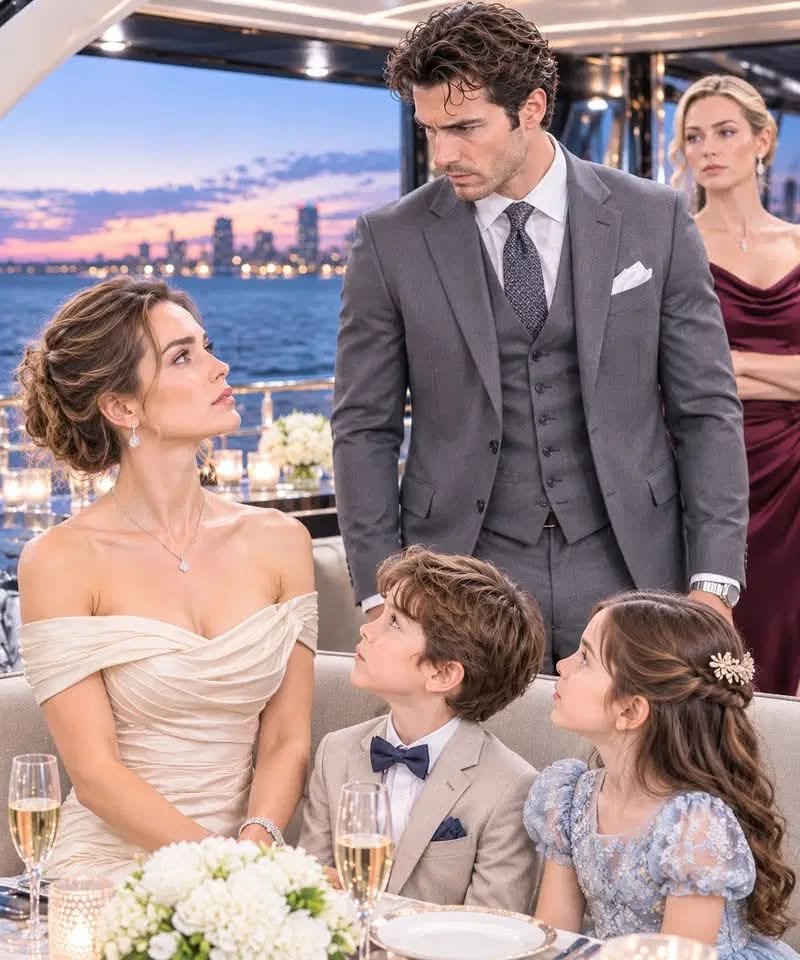
Chapter 1: The eyes he could not explain away
Luca Moretti first saw our children while holding another woman’s hand. I was laughing: Amara called crème brûlée “basically fancy pudding,” while Noah loudly defended pudding.
“Pudding comes in cups,” he declared with all the seriousness of a seven-year-old. Amara rolled her eyes.
“So does soup sometimes.”
“That doesn’t make soup pudding.”
Suppressing a giggle behind my hand, I warned them:
“You two are going to get us banned from this restaurant.”
“No, we’re not,”
Amara surveyed the luxurious dining room and dropped her voice theatrically.
“We look expensive.”
I laughed freely, something I’d feared for years because happiness never felt secure. In that exclusive Chicago restaurant, I wasn’t Nia Carter, Luca’s ex-wife whom gossip columns dubbed “the private first Mrs.
Moretti.” or the heartbroken woman who left a penthouse with one suitcase. I was Mom.
Before Moretti Global absorbed rivals and covered Chicago with his name, Luca’s quiet authority already straightened waiters, subdued executives and attracted strangers. Now he stood at the hostess station, charcoal suit probably dearer than my first car, dark hair shorter, eyes faintly lined, features harder.
Evelyn Shaw Moretti rested a hand on his arm. Familiar from Chicago newsstands, she looked immaculate in cream silk and subtle diamonds. I hated how good they looked together. Please, don’t notice the twins.
Ignoring the hostess, Luca met my eyes. Seven years vanished: our kitchen, snow beyond the huge windows, a cooling mug, his wedding ring still on as he withdrew his love. Clutching my napkin, I barely nodded.
Amara had his near-black brown eyes with amber rings and the crease he developed reading contracts. Noah had my smile, cheekbones and mother’s dimples, but Luca’s brows and developing jaw. When Noah tilted his head toward the entrance exactly like him, Luca whitened.
Evelyn noticed.
“Luca?”
He remained silent. Noah followed his gaze.
“Mom?”
“Who’s that man?”
He’d negotiated with men twice his age, ordered coffee when a $100 million deal collapsed, and waited until we were alone to cry over his father’s coffin. Now he lost public control. Evelyn caught his elbow.
“Luca.”
He pulled away. Heart pounding, I rose to shield the twins. His hurt briefly pleased me.
“Nia.”
Hearing him pronounce my name after seven years nearly undid me.
“Hello, Luca.”
Noah glanced between us.
“You know him?”
“Yes.”
Amara, always wary of unfamiliar people, scrutinized him.
“What kind of know?”
I almost smiled; Luca looked at her in disbelief.
“How old are they?”
Evelyn immediately understood, studying our faces.
“Luca,” she murmured.
“Don’t,” I warned him.
“How old?”
“This is not the place.”
“Nia.”
His boardroom authority returned. I’d loved that certainty before discovering its danger without trust.
“You don’t get to interrogate me.”
“I asked a question.”
“And I answered you.”
“No, you didn’t.”
As neighboring diners began watching, Luca spoke more quietly.
“How old are they?”
Amara took my hand, reminding me I was their mother.
“Seven.”
He calculated: divorced seven years eight months, twins born thirty-three weeks after signing. Noah frowned with that identical crease. Evelyn inhaled; Luca stiffened.
“Seven,” he echoed.
“Yes.”
“When is their birthday?”
“Stop.”
“When, Nia?”
“February twelfth.”
Eyes shut, he recalled our final month’s fragile truce and anniversary night, free of doctors, results and failure. He looked horrified.
“Are they mine?”
Amara’s hand remained in mine. Noah glanced at us both.
“What?”
I’d dreaded this in shops, at school events, on sidewalks, whenever black sedans slowed or Moretti Global appeared on television. I’d prepared documents, answers and defenses, never expecting him to ask before the children.
“Enough.”
My voice trembled as Luca’s expression crumbled.
“You had my children?”
Ignoring Evelyn’s whispered reminder, he looked at me. I stepped forward.
“If you have even one ounce of respect left for me, you will not do this here.”
“Respect?”
From him, that word sounded almost offensive.
“Yes, Luca.”
“You let me live seven years without knowing I had children.”
“You don’t know what happened.”
“Then tell me.”
“Not in front of them.”
His voice splintered.
“Tell me.”
Noah, small for seven and secretly attached to his dinosaur night-light, rose beside me.
“Don’t yell at my mom.”
Luca froze. Noah’s furious stance recalled twenty-nine-year-old Luca confronting the officer who ticketed my car. Same indignation, same faith in anger’s power. He recognized his son again.
“I’m not yelling at her,” he answered gently.
“You kind of are.”
Amara agreed.
“You definitely are.”
Evelyn seemed close to laughing, but rested a hand on her husband’s arm instead.
“We should go.”
He turned guiltily toward Evelyn. She addressed me with composure.
“Nia,” she murmured, “I’m sorry.”
Only the person least indebted to me apologized.
“I need to speak with you.”
“No.”
“Nia.”
“You don’t get to walk into our lives because you saw familiar eyes across a restaurant.”
“They’re my children.”
His possessive declaration infuriated me.
“You don’t know that.”
“You know.”
“I know a great many things you never bothered to ask me.”
He recoiled. I collected the children’s coats, sensing that more than lunch might have ended.
“Mom?” Amara breathed.
“We’re leaving.”
“Don’t.”
He obeyed, surprisingly. The old Luca equated determination with permission. Perhaps Noah and Evelyn’s presence made him understand the cost of pursuing us.
Holding both small hands, I struggled toward the exit.
“Nia.”
Against my judgment, I stopped. His voice sounded unfamiliar.
“Did you know?”
“Did you know they were mine?”
“Yes.”
I watched the answer devastate him. Briefly, remembering how he’d calmly devastated me, vengeance felt gratifying. Noah squeezed my hand and that feeling evaporated.
Snow was falling outside, just as it had the night our marriage ended. Chicago’s irony was relentless. Halfway along the block, Amara spoke.
“Mom.”
“Yes?”
“Is that man our dad?”
I stopped amid Michigan Avenue traffic and pedestrians with shopping bags and umbrellas. Kneeling, I honored my promise not to mislead them any longer.
“Yes.”
“That man is your biological father.”
Amara’s mouth fell open. Noah glanced back at the restaurant.
“But you said our dad wasn’t part of our life.”
“He wasn’t.”
“Did he leave us?”
His question cut deeply.
“No.”
“No, sweetheart.
He didn’t leave you.”
“Then why doesn’t he know us?”
I feared he’d claim them while treating me as disposable. I’d disguised that fear as protection. Touching Noah’s cheek, I admitted:
“That is a story I should have told you sooner.”
Amara’s eyes watered.
“Is he going to take us?”
“No.”
“No one is taking you anywhere.”
I embraced them. A dark sedan departed across the road; for a moment I feared it was his, but it wasn’t.
After bedtime, I sat in the kitchen beside my overturned phone. Fourteen missed calls from Luca. He requested a conversation, answers and my location, denying any intention to frighten me. His demand for an explanation made me laugh bitterly. A minute later he conceded I’d deserved one too, then apologized. Seven years ago that would’ve meant everything.
Another unanswered call produced a voicemail thirty seconds later. Against my intentions, I listened.
“Nia, I know I have no right to demand anything from you.”
He paused.
“I know what I did.”
“But if those children are mine, I need to know them.”
The voice belonged to Luca, not the billionaire on magazine covers.
“And I need to know why you believed I should never know they existed.”
From beside the refrigerator, behind school forms, menus and coupons, I retrieved a yellowing sealed envelope bearing my name. It had survived three apartments and a house: pregnancy results and my unsent seven-year-old letter.
Luca,
I learned today that I’m pregnant, early but normal, according to my doctor. I understand what this means, what everyone said and what you believed. Would you want this child, or only the proof it represents?
I pressed the letter to my lips. The second heartbeat emerged two weeks later. Its final sentence had determined seven years: I couldn’t let my baby grow up watching Luca regard me as he had at the end.
Trembling, I noticed the date: June 3, three days after divorce. I remembered the next morning’s call, photograph and woman answering his private line, his future wife.
Chapter 2: The unsent letter
Neither Luca, his lawyers nor Mom understood that hiding my pregnancy wasn’t planned. People prefer simple explanations for angry concealment, assumed infertility and remarriage after love ends. Disaster actually accumulated through small decisions.
We weren’t rich. His father owned two South Side freight companies and a Cicero-area warehouse. Luca worshipped expansion, systems and scale. At twenty-four, I met him at my literacy nonprofit’s fundraiser. Late, badly suited, carrying his father’s company check, he seemed arrogant; I seemed rude. We debated prominent donor names on programs.
“They’re paying for the programs,” he argued.
“The children are the point of the programs.”
“Money keeps the lights on.”
“Then donate anonymously.”
“You always talk to donors like this?”
“Only the ones who annoy me.”
His smile either saved or ruined me. Two years later we married. Moretti Freight became Moretti Logistics, acquiring hotels regionally, commercial property and technology investments. His wealth reached nine figures by anniversary seven, billions by ten. Problems meant restructuring, acquisitions, litigation or settlements, automation and selling underperforming buildings.
Conception defeated money. Hope became impatience and fear. I charted temperatures, changed diets, quit wine, started then abandoned yoga over implantation concerns, swallowed giant vitamins and faced monthly negative tests.
“We’ll figure it out,” Luca would reassure me.
Pregnancy wasn’t a negotiable acquisition. My hormonal fluctuations were treatable; scans disagreed about minor ovulation issues, and Luca initially tested normal. Others filled that diagnostic uncertainty.
Isabella Moretti considered me unsuitable, not hateful. Her old Italian-American family retained pride after losing wealth. She valued presentation; I worked for nonprofits, wore flats to galas and once served lasagna from the pan. Luca adored her. After failed treatment, I overheard them in his study.
“She is not telling you everything.”
“Mother.”
“Her doctor found something.”
“You don’t know that.”
“She told you there might be an ovulation issue.”
“A minor one.”
“That is what she says.”
I remained outside instead of confronting them.
“You are thirty-eight,” Isabella continued.
“You want children.”
“I want Nia.”
“Then why has she refused to see Dr.
Barrett?”
Barrett was her doctor. I wanted my body kept private, not treated as faulty family equipment. Isabella lowered her voice.
“You have built everything your father dreamed of building, but an empire needs a future.”
I left before his answer. Soon came questions about complete files, medication, Mom’s fertility and further consultations. Unspoken suspicion grew alongside meetings, flights and dinners. At two a.m., blue light often escaped his study. Once I found him reading financial reports.
“You coming to bed?”
“In a while.”
“You said that yesterday.”
“Nia, please.”
His plea sounded like rejection. Shame made me wonder whether Isabella was right, whether I was denying him a family and love was insufficient.
Snow covered the balcony when he requested divorce. I’d made tea for days of nausea mistaken for stress. Still wearing his coat, he stood at the kitchen island. I sensed abandonment.
“I don’t think I love you the way I used to.”
Gripping my steaming mug, I searched for hesitation.
“Is this really what you want?”
“Yes.”
Despite trembling, I set my cup on the marble without rattling it, a small triumph.
“I’ll have my attorney contact yours.”
“Nia.”
“What?”
“I don’t want this to become ugly.”
I gave a quiet, bitter laugh.
“You’re standing in our kitchen telling me you don’t love me, Luca.”
“It’s already ugly.”
I rejected most of the humiliatingly generous settlement, keeping our old condo and enough to restart. His lawyer twice questioned whether I understood the money refused. I wouldn’t be bought.
Three days after divorce, nausea, sore breasts and a late period prompted a test in my condo. Stress had disrupted my cycle before. Two lines. Ten minutes on the floor preceded laughter, tears and vomiting. My doctor confirmed five normal weeks that afternoon.
“Congratulations,” she said.
I’d waited years for that word. Studying the ultrasound’s black circle, then driving home with a hand on my stomach, I knew he should know. I wrote the letter but chose to call instead. Four rings, then a woman.
“Hello?”
“Is Luca there?”
“He’s showering.”
“Who is this?”
“Evelyn.”
Evelyn Shaw, strategy chief at a recent acquisition, was clever, poised and beautiful. We’d met twice; she’d been unusually cautious around Luca.
“May I ask who’s calling?”
I hung up. Half an hour later a gossip site published last night’s photographs: Luca leaving Evelyn’s building, holding her hand. He denied any earlier affair; I never proved one. But with my positive test in the bathroom garbage, I couldn’t consider nuance. Another woman answered my ex-husband’s phone days after divorce. Even that word required practice.
I shelved the letter for a week or two. The next ultrasound technician’s silence terrified me.
“What’s wrong?”
“Nothing.”
“There are two.”
“Two what?”
“Babies.”
She indicated the screen.
“Here.”
Two heartbeats. I sobbed into tissues, briefly fearless. After sitting in my car almost an hour, revealing twins felt even more explosive. I postponed through sixteen weeks, my first grave error. Photographs exposed Luca and Evelyn’s unconfirmed relationship. Mom unexpectedly found me asleep beside saltines and was furious he didn’t know.
“Nia.”
“I’m going to tell him.”
“When?”
“I don’t know.”
“That is not an answer.”
“He left me believing I couldn’t give him children.”
“Then this proves he was wrong.”
“That’s exactly what I’m afraid of.”
I attempted to articulate my fear.
“What if he comes back because I’m pregnant?”
“What if he doesn’t?”
“That’s worse.”
“What if he wants the children but not you?”
I could barely survive losing him, let alone watching him build another family. I imagined alternate weekends, Isabella holding my babies, Evelyn mothering them before I could, Luca wielding lawyers and wealth. I called fear logic.
Born at thirty-three weeks, Noah weighed four pounds one ounce, Amara three pounds eleven. For seventeen days I scarcely left the hospital’s monitors, oxygen and incubators. Noah’s tiny grip replaced thoughts of disclosure with a selfish, primal need to keep him. When Amara came off oxygen, I held both, promising safety.
I resumed work, founded an education consultancy, bought a townhouse and hired help. The twins knew their living biological father wasn’t involved; I invented no hero, explaining that adults made incomprehensible choices. Inadequate answers grew harder to correct each year until the restaurant encounter.
At 6:13 next morning, Luca knocked, alone, snow on his dark overcoat. I opened but blocked entry.
“You cannot come here unannounced.”
“I know.”
“Apparently you don’t.”
“I didn’t know if you would answer the phone.”
“I wouldn’t.”
“I noticed.”
He looked exhausted. I briefly welcomed that, then despised the reaction.
“What do you want?”
“To talk.”
“The children are sleeping.”
“I’m not asking to see them.”
Surprisingly, he deliberately looked away from the hallway and back at me.
“I’m asking you.”
“For what?”
“The truth.”
“You should be familiar with not receiving one.”
“I deserve that.”
“Yes.”
“But they don’t.”
His point struck home. Outside, I closed the door, cold penetrating my sweater.
“You have ten minutes.”
“Nia, it’s freezing.”
“You have nine minutes and fifty seconds.”
A flash of recognition crossed his features.
“You still do that.”
“Do what?”
“Turn fear into anger.”
“You are in no position to psychoanalyze me.”
“No.”
“I’m not.”
After a silence he asked:
“Why didn’t you tell me?”
For seven years I’d rehearsed eloquence. Now emotions collided.
“I tried.”
“What?”
“The day after I found out, I called you.”
“You never called me.”
“Yes, I did.”
“I would remember.”
“Evelyn answered.”
He went rigid, remembering.
“June fourth,” I specified.
“Your private number.”
“She was at my apartment.”
I laughed without amusement.
“I know.”
“Nothing had happened between us when we were married.”
“I didn’t ask.”
“I need you to know that.”
“Why?”
“Because if you believed—”
“What I believed did not matter to you when you were divorcing me.”
“Nia.”
“You asked why I didn’t tell you.”
“Yes.”
“I heard another woman answer your phone three days after our divorce became final.”
“We were divorced.”
“I know what the calendar said.”
Moving nearer, I explained:
“But my body didn’t know.”
“I was carrying your child while learning you had already moved on.”
“Children.”
“I didn’t know that part yet.”
His eyes glistened. In eleven years I’d seen tears only over his father’s death and Bruno’s euthanasia.
“How far along were you when you found out?”
“Five weeks.”
“When did you know there were two?”
“Seven weeks.”
Remembering our final anniversary and last night, he turned away, breathing deeply twice.
“I lost seven years.”
“You lost?”
“Yes.”
“You chose to leave.”
“I left you.”
“I did not leave them.”
“You left a marriage because you thought I couldn’t give you children.”
“I never said that.”
“You didn’t have to.”
“That is not the same thing.”
“No?”
“No.”
“I left because we had become miserable.”
“We became miserable after you decided my body was hiding something from you.”
“I did not decide that.”
“Your mother did.”
Recognition crossed his face as the old wound reopened.
“Isabella talked to you,” I reminded him.
“About my doctors.”
“That was private.”
“I know.”
“Did you ask her how she knew?”
“What?”
“My medical information.”
“She said you told her.”
“I never discussed my reproductive health with your mother.”
He suddenly seemed uncertain.
“She knew about the ovulation scan.”
“Nia.”
“She knew I refused Dr.
Barrett.”
“I thought you told her.”
“I didn’t.”
“Then how—”
“I never found out.”
I’d wondered too, but a collapsing marriage and premature twins precluded investigation.
“Why didn’t you tell me this then?”
“I tried telling you a hundred things.”
“No.”
“You withdrew too.”
“After you stopped trusting me.”
“I was scared.”
“So was I.”
“I thought we might never have children.”
“So did I.”
“I thought you knew something you weren’t telling me.”
“And instead of asking me directly, you punished me for a confession I had never made.”
“I didn’t know how to talk to you anymore.”
“Then you should have learned.”
Seven years of damage separated us beneath Chicago’s gray sky. Luca revealed:
“I saw three specialists last year.”
“What?”
“Fertility specialists.”
“Evelyn and I tried to have children.”
“We couldn’t.”
Although I felt a familiar pang, I had no claim to it anymore.
“I’m sorry.”
“You’re sorry.”
“Infertility hurts regardless of who experiences it.”
He laughed painfully before answering.
“There was no infertility.”
“What?”
“Not on my side.”
“Two doctors in Chicago.”
“One in Manhattan.”
“All said the same thing.”
“There was nothing wrong with you.”
“No.”
I mentally returned to our snowy kitchen, mug in hand, facing his distrust.
“The Manhattan specialist reviewed my older records too.”
“What did he say?”
“That the tests we had during our marriage never showed a reason to believe you were infertile.”
“I knew that.”
“I didn’t.”
“You could have.”
“Yes.”
“Yes, I could have.”
I hated wanting him to suffer, and that his suffering couldn’t heal me. He eyed the door.
“I want a paternity test.”
“Not because I don’t believe you.”
“Then why?”
“Because I need it documented.”
“For court?”
“No.”
“Then why?”
“Because seven years have passed, Nia.”
“I walked into a restaurant yesterday and saw two children with my face.”
“I need one piece of paper in my life that isn’t based on assumptions.”
I disliked his request for certainty, yet understood it.
“You will not take them from me.”
“I’m not trying to.”
“You have money.”
“So do you.”
“Not Moretti money.”
“Do you think I would use that against you?”
“I once thought you would never stop loving me because a doctor couldn’t explain why I wasn’t pregnant.”
“People change.”
“Exactly.”
After a lengthy look, he made promises.
“I won’t file anything.”
“I won’t contact a lawyer about custody.”
“You choose the testing facility.”
“I will not tell the press.”
“You better not.”
“I will not tell my mother.”
The mention of his mother caught my attention.
“Not yet.”
“I don’t trust what I think I know anymore.”
For once I believed him fully. A small voice interrupted us.
“Mom?”
Amara stood in the doorway, pink pajamas, one sock. Luca softened.
“Hi,” she greeted him.
“Hi.”
“Is he still my dad today?”
“Yes, baby.”
She accepted that, then turned toward him.
“What do we call you?”
Speechless initially, he lowered himself to her eye level.
“You can call me Luca.”
“Okay.”
Her familiar frown caught his breath.
“Do you like pancakes?”
“Yes.”
“Chocolate-chip?”
“Yes.”
“That’s good.”
Satisfied, she went inside. He remained crouched, finally rising tearful.
“I missed everything.”
“First words.”
“Yes.”
“First steps.”
“Yes.”
“Birthdays.”
“Yes.”
“School.”
“Yes.”
Each confirmation wounded him. Then he considered my experience.
“And you did all of it alone.”
“Not alone.”
“My mother helped.”
“My friends helped.”
“I built a community.”
“Of course you did.”
I almost objected to his proud tone, but instead promised:
“I’ll arrange the test.”
He nodded and departed, stopping at the foot of the steps.
“Nia.”
“What?”
“If the test confirms what we both already know…”
“I want to be their father.”
Fear rose so fast it resembled anger. I folded my arms.
“That word is bigger than biology.”
“I know.”
“Do you?”
“No.”
“But I’m willing to learn.”
Three days later, a private medical office confirmed Luca’s paternity above 99.99 percent. His hands shook over the report. An unfamiliar number messaged: Evelyn Moretti knew why he’d suspected me of concealing medical information.
Chapter 3: The woman I believed had taken my place
The doctor discreetly left us alone. Luca silently held the report while I struggled to comprehend Evelyn’s message.
“Nia?”
“What?”
“You’re pale.”
“I’m fine.”
“Who messaged you?”
“None of your business.”
“Right.”
He still recognized my lies. Evelyn requested a private conversation without him. Uneasily, I stood.
“I need to go.”
“When can I see them?”
“We’ll discuss it.”
“Nia.”
“I said we’ll discuss it.”
“I am trying very hard not to push.”
“Try harder.”
His restrained exhalation recalled assembling furniture without instructions.
“I want to meet them properly.”
“They met you.”
“You know what I mean.”
“Yes.”
Collecting my coat, I established rules.
“You will not show up unexpectedly.”
“I won’t.”
“You will not bring gifts worth more than their college funds.”
“That specific?”
“I know you.”
“Apparently not as well as either of us thought.”
His painful observation killed the humor. He studied the report.
“Noah and Amara.”
“Yes.”
“Why those names?”
“Noah because my father loved the name.”
Luca had loved my late father.
“And Amara?”
“You once told me if we had a daughter, you wanted a name that meant grace.”
“Amara doesn’t exactly mean that in every language, but I liked the sound.”
“You remembered.”
“Of course I remembered.”
Regretting my candor, I departed before he answered.
Curiosity took me to a quiet River North café that afternoon. Evelyn arrived even earlier than me, seated in back, black trousers and camel coat replacing her usual diamonds. Her exhausted humanity unsettled me.
“Nia.”
“Evelyn.”
“Thank you for coming.”
“I haven’t decided whether I should.”
“That’s fair.”
“May I buy you another?”
“No.”
“Also fair.”
Several quiet seconds passed.
“I didn’t know.”
“About the twins?”
“Yes.”
“I assumed.”
“I mean I didn’t know about a great deal.”
She laid a folder on the table, making my stomach clench.
“What is that?”
“Something I found two years ago.”
“In Luca’s mother’s home office.”
“Why were you searching Isabella’s office?”
“I wasn’t.”
“She had undergone hip surgery.”
“I was helping organize insurance documents because Luca was in Zurich during an acquisition.”
“I was trying to be a good daughter-in-law.”
Her dutiful daughter-in-law remark conveyed painful history.
“And?”
“I opened a file drawer labeled medical.”
“Your name was inside.”
“My medical records?”
“Copies.”
“How?”
“I don’t know.”
“Did you ask Isabella?”
“Yes.”
“What did she say?”
“That you had given them to her.”
“I did not.”
“I know.”
“How?”
“Because several pages contain transmission headers from a private clinic.”
“Which clinic?”
“Lakeview Reproductive Medicine.”
Most of our fertility testing happened there. Trembling, I examined bloodwork, scans and medication schedules never authorized for outsiders.
“This is illegal.”
“Yes.”
“Why didn’t you tell me?”
“Because I didn’t know where you were.”
“You could have found me.”
“Yes.”
“I could have.”
She offered no excuses. I shut the folder.
“Why didn’t you tell Luca?”
“I did.”
“When?”
“Two years ago.”
“What happened?”
“He confronted Isabella.”
“And?”
“She said you had authorized her access while you were married.”
“I didn’t.”
“She had an explanation for everything.”
“She said you were embarrassed by your diagnosis and had asked her not to tell Luca how serious it was.”
“There was no serious diagnosis.”
“I know that now.”
I asked what had changed.
“What changed?”
“Luca’s new fertility testing.”
“He became obsessed with reviewing the old records.”
“I think he needed to prove something.”
“That you were the problem?”
“No.”
“That he wasn’t.”
“The specialist in Manhattan asked for copies of every fertility record from your marriage.”
“He reviewed them independently.”
“And concluded?”
“That neither of you had ever been diagnosed with infertility.”
Outside, pedestrians passed and a cyclist yelled at a taxi.
“The doctor said unexplained infertility is common,” she explained.
“He said conception sometimes occurs naturally after years of unsuccessful treatment.”
“So there was never evidence.”
“No.”
“Just suspicion.”
“Yes.”
“Fed by Isabella.”
“Yes.”
“There’s more.”
“I believe Isabella contacted someone at the clinic.”
“Believe?”
“I cannot prove it.”
“Then what can you prove?”
“The documents were faxed to a number registered to a Moretti family office.”
“That proves she received them.”
“Yes.”
“Not how.”
“No.”
My pulse quickened, recalling Isabella’s insinuations, confidential details and shame.
“How much did Luca know?”
“About the records?”
“Yes.”
“During your marriage?”
“I don’t know.”
Her uncertainty was credible, which frustrated me.
“Nia, I’m not here to defend him.”
“Good.”
“But I’m also not here to help you hate him more than the truth justifies.”
“That is an interesting position for his wife.”
“Is it?”
Her expression revealed pain familiar from my marriage.
“Did Luca tell you about the children?”
“He didn’t have to.”
“You were there.”
“Yes.”
“I watched my husband look at another woman’s children and understand his entire life differently.”
“I’m sorry.”
“You keep apologizing to people who were given things you lost.”
“That doesn’t mean you can’t hurt.”
Her composure cracked; tears rose.
“We tried for four years.”
“I had two miscarriages.”
“I’m sorry.”
“Thank you.”
“After the second one, Luca became distant.”
Again, Luca had retreated into work, silence and control.
“He didn’t blame me,”
“Not directly.”
“Did Isabella?”
“Repeatedly.”
We both knew what indirect blame meant.
“She suggested specialists.”
“Diets.”
“Doctors.”
“Surrogacy.”
“She once told me the Moretti family had survived wars, bankruptcy, and migration, but apparently not women with defective wombs.”
My jealousy gave way to a more focused anger.
“She said that to you?”
“Yes.”
“And Luca?”
“Was in the room.”
“What did he do?”
“He told her to leave.”
“That was more than he did for you, wasn’t it?”
“Yes.”
“He learned too late.”
“People usually do.”
Her sincere question sharpened the painful contrast. After silence, she announced:
“I’m leaving him.”
“That isn’t my business.”
“No.”
“But I don’t want you to think this happened because he saw you.”
“It began months ago.”
She folded her hands.
“Luca is not cruel in the obvious ways.”
“He doesn’t scream.”
“He doesn’t insult you.”
“He doesn’t threaten.”
“He simply retreats into work until you are alone beside him.”
Her description of loneliness inside marriage could have been mine.
“He loves through solutions,” Evelyn said.
“If the problem has no solution, he doesn’t know where to put himself.”
“Yes.”
“And when he is afraid, he becomes suspicious instead of vulnerable.”
“Yes.”
“And when he is ashamed, he disappears.”
“Yes.”
“I loved him.”
“Maybe part of me still does.”
“But I cannot spend the rest of my life waiting for a man to learn that silence is also a choice.”
She hadn’t stolen my life; she’d inherited the ruins of the same marriage.
“Why are you giving me this?”
“Because whatever happens between you and Luca, you deserve the truth.”
“And the children?”
“They deserve a father who understands what he did before he enters their lives pretending regret is the same as change.”
“You don’t hate me?”
“Nia, yesterday I thought my husband had discovered two children he never knew existed.”
“Today I know you were a woman terrified enough to believe silence was safer than trusting him.”
“That doesn’t make what I did right.”
“No.”
“It doesn’t.”
I valued her painful honesty. She rose, then paused.
“For what it’s worth, there was nothing between Luca and me before your marriage ended.”
“He was emotionally gone long before he became available,”
“I won’t pretend that makes it noble.”
“But we didn’t have an affair.”
“I believe you.”
The relief on her face was unmistakable.
“I hated you anyway.”
“I know.”
“I’m sorry.”
“So am I.”
She left me with the records. I nearly canceled Luca’s first scheduled visit that evening, but Noah feigned indifference while questioning me every twenty minutes.
“What does he do?”
“Business.”
“What kind?”
“Several kinds.”
“Does he like basketball?”
“I don’t know.”
“You were married to him.”
“I didn’t memorize his hobbies.”
Amara lifted her head from her coloring.
“Yes, you did.”
“You remember everybody’s stuff.”
My children’s perceptiveness was alarming. At precisely six, Luca arrived carrying two paper bags.
“No extravagant gifts?”
“Pancake mix.”
“And chocolate chips.”
Amara called from behind me:
“He remembered!”
I admitted him into the twins’ home. Staircase photographs, fridge artwork, abandoned sneakers and Amara’s purple backpack revealed ordinary years he’d missed. I didn’t rescue him.
Noah emerged from the hallway.
“Hi.”
“Hi.”
“Mom says you own hotels.”
“Some.”
“How many?”
“Answer him.”
“Twenty-seven.”
“You own twenty-seven hotels?”
“Moretti Global owns interests in twenty-seven.”
“Do you have to pay when you sleep there?”
“Usually no.”
“That’s awesome.”
Luca looked nervous; Noah admired free hotel stays. Within twenty minutes, they attempted pancakes. International mergers were easier for Luca than circular pancakes.
“That one looks like Florida.”
“It does not.”
“It definitely does.”
“That one looks like a shoe.”
“I followed the instructions.”
“Mom doesn’t use instructions.”
From beside the counter, I protested:
“That is a lie.”
I cooked by intuition. For an hour we resembled a different family. Noah flicked flour onto Luca’s sleeve; Amara climbed onto a stool and dismissed his favorite dinosaur, velociraptor, as “basic.” He learned Noah hated strawberries, Amara liked crisp edges, both preferred blue cups for milk, and embarrassment silenced Noah but amplified Amara.
After eating, Noah asked what I’d feared.
“Why didn’t you know about us?”
Instead of answering, I watched him crouch beside Noah’s chair.
“Your mom and I made some mistakes.”
“What kind?”
“The kind adults make when they’re hurt and scared.”
“Mom said you didn’t leave us.”
“No.”
“I didn’t know you existed.”
“Would you have wanted us?”
“Yes.”
“Yes.”
He answered without hesitation. Noah turned to me.
“Then why didn’t Mom tell you?”
Accepting responsibility, I sat beside Noah.
“Because I was afraid.”
“Of him?”
“Yes.”
“Was he mean?”
“He hurt me.”
“But I also made a choice that hurt him.”
Noah glared at Luca, who accepted it. I touched Noah’s hand.
“That’s the difficult part.”
“Sometimes two people can both make wrong choices.”
“Did you say sorry?”
“Yes.”
“To Mom?”
“Yes.”
“Did you say sorry?”
“Not yet.”
“Well.”
I silenced Luca’s hidden smile with a glare, then addressed both children.
“I am sorry that I kept your father from knowing about you.”
“I thought I was protecting us.”
“But I should have found another way.”
Noah examined our joined hands.
“Are you sorry we lived with you?”
“No.”
“Never.”
“Not for one second.”
I embraced Noah as Amara joined my lap. Luca looked away.
After bedtime, I escorted Luca to the door.
“Thank you.”
“Don’t.”
“For tonight.”
“I said don’t.”
I handed him Evelyn’s folder. His features tightened over the pages.
“Where did you get this?”
“Your wife.”
“She contacted you?”
“Yes.”
“Evelyn told me she found them at Isabella’s.”
“She did.”
“You knew.”
“I knew they existed.”
“Did you know I never authorized anyone to receive them?”
“No.”
“Did you ever ask?”
“No.”
Assumptions again. His businesslike tone returned.
“I’m going to find out how she got them.”
I reclaimed the folder.
“No.”
“No?”
“You are not turning this into a war.”
“Nia, someone accessed your private medical records.”
“I understand that.”
“If my mother—”
“This is not about punishing Isabella.”
“It is if she committed a crime.”
“And there you go.”
“What?”
“You found a problem you know how to solve.”
“Investigate.”
“Confront.”
“Fire someone.”
“Sue someone.”
“Control something.”
I quietly redirected him toward the real problem.
“But the problem standing in front of you is not your mother.”
“It’s you.”
“You chose to believe suspicion over me.”
“You let someone else’s fear become more important than your wife’s voice.”
“I know.”
“No.”
“You know the result.”
“You still haven’t looked at the choice.”
“If Isabella stole those records, she was wrong.”
“If someone at the clinic gave them to her, they were wrong.”
“But you were my husband.”
“You knew me.”
“Or you were supposed to.”
“I loved you.”
“Love without trust becomes surveillance.”
His composure crumbled briefly. His reopened eyes were wet; my words hurt me too.
“I don’t know how to fix this.”
“Good.”
“Maybe start there.”
Chapter 4: The cost of discovering the truth too late
Luca investigated discreetly despite my warning: no investigators at my door, attorney calls or headlines. Three weeks later, after a museum outing, he asked to talk. By then came two weekly dinners, Saturday trips and video calls while traveling, no pressure to say Dad. No ponies, but Noah’s telescope exceeded my monthly mortgage. After a loud argument about educational gifts, he bought Amara colored pencils. She called them “not as cool as Noah’s telescope.” amusing me.
The twins adapted faster than I did. Luca’s smile recalled our marriage; baseball lessons evoked missed years; kitchen coffee made me momentarily forget Evelyn. Her quiet divorce filing became news two weeks later without mentioning the twins. Speculative reporters pursued the story; photographers appeared near school. Security changed routes; Luca threatened legal action over minors’ photographs. For once, I appreciated his control.
With the children upstairs, Luca set a page on my living room coffee table.
“I found the employee.”
“At the clinic?”
“Yes.”
“What happened?”
“She worked in records administration.”
“Worked?”
“She retired six years ago.”
“My mother paid her.”
“Not much.”
“Enough.”
“She sent copies of your files.”
“Why?”
“Isabella told her you had authorized it.”
“Did she believe her?”
“I don’t know.”
“Does it matter?”
“No.”
Dates, amounts and transaction records supplied evidence.
“Did your mother admit it?”
“Yes.”
“She said she was protecting me.”
“She believed you were minimizing a fertility diagnosis because you were afraid I would leave.”
“So she violated my privacy because she thought I was afraid you would leave.”
“Yes.”
“And then you left.”
“Yes.”
The cruel irony struck me.
“What did you say to her?”
“I asked whether she understood what she had done.”
“What did she say?”
“That our marriage was already weak.”
“She said if it had been strong, nothing she said would have mattered.”
Isabella had crossed legal and moral boundaries, but she hadn’t forced his distrust or my silence about pregnancy. Our worst choices remained ours.
“What happens now?”
“I removed her from the family foundation board.”
“You did what?”
“She used a Moretti family office to facilitate the payment.”
“She abused company resources.”
“You fired your mother?”
“From the board.”
“Very corporate punishment.”
“She’s also no longer welcome in my home.”
My brief amusement at his corporate punishment disappeared.
“Luca.”
“I’m not discussing it.”
“You should.”
“No.”
“She took private medical information belonging to my wife.”
“Ex-wife.”
“You were my wife then.”
“She used that information to manipulate me.”
“You let her.”
“I know.”
“And cutting her off doesn’t change your part.”
“I know.”
“You think I don’t know?”
His voice rose and he stood, years of suppressed feeling breaking through.
“I wake up knowing.”
“I see Noah laugh and I know.”
“I hear Amara tell me a story about kindergarten and I know.”
“I look at photographs in your hallway and I know.”
“There is a picture of Noah missing his two front teeth.”
“I wasn’t there.”
“Amara broke her arm when she was five.”
“I wasn’t there.”
“They had first days of school.”
“Fevers.”
“Nightmares.”
“Christmas mornings.”
“Birthdays.”
“And I was sitting in conference rooms congratulating myself for building an empire while my children were growing up twelve miles away.”
I’d never heard him speak like this.
“And the worst part is that I cannot even hate you properly for keeping them from me.”
“Because every time I try, I remember why you thought you had to.”
He covered his face.
“I did that.”
“I made you believe I was more dangerous to your children than my absence.”
“I don’t know how to live with that.”
Nobody had articulated my fear so clearly. I’d once have rushed to comfort him; now I remained seated.
“You live with it by changing.”
“Not by suffering dramatically.”
“Not by punishing Isabella.”
“Not by buying the children things.”
“You change.”
“How?”
“Stay when you’re uncomfortable.”
“Answer questions you don’t like.”
“Say when you’re scared instead of becoming suspicious.”
“Apologize without expecting forgiveness.”
“Let people be angry with you.”
“You make that sound easy.”
“It isn’t.”
“Then why are you so good at it?”
His question drew a quiet laugh.
“I had seven years of practice.”
Though wounded, he accepted my answer.
A month later Isabella twice requested meetings; I refused and returned her unopened letter. Luca never pressured me. One Saturday he found me on the steps holding another envelope.
“What happened?”
“She wrote again.”
“I told her to stop.”
“I know.”
“Do you want me to—”
“No.”
“I think I’m going to read it.”
He sat beside me without making contact.
“Why?”
“Because I’m tired of being afraid of what people might say.”
Three pages. Isabella initially justified herself: Luca’s dying father feared for their legacy, Luca surpassed expectations, and she feared childlessness. Convinced I concealed medical facts, she thought she helped. Midway through page two she admitted mistaking fear for wisdom, presuming to know her son’s needs, encouraging his worst instincts and unjustifiably violating my privacy. My eyes burned. Finally, she acknowledged knowing the twins.
“She knows?”
“Apparently.”
He cursed. Isabella wouldn’t seek a meeting without permission; children shouldn’t repair adult damage. I lowered the letter.
“I didn’t tell her.”
“I believe you.”
“She must have heard from someone.”
“Probably.”
“I may let her meet them eventually.”
“You don’t have to.”
“I know.”
“Then why?”
“Because I’m trying not to make permanent decisions from temporary fear.”
We understood. Five minutes later Noah emerged with his glove, Amara wearing sunglasses despite clouds.
“Let’s go!”
“Where are we going?”
“The aquarium,”
“You said baseball.”
“She changed the plan.”
“I like sharks now.”
“She liked sharks yesterday too,”
“They’re still there.”
Laughing, I avoided Luca’s tender gaze. That evening he carried a sleeping child on each shoulder, tucked them into their own rooms, lingering at Amara’s doorway. Downstairs he stopped.
“Evelyn signed the final papers.”
“I’m sorry.”
“She isn’t.”
“That doesn’t mean you aren’t.”
“No.”
“She deserved better.”
“Yes.”
“So did you.”
“Yes.”
“Nia.”
“No.”
“I haven’t said anything.”
“I know that face.”
“What face?”
“The face where you’re about to make a terrible emotional decision and package it like a business proposal.”
Luca laughed genuinely for the first time in months, then became solemn.
“I still love you.”
Seven years overdue, his declaration brought sadness rather than vindication or healing.
“You don’t get to say that and expect anything.”
“I know.”
“Do you?”
“Yes.”
“I’m not asking you to take me back.”
“Good.”
“I’m telling you because I am trying to stop hiding behind things I can control.”
“Okay.”
“Okay?”
“You told me.”
“Yes.”
“And I heard you.”
“That’s all?”
“What did you expect?”
“Nothing.”
“That is what I’m learning.”
I opened the door, admitting cold air. He stepped outside and turned.
“Nia.”
“What?”
“Do you still love me?”
I’d loved, hated, missed him, then rebuilt and watched him become a father. Love sometimes changes into something difficult to name.
“I love who you were.”
“And I’m beginning to understand who you are now.”
Hope crossed his face; I lifted my hand.
“Do not turn that into a promise.”
“I won’t.”
“Good night, Luca.”
“Good night, Nia.”
Against the closed door, hearing a child laugh in sleep, I wondered whether forgiveness meant ceasing to run rather than returning.
Chapter 5: What we owed our children
Six months later at Little League, Noah first called Luca Dad. With two strikes against Noah, Luca gripped the bleachers three seats away as though his corporation depended on an eight-year-old.
“Relax,” I murmured.
“I am relaxed.”
“You look like you’re negotiating with God.”
“I don’t negotiate with God.”
“That may be the first healthy boundary you’ve ever had.”
He nearly smiled. Noah missed his swing, striking out, and his shoulders sank. Luca quietly groaned.
“Do not react,”
“I didn’t.”
“You made a sound.”
“I breathed.”
“You breathed judgmentally.”
Next inning: one strike, two balls, a foul. Luca scarcely blinked. Noah struck the next ball between second and third.
“Go!” I shouted.
Luca rose.
“Run!”
Noah reached first as the outfielder fumbled.
“Second!”
Helmet crooked, Noah slid into second before the throw. Safe, dirt-covered, he turned to us.
“Dad!”
“Did you see?”
Luca became motionless, wearing the same stunned expression I’d seen in the restaurant.
“Dad!” Noah called once more.
Luca stood, his voice cracking.
“Yes!”
“I saw!”
Noah grinned and resumed playing, unaware how profoundly he’d affected his father. Luca sank onto the bench, watching the field through gathering tears.
“He called me Dad.”
“I heard.”
“He called me Dad.”
“Yes, Luca.”
“He did.”
I turned away to give him privacy as he covered his mouth.
After bedtime I found him on my rear porch. The Chicago air was warm and cicadas sounded among the trees. I gave him coffee.
“You okay?”
“I don’t know.”
“Do you know what I thought fatherhood would feel like?”
“No.”
“Like responsibility.”
“That sounds like you.”
“I thought I would teach them things.”
“Protect them.”
“Provide.”
“I didn’t understand that one word could make me feel like someone handed me back seven years and took them away again at the same time.”
Leaning against the railing, I struggled to answer.
“I’m sorry.”
“No.”
“We agreed.”
“No more apologies every time the past appears.”
“We did.”
He studied his cup before mentioning his mother.
“I saw my mother yesterday.”
“You didn’t mention that.”
“I wasn’t sure I should.”
“How was it?”
“Terrible.”
“At least you’re honest.”
“She apologized.”
“To you?”
“Yes.”
“Did you forgive her?”
“No.”
“Not yet.”
“That sounds familiar.”
“I told her she could meet the twins if you approved.”
“You didn’t promise?”
“No.”
“Good.”
“She cried.”
Once I’d wanted Isabella to suffer; now the prospect simply tired me.
“I’ll think about it.”
“That’s all I told her to expect.”
In the warm darkness, he changed subjects.
“Moretti Tower is opening in October.”
“I know.”
“Of course you know.”
“It’s difficult to avoid a seventy-story building with your name on it.”
“I want the kids there.”
“For the opening?”
“Yes.”
“Press?”
“Controlled.”
“No interviews.”
“Agreed.”
“No photographs unless we approve.”
“Agreed.”
“And they are not props for your legacy.”
“They’re not.”
“I mean it.”
“So do I.”
“Okay.”
“Okay?”
“Don’t make me regret it.”
“I’ll try not to.”
On a bright, cold October day, Moretti Tower opened above the Chicago River. Governors, executives, cameras and financial reporters discussed billion-dollar valuations and architectural advances. With the twins behind the audience, I watched Luca thank investors, employees, architects, builders and his father before unexpectedly pausing.
“There was a time,” he began, “when I believed success meant building things no one could take away from me.”
The audience fell quiet.
“I was wrong.”
“The most important things in life are not owned.”
“They are trusted to us.”
“Families.”
“Relationships.”
“Time.”
“And if you treat any of those things as guaranteed, you can lose years before you understand their value.”
He glanced toward us, tightening my throat.
Noah whispered, “Is he talking about us?”
Amara quietly replied, “Obviously.”
Suppressing laughter, I listened as Luca finished.
“This building will probably stand longer than I will.”
“But that does not make it my legacy.”
“They do.”
Cameras tracked his gaze toward the twins. He promptly redirected attention, remembering our boundaries: no exploitation or public announcement.
Isabella approached with my reluctant approval, looking diminished by age and consequences. Twenty feet away, the twins debated with Luca whether desserts counted as dinner. She didn’t approach them.
“Nia.”
“Isabella.”
“I am sorry.”
“I have written explanations.”
“Yes.”
“They were excuses.”
“Yes.”
“I believed I was protecting my son.”
“You were protecting an idea.”
“A family name.”
“A legacy.”
“Control.”
“Yes.”
“He didn’t need protection from me.”
“I know.”
“He needed someone to tell him fear did not make him right.”
“I know.”
After years of fantasizing about a devastating confrontation and triumphant departure, the actual encounter felt subdued.
“You hurt me.”
“I know.”
“You helped destroy my marriage.”
“I know.”
“But you didn’t do it alone.”
“No.”
I took a steadying breath.
“I’m not forgiving you today.”
“I understand.”
“But you can meet them.”
She covered her mouth. I raised a finger to establish conditions.
“With me present.”
“Yes.”
“And Luca.”
“Of course.”
“You do not discuss fertility.”
“I won’t.”
“You do not say anything about carrying on the Moretti name.”
“I won’t.”
“You do not make them responsible for fixing your relationship with your son.”
“I understand.”
“Then come say hello.”
Amara’s hug made Isabella cry. Noah’s suspicion vanished upon hearing she’d seen Michael Jordan play. Luca joined me nearby.
“You okay?”
“No.”
“Me neither.”
Neither tried to fix the discomfort. We stayed.
Two years of consistency established Luca as a parent: school conferences, bad braids after my wrist fracture, Noah’s overengineered collapsed science-fair bridge, meetings sacrificed for school plays. Not all meetings. He learned “I’m scared.” which made me suspect fever, and “I don’t know.” even more alarming. Mostly he solved my problems only when asked.
I learned protection wasn’t controlling emotions, justified anger could imprison me, and I’d concealed the twins because I was terrified, not because Luca was entirely dangerous.
At ten, the twins requested the unsoftened story. In my living room we admitted his fear-driven distrust and my post-divorce concealment. Noah grew angry with both of us; Amara cried. We accepted their feelings.
Noah eventually asked, “Do you wish you never got divorced?”
Luca and I exchanged glances.
“No,” I answered, surprising him.
“I wish we had been kinder.”
“I wish we had trusted each other.”
“I wish I had told your dad about you immediately.”
Luca nodded.
“I wish I had never made your mom feel she had to be afraid of me.”
Amara dried her cheeks.
“But if you didn’t divorce, would everything be better?”
“Not necessarily.”
Children sometimes ask what adults avoid for decades.
“People don’t become healthy just because they stay married.”
Luca lowered his head. Noah continued:
“Are you going to marry again?”
I almost choked, and Luca coughed. Amara inspected us suspiciously.
“You still look at each other weird.”
“What does that mean?”
“You know.”
“No, I absolutely do not.”
“You do.”
Seeing Luca’s amusement, I glared.
“Don’t encourage her.”
“I didn’t say anything.”
“Your face did.”
Noah groaned.
“This is gross.”
The question remained. Society columns, business magazines and photographers outside school events speculated, but we hadn’t reunited officially. Trust required slow, uncomfortable therapy, boundaries, honest conversations and disagreements without retreat. Sometimes friendship seemed sufficient.
My forty-second birthday meant dinner at home, no ballroom or diamonds. The twins made a lopsided cake, Mom brought wine, Luca flowers from my first bouquet’s shop nearly twenty years earlier. Afterward I found him washing dishes.
“You know I have a dishwasher.”
“I’ve been informed.”
“Then why are you doing that?”
“Nervous energy.”
“I’m scared.”
“Of what?”
“This.”
He dried his hands and reached into his coat. My heart lurched.
“No.”
“It’s not a ring.”
“Oh.”
“That enthusiastic?”
“Luca.”
“Right.”
His envelope held an unknown fundraiser photo: my natural hair wild in humid summer, his awful suit.
“Where did you get this?”
“The organization’s archive.”
“You hated me that night.”
“You called me an arrogant donor.”
“You were an arrogant donor.”
He laughed, then sobered.
“I spent years wanting to go backward.”
“To before the divorce.”
“Before the doctors.”
“Before I ruined everything.”
“You didn’t ruin everything alone.”
“I know.”
“That matters now.”
He approached without touching me.
“I don’t want to go backward anymore.”
“I want to know whether we can go forward.”
“Luca.”
“I am not asking for marriage.”
“Good.”
“I’m not asking you to forget.”
“I couldn’t.”
“I’m not asking for the woman who loved me when I was thirty.”
“I’m asking whether the woman you are now might want dinner with the man I’m trying to become.”
His carefully worded invitation made me laugh.
“That is terrible.”
“I practiced it.”
“That makes it worse.”
“I know.”
Smiling, I considered the young couple in the photograph, who had loved each other before fear turned them into strangers.
“I have conditions.”
His face immediately adopted its negotiating expression.
“See, that face.”
“What face?”
“You just turned this into a negotiation.”
“I can’t help my face.”
“Work on it.”
He consciously relaxed his features. The ridiculous sight made me laugh.
“Dinner.”
“One dinner.”
“Yes.”
“No assumptions.”
“Agreed.”
“No headlines.”
“Agreed.”
“No telling the twins until we know whether we can stand each other romantically for more than three hours.”
“That seems reasonable.”
“And Luca?”
“Yes?”
His smile disappeared at my most important conditions.
“If you ever stop trusting me again, you ask.”
“I ask.”
“You don’t assume.”
“I don’t assume.”
“You don’t disappear into work.”
“I stay.”
“And if you decide you don’t love me?”
“I tell you before silence tells you for me.”
That was what I needed: not reassurance that pain and mistakes were impossible, but a commitment to truth before silence or fear. I nodded.
“Dinner.”
He breathed out like someone who’d secured his biggest acquisition. I rolled my eyes.
“Do not make that face.”
“What face?”
“The billionaire victory face.”
“I don’t have one.”
“You absolutely do.”
Two weeks later, we chose a quiet Lincoln Park Italian restaurant, not our reunion site. No photographers, private room or visible security. Luca’s navy sweater looked unfamiliar. Rather than custody, school, Isabella or business, we discussed books, food, travel, our absurd fundraiser, first apartment’s ceiling leaking into a cooking pot, and our impulsively adopted dog. Three hours reminded me why I’d loved him, and why love alone wasn’t enough.
Escorting me home, he paused at my steps.
“Can I kiss you?”
Previously he’d have assumed permission. This time he asked, which mattered more than the kiss itself.
“Yes.”
He kissed me gently, without possession, desperation or erasing seven years. A beginning. He rested his forehead against mine.
“I thought about this every day.”
“Don’t ruin it.”
“Still you.”
“No.”
“Not still me.”
“Better me.”
“Better you.”
He’d seen a woman incapable of giving him a future; I’d seen a man who stopped choosing me. Both were wrong; regret couldn’t undo the harm.
The twins were ten when we dated, eleven when he moved closer rather than moving us into his properties, twelve when he proposed in my kitchen. No cameras, gala, penthouse or orchestra. I exchanged his excessive diamond for a smaller one, earning three weeks of complaints.
We remarried beside Lake Michigan. Mom cried; surprisingly, Evelyn sent flowers and a card advising open-eyed choices, which I kept. Isabella sat quietly in row two. Noah stood beside Luca, Amara beside me. Noah whispered something that made Luca laugh. Our son refused to repeat it; Luca eventually confessed:
“Don’t mess it up again.”
Wise child.
His vows began with honesty rather than certainty.
“I cannot promise never to be afraid,” he began.
“I cannot promise never to make mistakes.”
“I already know what those promises are worth.”
Several guests chuckled. Maintaining eye contact, he continued.
“But I promise you will never have to guess what I am feeling because I am too proud to say it.”
“I promise to ask before I assume.”
“To stay before I retreat.”
“To listen before I decide.”
“And when I am wrong, I promise I will not make you suffer just so I can avoid knowing it.”
Tearful, I delivered my vows with a trembling voice.
“I promise I will not confuse silence with safety.”
“I will tell you when I am afraid.”
“I will not make decisions for you because I am terrified of what you might choose.”
“I will protect our children without teaching them that love is something people must hide from.”
“And I will remember that forgiveness is not forgetting.”
“It is choosing what happens next with the truth fully visible.”
Luca clasped my hands, Noah behind him, Amara beside me. They’d exposed our false beliefs: my brokenness, his heartlessness, wealth preventing regret, silence preventing pain, love surviving untouched or dying entirely. Love could fail and trust sometimes be rebuilt. The past remained in missed photographs and birthdays, my unsent letter, stolen records and that snowy kitchen where trust died before love. It no longer controlled us.
Beside Lake Michigan, Chicago’s skyline bore Luca’s name in steel and glass, once his identity. Amara took his hand, Noah playfully nudged him. Watching him regard us, I recognized his rediscovery: legacy isn’t a tower, empire or money, but presence, listening and timely honesty.
Seeing two children with his eyes had shattered Luca’s certainty. I’d thought it shattered me too. Sometimes collapse reveals a flawed foundation.
He squeezed my fingers.
“You okay?”
I studied Noah, Amara, and the man I’d married, lost, feared and gradually come to know again.
“Yes.”
I meant it now. Amara groaned.
“Can we eat now?”
“I’m starving.”
“We just had appetizers.”
“Those were tiny.”
“They were intentionally small.”
“That’s stupid.”
I laughed at Luca’s offended reaction. He sighed.
“My children have no respect for fine dining.”
I lifted an eyebrow.
“Your children?”
He looked back at me, smiling.
“Our children.”
That was a considerable improvement.