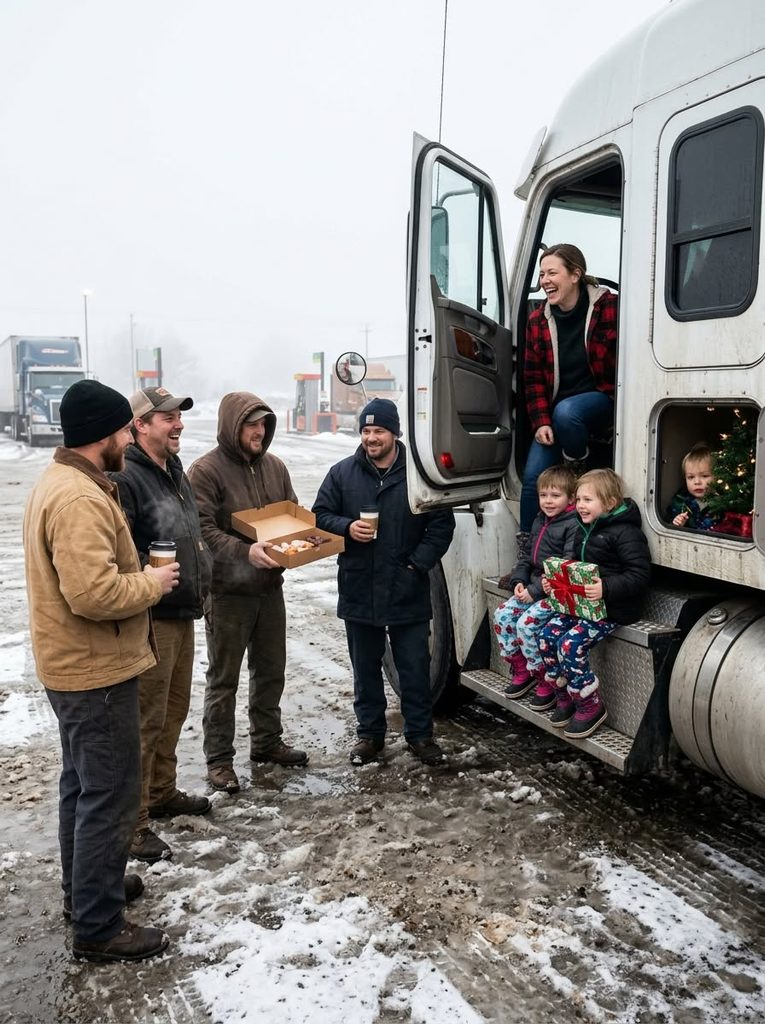
At two minutes to six on Christmas Eve morning, my father-in-law slid a load sheet across his desk at me without looking up from his coffee, and I knew before I read it that my Christmas was gone.
The office at the yard in Mount Pleasant still smelled like burnt coffee and diesel the way it always did. The space heater ticked under his desk. Out the window, a dozen tractors sat in two rows under the yard lights, frost on every windshield.
“Laredo,” Elwood said. “Pick up’s already on the trailer. Door seven, the dry van. Delivers at seven on the twenty-sixth. Pays twenty-eight hundred to the company. You’ll do fine on it.”
I read it twice. Mount Pleasant to Laredo, about 1,250 miles. Two and a half days down, if the weather held and the scales stayed shut. It had Keaton’s name typed on it, crossed out in pen, with mine written over the top in Elwood’s square printing.“This is Keaton’s load,” I said.
“Keaton’s got plans.” He took a drink of his coffee. “He’s got that girl coming in from Burlington. Maribel. They’re doing Christmas with her folks.”
I had asked for Christmas Eve off in April. I had asked for it again in September, and once more the first week of December, standing in that same doorway. It was the only day off I had asked for all year, and he had said yes every single time.
“Elwood, you told me I had today,” I said. “Nate’s in Ohio. He can’t get back till the twenty-sixth at the earliest. I’ve got nobody to keep the kids.”
“Then take them,” he said. “Plenty of drivers run with family. I’ll sign the rider form.”
And he did. He pulled the passenger authorization out of the file drawer, filled in three names and three birthdays from memory, and signed the bottom. He never once raised his eyes to mine. That was the part I kept seeing later, the top of his gray head bent over the paper.
I want to tell you why I did not just say no. I have been asked it since, and it is a fair question.
Two Thanksgivings before, one of our drivers had turned down a holiday load from Elwood. He was good, safe, nineteen years without a ticket. He sat in the yard for three weeks waiting on a dispatch that did not come, and in January he went to work for an outfit in Ottumwa.
That is how it works at a small family company. Nobody fires you. You just stop getting the next load. And Nate and I had a house payment of $1,140 a month on a three-bedroom on the east side of town, three kids, and a minivan with a transmission that whined in second gear.
So I folded the load sheet in half and put it in the chest pocket of my flannel, and I said, “I’ll be rolling by seven-thirty.”
“Good girl,” Elwood said. He was already reading something else.
I have driven for Hartzell Trucking for nine years. I married into the name, and then I married into the job, because Nate drove for his dad and the money was steadier than anything else in Henry County. I got my CDL at thirty, in a class at the community college, with Wes not even born yet.Nine years is a long time in a truck seat. It is a sore right hip that wakes me at two in the morning. It is a lower back that will not let me sit in a church pew for a full sermon. It is boots I buy once a year and wear through at the heel by October.
It is fueling at a pump in Kansas in a crosswind at four below, the nozzle so cold it burns through your gloves. It is coffee instead of sleep and sunflower seeds instead of supper. It is learning to hold it for a hundred miles because the next exit has no place for a truck to turn around.
I was good at it. I had my own truck, a white conventional with the Hartzell name on the doors, and I had not had a preventable accident in nine years. Elwood said so himself, every year at the company Christmas dinner, raising his glass of iced tea.
I called Nate from the cab while the engine warmed up. He was at a shipper outside Columbus, sitting in a dock line that had not moved since midnight. They were short on loaders for the holiday and nobody knew when his trailer would be ready.“He did what?” Nate said.
I told him again. I heard him breathe out through his nose, slow, the way he does when he is trying not to say what he is thinking.
“I’m calling him,” he said.
“Nate, don’t. You’ll just put us both in the yard.”
“I’m calling him anyway,” my husband said. “He’s my dad. Somebody has to tell him.”
He called. Elwood did not pick up. Nate called twice more and then texted him, and later I saw that text. It said, Dad, those are your grandkids. Please. Elwood never answered it.
I want to be fair to Elwood, because I have had a year to think about him.
Keaton was his baby. Keaton was born when Elwood was thirty-six and his wife was thirty-nine, a surprise baby, and when she passed of cancer Keaton was only fifteen. Keaton took it hard, and then he took to drinking, and for most of his twenties he was a worry that never stopped.
Fourteen months before that Christmas, Keaton got sober. He went to the meetings in a church basement in town on Tuesday and Friday nights. He got his CDL back. He started driving for his dad and he was good at it. And then he met Maribel, who taught second grade, and he smiled again for the first time since he was a boy.
Elwood would have given Keaton anything that kept him home and happy. I understood that. I am a mother too. But understanding a reason is not the same as calling a thing right. He gave his youngest son a Christmas by taking away three grandchildren’s, and he did not even look at me while he did it.
I drove home at six-twenty with the load sheet in my pocket and my hands shaking on the wheel of the minivan.
The kids were still asleep. The tree was lit in the front window because Hattie had begged to leave it on all night, just for Christmas Eve. I stood in the doorway of the living room and looked at it and let myself cry for exactly one minute by the clock on the stove.
Then I woke them up.
Rowan, my oldest, was eleven, and he understood right away. He did not ask a single question. He just got his duffel bag out of the hall closet and started packing like he had done it a hundred times before.
On page 3
Hattie was eight and she cried, because she had been counting down on the paper chain taped to her bedroom door and there were still two links left.