Then again.
Knock.
I stood.
“Noah?”
Silence.
I stepped toward the closet.
“Noah, it’s Grandpa.”
A frightened voice came from the other side.
“Did Lily wake up?”
I pulled the door open.
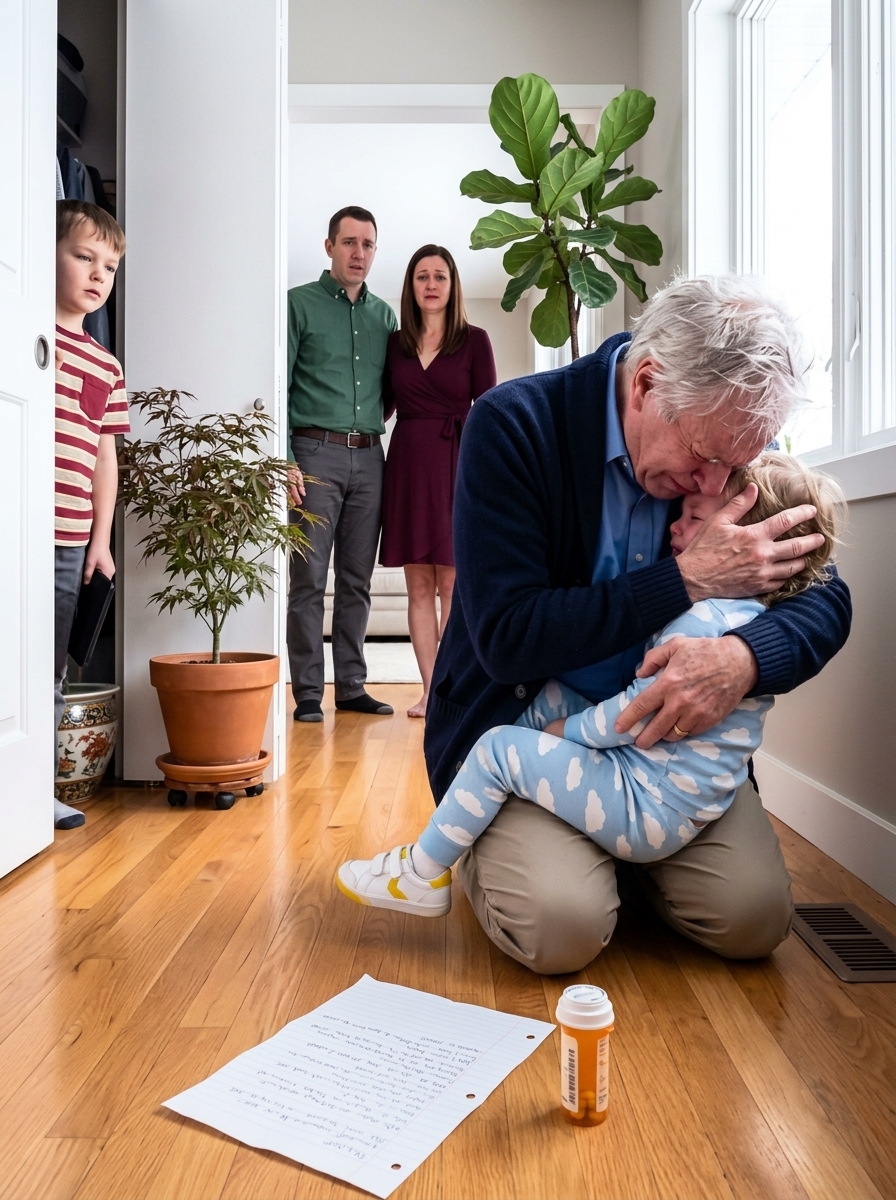
My ten-year-old grandson was sitting on the floor in the darkness with his knees pressed against his chest.
His face was swollen from crying.
One sock was missing.
One foot was bare.
And in his arms, he was clutching his tablet as if it were the only thing in the world he trusted.
Advertisement
He looked past me toward his sister.
“Is she going to be okay?”
“The ambulance is coming.”
He immediately tried to stand.
His legs trembled.
I helped him up.
“Why were you in there?”
He looked down.
“Dad told me I had to stay until I stopped lying.”
“Lying about what?”
His eyes moved toward the medicine bottle in my hand.
“I told him they couldn’t leave Lily here.”
I stared at him.
“And your father locked you in a closet because you said that?”
Advertisement
Noah’s lower lip trembled.
“He said I ruin everything.”
Something inside me broke.
Not loudly.
Not dramatically.
It simply broke.
For decades, Eric had been my son first.
The boy I taught to ride a bicycle.
The teenager whose first car I helped repair.
The man whose mistakes I repeatedly explained away because fathers don’t want to believe the worst about their own children.
But standing in that hallway, looking at Noah barefoot and terrified while Lily burned with fever on the floor, I no longer saw the boy I had raised.
Advertisement
I saw a grown man who had made choices.
And two children were paying for them.
The ambulance arrived minutes later.
Two paramedics rushed inside.
They went straight to Lily.
One took her temperature.
The other checked her pulse, oxygen level, and blood pressure.
Their expressions changed almost immediately.
“What has she taken?” one asked.
I handed over the bottle.
“I found this on the table.”
He read the label.
His eyes sharpened.
“Is this prescribed to her?”
“No.”
“How much was she given?”
Advertisement
“I don’t know.”
From behind me, Noah spoke.
“Dad said enough to make her sleep until tomorrow.”
Everyone went still.
The paramedic looked at Noah.
“Did you see him give it to her?”
Noah nodded.
“Dad gave it to her. Karen brought the water.”
I closed my eyes for half a second.
That was all I could allow myself.
The paramedics lifted Lily onto a stretcher.
They started fluids before they even moved her from the house.
One of them contacted the emergency department and gave a report.
Advertisement
Severe fever.
Dehydration.
Possible inappropriate medication exposure.
Altered level of consciousness.
Child found without adult supervision.
The words sounded clinical.
Controlled.
They did not sound like my granddaughter.
To me, Lily was the child who still drew a smiling sun in the corner of every picture.
The little girl who once called me because she found a ladybug in the backyard and believed I needed to know immediately.
The girl who always stole the cherries from my ice cream.
Now strangers were rushing her into an ambulance because her own father had decided she was exaggerating.
Advertisement
I followed the stretcher toward the front door.
That was when Noah grabbed my sleeve.
Hard.
I turned.
“What is it?”
He was holding the tablet against his chest with both hands.
His face had gone pale.
“Dad said if I showed anyone this, you’d believe him instead of me.”
I looked at the tablet.
“What do you have?”
“I recorded it.”
“Recorded what?”
“Them deciding to leave us.”
For one second, every sound around me seemed to disappear.
The ambulance engine.
Advertisement
The paramedics.
The radio.
Everything.
“What exactly did you record?”
Noah’s eyes filled with tears.
“Dad and Karen talking.”
Before I could ask more, Lily moaned from the stretcher.
That settled it.
Whatever was on the tablet could wait.
Lily couldn’t.
I grabbed Eric’s note.
The medication bottle.
Noah’s loose sneaker.
Then I locked the house behind us.
Noah climbed into my car with the powered-off tablet clutched against him while I followed the ambulance toward the hospital.
We had gone only a few blocks when he spoke.
May you like

My Husband Demanded We Split Everything 50/50—Then He Learned His Company Was Partly Mine
“Grandpa?”
“Yes?”
“There are more rules.”
I glanced at him.
“What rules?”
“Dad wrote them.”
My hands tightened around the wheel.
“What kind of rules?”
Noah stared through the windshield.
“Rules about what we’re allowed to tell people.”
I wanted to ask him everything.
But he looked exhausted.
Scared.
And I knew enough now to understand that I should stop questioning him like an investigator.
So I said only one thing.
“You don’t have to protect anybody tonight.”
He turned toward me.
Advertisement
“Not even Dad?”
Especially not Dad, I thought.
But I chose my words carefully.
“You tell the truth. That’s all you have to do.”
At the hospital, Lily disappeared through the emergency-room doors almost immediately.
Doctors and nurses surrounded her.
Noah and I were taken into a separate family area.
A nurse brought him socks, a blanket, juice, and crackers.
He barely touched them.
Twenty minutes later, a physician named Dr. Patel came to speak with me.
“Mr. Bennett?”
I stood.
Advertisement
“How is she?”
“She’s very ill, but she’s responding to treatment.”
My knees nearly gave way.
Dr. Patel continued.
“Her fever is significant. She’s dehydrated, and we’re concerned about what medication she may have received. We’re running tests and monitoring her closely.”
“Is she going to be okay?”
“We have reason to be hopeful. You got her here when she needed to be here.”
I looked through the glass doors toward the treatment area.
“What would’ve happened if she hadn’t called me?”
Advertisement
The doctor hesitated.
That hesitation told me more than any answer could have.
“We’re glad she did.”
I sat down slowly.
Noah had heard everything.
He pulled the blanket tighter around himself.
“This is my fault.”
I turned so fast my chair scraped the floor.
“What?”
“I should’ve stopped him.”
“No.”
“I knew Lily was getting worse.”
“Noah.”
“I yelled at Dad, but then he got mad and—”
I moved my chair in front of him.
“Listen to me. You are ten years old.”
Advertisement
Tears rolled down his face.
“You tried to help your sister. You warned your father. You kept the tablet. And you knocked on that closet door until I heard you.”
“I should’ve called you.”
“You were locked in a closet.”
He wiped his face.
“Dad said Grandpa would be mad if we bothered him at night.”
My chest tightened.
“He said that?”
Noah nodded.
“That’s one of the rules.”
Before I could respond, two police officers entered the waiting area with a hospital social worker.
Advertisement
One of the officers introduced herself as Officer Megan Ruiz.
The paramedics had reported the circumstances at the house.
She asked if I still had the note.
I handed it to her.
Then the medication bottle.
She read Eric’s message carefully.
When she reached the line about the closet, her expression hardened.
“Mr. Bennett, we need to preserve this.”
“Take whatever you need.”
Then Noah spoke.
“I have a video.”
Officer Ruiz turned toward him.
She did not rush over.
Advertisement
She crouched several feet away.
“You don’t have to show me anything until you’re ready.”
Noah looked at me.
I nodded.
He turned on the tablet.
His hands were shaking so badly that I helped hold it.
The video had been recorded that evening.
At first, the image showed only the edge of a kitchen counter.
Noah must have propped the tablet behind something.
Eric’s voice came through first.
“I’m not canceling Gatlinburg because Lily has another little fever.”
Karen answered.
Advertisement
“She looks pretty sick.”
“She always looks sick when she wants attention.”
Then Noah’s voice.
“She threw up twice.”
Eric responded sharply.
“Noah, stay out of it.”
“She can’t be by herself.”
“We’ll give her something. She’ll sleep.”
Karen lowered her voice.
“What if she wakes up?”
“She has water.”
“What if she calls Walter?”
A pause.
Then my son’s voice.
“I’ll leave him a note. Dad always panics when the kids complain.”
I felt something cold move through me.
Advertisement
The recording continued.
Noah protested again.
“You can’t leave Lily.”
A chair scraped.
Eric’s voice grew louder.
“Give me the tablet.”
Then Noah said, “No.”
The camera moved wildly.
There were footsteps.
Karen said, “Eric, stop.”
Then Eric shouted, “If you’re going to keep lying and ruining Noah’s birthday trip, you can sit in the closet until you learn to mind your own business.”
The recording ended.
Nobody in the waiting room spoke.
Officer Ruiz slowly stood.
“Is there anything else on the tablet?”
Advertisement
Noah nodded.
“Pictures.”
He opened a folder.
There were photographs of sheets of paper taped inside a kitchen cabinet.
The rules.
Eric had apparently removed the originals before leaving.
But Noah had photographed them.
The first said:
DO NOT CALL GRANDPA WITHOUT PERMISSION.
The second:
IF LILY SAYS SHE IS SICK, SHE IS PROBABLY EXAGGERATING.
The third:
IF NOAH SAYS DAD YELLED OR PUNISHED HIM, HE IS LYING BECAUSE HE DOESN’T LIKE RULES.
Another said:
WHAT HAPPENS IN THIS HOUSE STAYS IN THIS HOUSE.
And then Officer Ruiz reached the last photograph.
Her face changed.
IF GRANDPA ASKS WHERE YOU ARE THIS WEEKEND, SAY YOU ARE STAYING WITH AUNT MICHELLE.
I stared at those words.
That was the moment everything became even worse.
This was not a bad decision made in a burst of frustration.
Eric had planned the lie.
He had prepared the children to support it.
He had already told me Lily was with one of Karen’s relatives.
The rules were there to make sure the lie held.
Officer Ruiz looked at the social worker.
The social worker looked at me.
Neither needed to explain what that meant.
At 4:36 a.m., my phone rang.
Eric.
I stared at his name.
Officer Ruiz asked, “Do you want to answer?”
I did.
“Dad?”
His voice was angry, not worried.
That told me everything.
“Where are you?”
“At the hospital.”
Silence.
Then, “Why?”
I almost laughed.
Not because anything was funny.
Because I could not understand how my own son could ask that question.
“Lily called me.”
Another pause.
“You went into my house?”
“She was on the floor.”
“She gets dramatic when she’s sick.”
I looked across the room at Noah.
He had gone completely still.
I lowered my voice.
“Your daughter could barely wake up.”
Eric sighed as though I were inconveniencing him.
“Dad, I told you in the note not to overreact.”
“You also told me not to believe her about the closet.”
This time, the silence lasted longer.
Then Eric said, “Noah wasn’t locked in there.”
I looked at Officer Ruiz.
She was listening.
“He was sitting behind a closed door in the dark.”
“He could’ve opened it.”
Noah shook his head immediately.
I remembered something.
“Noah,” I whispered, covering the phone. “Was it locked?”
He nodded.
“Dad used the little hook outside.”
My stomach turned again.
I repeated it.
Eric’s voice changed.
“He’s lying.”
And there it was.
Exactly as written in the rules.
If Noah says Dad punished him, he is lying.
I asked the question I had been afraid to ask.
“What did you give Lily?”
“Something to calm her down.”
“What?”
“It doesn’t matter.”
“It matters to the emergency-room doctors.”
For the first time, Eric sounded nervous.
“Why are doctors involved?”
“Because she’s in the emergency room.”
“Dad, what did you do?”
I closed my eyes.
What did I do?
I looked at the officers.
At the social worker.
At Noah’s bare ankle beneath the hospital blanket.
Then I answered.
“I believed my granddaughter.”
Eric began talking fast.
“You don’t understand what those kids are like when Karen and I are trying to manage them. Lily manipulates people. Noah lies constantly. You’ve always spoiled them, and now you’ve turned this into some huge—”
Officer Ruiz held out her hand.
I gave her the phone.
“Mr. Bennett,” she said, “this is Officer Megan Ruiz. We need to know your current location.”
Eric stopped talking.
Then the call ended.
He had hung up.
The next several hours blurred together.
Lily’s fever slowly began coming down.
The doctors told me the medication in her system could explain why she had been so weak and difficult to wake, especially combined with dehydration and illness.
She would need observation.
But she was awake.
She recognized me.
And when I finally sat beside her bed, she whispered, “Did I get in trouble?”
I nearly broke down.
“No.”
“Dad said I wasn’t supposed to call.”
“You did exactly the right thing.”
“He said you’d be mad.”
“I’m not mad at you.”
Her eyes moved toward the doorway.
“Where’s Noah?”
“He’s safe.”
Only then did she relax.
The social worker later spoke to Lily without me in the room.
Then Noah.
Separately.
Neither child was coached.
Neither was told what the other had said.
When the social worker came back, her expression told me enough.
“This did not begin tonight,” she said.
I looked at her.
“What does that mean?”
“There have been other incidents involving isolation, threats, and instructions not to tell trusted adults.”
I felt as if someone had punched me.
“How did I not know?”
She did not answer that.
Maybe because there was no answer that would help.
I started remembering things.
Noah becoming unusually quiet whenever Eric entered a room.
Lily asking me once whether grown-ups were allowed to take away dinner as punishment.
Eric refusing to let the children stay overnight with me because he said I made them “soft.”
Phone calls that ended suddenly.
Birthday visits canceled at the last moment.
Each memory had seemed small on its own.
Together, they formed something I no longer wanted to see.
By noon, officers in Tennessee had located Eric and Karen at their hotel outside Gatlinburg.
They had not expected police.
Apparently, Eric initially insisted everything was a misunderstanding.
Karen told a different story.
Then another.
Then, after investigators mentioned the tablet recording, she stopped trying to match Eric’s version.
She admitted Lily had been feverish before they left.
She admitted she knew the medication had not been prescribed to Lily.
She admitted Noah had been placed in the closet after arguing with Eric.
But she insisted she had wanted to cancel the trip.
Officer Ruiz explained that Karen’s claims would have to be compared with the evidence.
The recording did contain her hesitation.
It also showed that she left anyway.
That afternoon, Eric called me again.
This time from a police station.
I did not answer.
He left a voicemail.
“Dad, please. This is getting completely out of control. You know me. You know I would never hurt my kids. Noah is twisting everything because he was angry about being punished. Lily gets dramatic when she’s sick. You need to tell them that.”
You know me.
Those words stayed with me.
Because for years, I thought I did.
Later, Officer Ruiz asked whether I wanted to listen to another audio file Noah had saved on the tablet.
It had been recorded several weeks earlier.
In it, Eric was explaining the house rules.
His voice was calm.
Almost casual.
“If Grandpa asks questions, you say everything is fine. If you tell him private family business, visits stop. Understand?”
Lily’s little voice answered.
“Yes.”
Then Noah.
“Yes.”
I stopped the recording.
I couldn’t listen anymore.
That evening, a judge approved an emergency protective arrangement.
The children would not be returning to Eric’s custody while the investigation continued.
Because I was their grandfather, had an existing relationship with them, and had passed the initial safety review, the social worker asked whether I would be willing to become their temporary placement once Lily was discharged.
The question almost offended me.
“Willing?”
She waited.
“They’re my grandchildren.”
“I understand.”
“There’s nowhere else they need to go.”
Two days later, Lily came home with me.
Not Eric’s home.
Mine.
She walked slowly through my front door holding Noah’s hand.
I had prepared the guest rooms.
Fresh sheets.
Night-lights.
New toothbrushes.
A pitcher of water beside Lily’s bed.
I expected them to be relieved.
Instead, Noah stood in the hallway staring at the bedroom door.
“What’s wrong?” I asked.
“Are we allowed to close it?”
My throat tightened.
“You’re allowed to open it, close it, lock it, leave it open—whatever makes you comfortable.”
He looked confused.
Lily pointed toward the kitchen.
“Can I get water without asking?”
I turned away for a second because I didn’t want them to see my face.
“Yes.”
“Anytime?”
“Anytime.”
That first night, neither child slept much.
At 1:58 a.m.—exactly forty-eight hours after Lily’s call—I woke to footsteps.
I found her standing outside my bedroom.
She was wearing the same pink pajamas.
Clean now.
Her fever was gone.
But she looked frightened.
“Grandpa?”
“I’m here.”
“I had a bad dream.”
I opened my arms.
She climbed beside me.
A few minutes later, Noah appeared too.
He didn’t say anything.
He simply sat at the edge of the bed.
So we stayed there.
The three of us.
No rules.
No threats.
No locked doors.
Just quiet.
The investigation lasted months.
I learned things I wish I never had.
Neighbors had heard Eric shouting.
A teacher remembered Noah becoming anxious whenever school staff discussed calling home.
A pediatrician documented missed follow-up appointments.
The children’s statements remained consistent.
The tablet recordings remained consistent.
The note remained consistent.
And the prescription bottle did not disappear simply because Eric wanted everyone to believe he had been misunderstood.
His attorney tried to describe that night as a parenting mistake.
Prosecutors described a series of deliberate decisions.
Leaving a severely ill eight-year-old without adult supervision.
Giving her medication not prescribed to her.
Locking a ten-year-old child away after he objected.
Creating written rules intended to isolate both children from a trusted adult.
Then leaving town.
I attended every hearing I was permitted to attend.
Eric rarely looked at me.
The first time he finally did, he mouthed one sentence across the hallway.
You did this.
For years, words like that would have crushed me.
I would have wondered whether I had betrayed my son.
Whether I should have handled things privately.
Whether calling authorities had destroyed the family.
But then Noah reached for my hand.
And I remembered who had actually called for help.
An eight-year-old girl with a dangerous fever who had been told not to call anyone.
I looked back at Eric.
And for once, I did not look away.
No.
I had not done this.
He had.
Months later, Noah asked me a question while we were eating pancakes.
“Grandpa?”
“What?”
“Why did Dad write all those rules?”
I put down my fork.
I thought about giving him an easy answer.
Adults sometimes make mistakes.
Your dad was stressed.
He didn’t understand.
All the excuses I had made for Eric for years.
Instead, I told him the truth in a way a ten-year-old could carry.
“Sometimes people make rules because they want children to behave. And sometimes people make rules because they’re afraid of what will happen if children tell the truth.”
Noah looked at his plate.
“Those were the second kind?”
“Yes.”
He nodded.
Then he asked, “Did you believe me?”
“From the moment I opened that closet.”
“What if I didn’t have the video?”
That question hurt more than anything else.
Because I knew what Eric had worked so hard to make him believe.
That without proof, nobody would trust him.
I leaned forward.
“Noah, the video helped the police. But you didn’t need a video for me to care about what happened to you.”
He was quiet.
Then Lily, who had been coloring at the end of the table, looked up.
“What about me?”
“You too.”
She smiled.
It was a small smile.
But it was the first one I had seen from her that looked completely like the old Lily.
Nearly a year after the call, I was cleaning out a storage box the police had finally returned from Eric’s house.
Most of it was ordinary.
School papers.
Old receipts.
Birthday decorations.
A jacket.
Then I found a small folded sheet of paper inside the pocket of Noah’s backpack.
I recognized Eric’s handwriting immediately.
For a second, I considered throwing it away without reading it.
Then I unfolded it.
It was another rule sheet.
Older than the others.
Across the top, Eric had written:
FAMILY RULES — NO EXCEPTIONS.
Most of the rules were familiar.
Don’t call Grandpa without permission.
Don’t discuss punishments.
Don’t tell teachers private family business.
If someone asks questions, say everything is fine.
But at the bottom was one sentence I had never seen before.
IF GRANDPA EVER FINDS OUT, REMEMBER THAT HE WILL ALWAYS CHOOSE HIS OWN SON OVER YOU.
I stood there holding that paper for a very long time.
That was what Eric had counted on.
Not the locked closet.
Not the medication.
Not the lies about Gatlinburg.
Me.
He had counted on my loyalty.
He had counted on the excuses I had been making for him all his life.
He had taught two frightened children that even if they somehow reached me, blood would matter more than truth.
That night, I showed the paper to Noah and Lily.
Not because I wanted them to carry Eric’s words forever.
But because I wanted them to see me tear the page in half.
Then again.
And again.
I dropped the pieces into the trash.
Lily watched me carefully.
“Was Dad wrong?”
I looked at both of them.
“Yes.”
“About what?”
I pulled out a chair and sat between my grandchildren.
“About me having to choose between my son and you.”
Noah frowned.
“I don’t understand.”
“You were never asking me to choose.”
I reached for their hands.
“You were asking me to believe the truth.”
Lily squeezed my fingers.
“And you did?”
I thought back to 1:58 in the morning.
The weak voice on the phone.
The empty garage.
The scorching heat of Lily’s forehead.
The prescription bottle.
The note.
The soft knocking from behind the closet door.
And one terrified little boy holding a tablet because he believed evidence was the only thing standing between him and being called a liar.
“Yes,” I said.
“I did.”
And if there is one thing I will carry with me for the rest of my life, it is this:
Children do not always know the perfect words to explain when something is terribly wrong.
Sometimes they whisper.
Sometimes they hide evidence.
Sometimes they break a rule.
Sometimes they call at 1:58 in the morning and say only:
“Grandpa, I can’t get up.”
When that call comes, you answer.
And this time, I did.