But something inside me had finally reached its limit.
“You don’t get to destroy my future because it’s convenient for you.”
He came around the table.
Brenda whispered, “Don’t encourage her.”
I took a step backward.
My father grabbed my wrist.
Hard.
Pain shot through my arm.
“Dad, you’re hurting me.”
He squeezed tighter.
“In MY house,” he said slowly, inches from my face, “I make the rules.”
When he released me, a dark mark was already forming around my wrist.
Advertisement
I stared at it.
Then at him.
Something in my expression must have angered him even more.
Because that was when he pointed toward the door.
“Get out.”
I thought he meant go upstairs.
Maybe leave the room.
Then he grabbed me.
And minutes later, I was standing barefoot in the snow.
Now, outside, the cold was becoming dangerous.
I knew enough to understand that.
My toes had stopped hurting.
That frightened me more than the pain.
My fingers were turning dark red, then almost blue at the tips.
Advertisement
I tried walking around the house, hoping a back door might be unlocked.
It wasn’t.
Neither was the garage.
I looked toward the neighboring houses.
Most were dark or hidden behind trees.
Our property sat at the end of a long private road.
My father liked the isolation.
He said it gave us privacy.
That night, it felt like a prison.
I hugged myself and forced my legs to keep moving.
Don’t sit down.
I remembered hearing somewhere that sitting down in extreme cold was dangerous.
Advertisement
So I paced.
Ten steps one way.
Ten steps back.
I looked through another window.
My half-brother was playing his new console.
Brenda was taking pictures beside the Christmas tree.
My father was opening a bottle of expensive whiskey.
No one looked toward the door.
My eyes burned.
I refused to cry.
I had cried enough in that house.
When my mother died, I was still young enough to believe adults always protected children.
For a while, my father had been different.
Advertisement
Quieter.
Kinder.
Then Brenda came.
Little things changed first.
My mother’s photographs disappeared.
Then her jewelry.
Then stories about her stopped being told.
Eventually, even her name seemed unwelcome.
There was one person connected to my mother whom my father hated discussing more than anyone.
My grandmother.
My mother’s mother.
The woman I hadn’t seen properly in years.
Whenever I asked why, my father gave the same answer.
“She chose money over family.”
That was almost all I knew.
My grandmother was extraordinarily wealthy.
Advertisement
Not celebrity wealthy.
The kind of wealthy where companies carried her family name and newspapers occasionally photographed her at charity galas.
I remembered meeting her when I was younger.
Elegant clothes.
Silver hair.
A voice that never needed to become loud for people to listen.
After my mother’s death, she had tried to stay involved.
Then suddenly, she disappeared from my life.
My father claimed she’d lost interest.
For years, I believed him.
Until I was fifteen and discovered Christmas cards hidden inside a locked desk drawer.
Advertisement
They were addressed to me.
One for every year.
He had never given them to me.
I confronted him.
He burned them in the fireplace.
After that, I stopped asking questions.
But there was something else.
A promise my mother had made shortly before she died.
I remembered lying beside her in the hospital.
I was young, terrified, and trying not to cry.
She had taken my hand and whispered:
“When you turn eighteen, things will change.”
At the time, I thought she meant emotionally.
Advertisement
That growing up would make losing her hurt less.
Now, standing in the snow minutes before my eighteenth birthday, those words returned.
When you turn eighteen, things will change.
I looked toward the old clock visible through the living-room window before Brenda pulled the second curtain closed.
11:52 p.m.
Eight minutes.
I didn’t know why that mattered.
I only knew I had to stay conscious.
I stamped my feet.
Nothing.
I rubbed my hands together.
Barely any sensation.
May you like

U.S. Army Colonel Mother Takes Down Powerful Family After Daughter’s Terrifying Hospital Call
I Gave My Mother-in-Law $3,000 Every Month—Then I Found Proof My Husband Was Funding His Mistress
Texas Deputies Arrested the Wrong Woman—Then the Fingerprint Scanner Turned Red
11:54.
The wind howled across the driveway.
I whispered to myself.
“Stay awake.”
11:56.
My knees shook.
I pressed my back against the brick wall for shelter.
My vision blurred.
11:58.
Inside, they had started pouring champagne.
Of course they had.
Christmas night.
Another perfect year.
My father raised his glass.
Brenda leaned against him.
They were counting down toward midnight.
So was I.
But for a very different reason.
11:59.
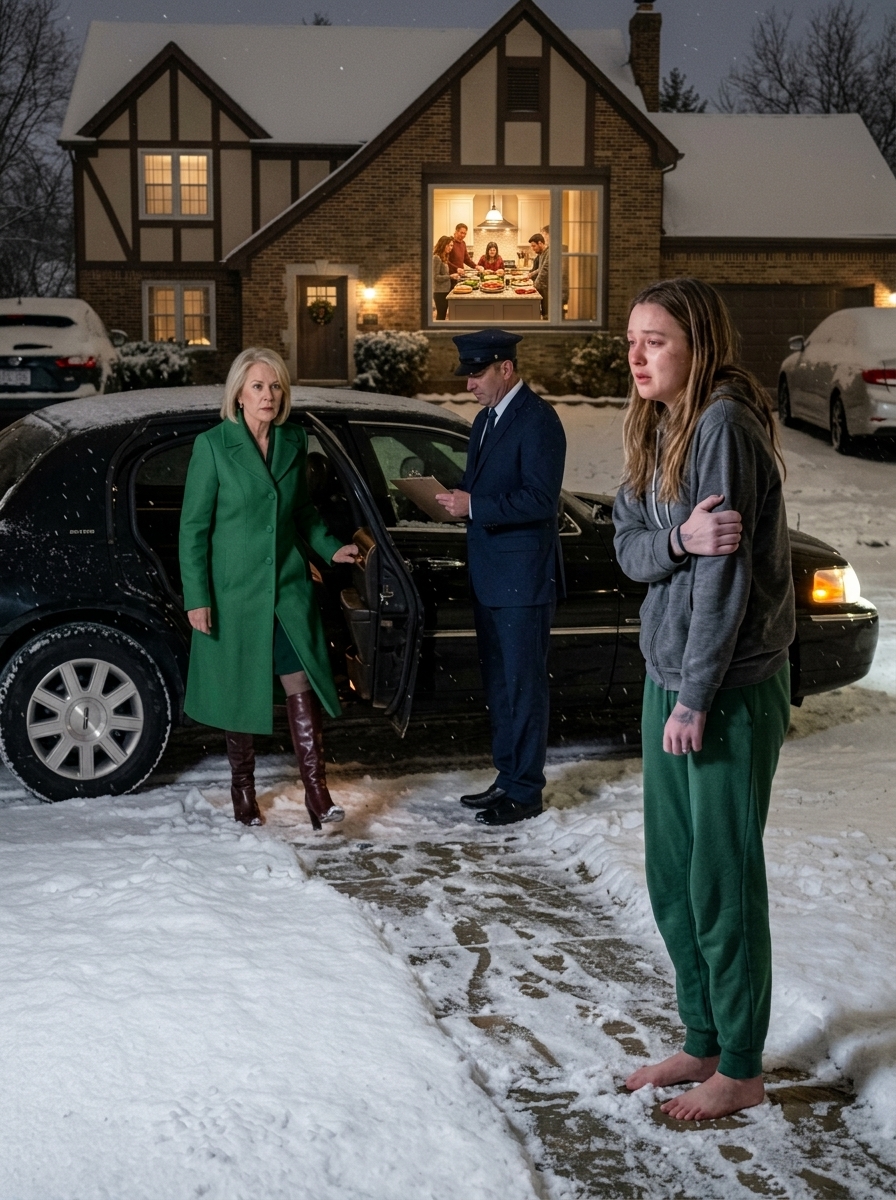
Then I saw headlights.
At first I thought I was imagining them.
Advertisement
Two bright beams appeared through the falling snow at the end of the private road.
The vehicle moved slowly toward the house.
Not a police cruiser.
Not a neighbor.
Something long.
Black.
Impossible to mistake.
A limousine.
It rolled through the gate and stopped directly in front of the house.
I stared.
The driver’s door opened.
A man in a dark coat stepped out, hurried around the vehicle, and opened the rear passenger door.
A woman emerged.
White cashmere coat.
Advertisement
Black gloves.
Silver hair.
Perfect posture.
My breath caught.
I knew her immediately.
My grandmother.
Older than I remembered.
But unmistakable.
For several seconds, neither of us moved.
Then her eyes traveled downward.
My thin sweater.
My bare legs.
My soaked socks.
My feet in the snow.
Then my hands.
Finally—
The bruise around my wrist.
Her expression changed.
She didn’t scream.
She didn’t gasp.
She didn’t rush toward the house.
Her face simply became still.
Terrifyingly still.
She crossed the driveway toward me.
Advertisement
“My God.”
Her voice broke on the final word.
She removed her coat immediately and wrapped it around my shoulders.
“Can you feel your feet?”
“Not really.”
Her eyes hardened.
“How long have you been outside?”
“I don’t know. Maybe twenty minutes.”
“Who put you here?”
I glanced at the house.
“My father.”
The chauffeur swore under his breath.
My grandmother didn’t.
She looked toward the glowing windows.
Inside, my family had finally noticed the limousine.
The curtain moved.
Brenda’s face appeared.
Advertisement
Then disappeared.
My grandmother took out her phone.
She didn’t call my father.
She didn’t knock.
She didn’t ask for an explanation.
Her first order was directed at the chauffeur.
“Call 911.”
Inside the house, someone dropped a glass.
Even through the window, I heard it shatter.
My grandmother continued.
“Tell them an eighteen-year-old girl has been deliberately locked outside in subzero weather with possible cold exposure and an injury to her wrist.”
Then she looked at her watch.
Midnight.
Advertisement
Exactly.
Her eyes met mine.
“Happy birthday.”
I started crying.
I hated myself for it, but I couldn’t stop.
She pulled me against her.
“It’s over,” she whispered.
Behind us, the front door suddenly opened.
My father stepped onto the porch.
“What the hell is going on?”
My grandmother turned.
I felt her body stiffen.
He stared at her as though he’d seen a ghost.
“You.”
She said nothing.
Brenda appeared behind him.
The second she recognized my grandmother, the color drained from her face.
Advertisement
My father recovered first.
“You have no business coming here.”
My grandmother looked down at my feet.
Then back at him.
“No business?”
“She was being disrespectful.”
The chauffeur stared at him in disbelief.
My grandmother’s voice remained quiet.
“You locked her outside without shoes.”
“For a few minutes.”
“In below-freezing weather.”
“She needed to learn a lesson.”
My grandmother stepped closer.
“No. You are about to learn one.”
My father’s face changed.
“You can’t come onto my property and threaten me.”
Advertisement
That sentence produced the strangest reaction.
My grandmother smiled.
Not warmly.
Almost sadly.
“Your property?”
My father’s mouth closed.
She tilted her head.
“Is that what you’ve been telling people?”
Brenda touched his arm.
“What does she mean?”
He ignored her.
My grandmother turned to me.
“Do you remember what your mother told you before she died?”
My throat tightened.
“She said things would change when I turned eighteen.”
“They just did.”
My father stepped down from the porch.
“Don’t.”
Advertisement
It was the first time I had ever heard fear in his voice.
My grandmother looked at him.
“Don’t what?”
“This isn’t the time.”
“It is exactly the time.”
In the distance, sirens began approaching.
My father looked toward the road.
Then at me.
Then at my grandmother.
His panic became obvious.
“This is a family issue.”
“No,” my grandmother replied. “Locking a child outside in dangerous weather is not a private family issue.”
“She’s eighteen.”
“She turned eighteen approximately two minutes ago. You threw her outside while she was still seventeen.”
Advertisement
He said nothing.
Police vehicles entered the driveway, followed by an ambulance.
Everything moved quickly after that.
Paramedics wrapped me in heated blankets and took my temperature.
One examined my wrist.
Another inspected my feet.
A police officer asked me who had locked me out.
I told him.
My father tried interrupting twice.
The officer told him to step away.
That alone felt unreal.
No one had ever told my father to step away from me before.
Inside the ambulance, I could still hear voices from the porch.
Brenda was insisting it had been a misunderstanding.
My father kept saying I was dramatic.
My half-brother stood behind them clutching his new controller, suddenly silent.
Then my grandmother climbed into the ambulance.
“I need to tell you something,” she said.
I looked at her.
“Why are you here?”
She took a breath.
“Because your mother asked me to be.”
I stared at her.
“She knew she was dying. She created several legal protections for you.”
My mind struggled to follow.
“What protections?”
“Your education. Your inheritance. And this house.”
I looked toward the window.
“This house?”
She nodded.
“It belonged to your mother.”
My mouth went dry.
“My father said he bought it.”
“He didn’t.”
She opened her handbag and removed a thin folder.
“Your mother inherited this property through our family trust. When she became ill, she placed it into a protected trust for you.”
I stared at her.
“Why was Dad living here?”
“Your mother granted him occupancy while you were a minor so you could remain in your childhood home. But ownership was never transferred to him.”
I couldn’t speak.
“At midnight tonight,” she continued, “control of the property passed to you.”
I almost laughed.
Not because it was funny.
Because it was too enormous to understand.
“You’re saying… this is my house?”
“Yes.”
Outside, my father was arguing with an officer on the porch of the house he’d spent years calling his.
My grandmother wasn’t finished.
“The house is only part of it.”
My stomach tightened.
“What else?”
“Your mother established an education trust. She knew how much you loved school.”
My eyes filled again.
“She also left instructions that I was to have greater authority over that trust after your eighteenth birthday.”
“Why didn’t you help me before?”
The question escaped before I could stop it.
Pain crossed her face.
“I tried.”
She reached into the folder.
There were photocopies.
Letters.
Court filings.
Returned envelopes.
Emails.
“I sent gifts. Letters. Birthday cards. Requests to see you. Your father restricted contact after your mother died. He told attorneys you were distressed by me and didn’t want visits.”
I felt sick.
“I never said that.”
“I know.”
“He told me you stopped caring.”
Her eyes closed briefly.
“I never stopped.”
For a few seconds, neither of us spoke.
Then she handed me another page.
A financial statement.
“What is this?”
“Your father received money from the trust for your care.”
I scanned the numbers.
My stomach dropped.
The amounts were huge.
“He told me we couldn’t afford school trips.”
My grandmother’s jaw tightened.
“We know.”
“He made me work for clothes.”
“I know.”
“He said my mother left almost nothing.”
“She left more than enough.”
The ambulance suddenly felt too small.
Every memory rearranged itself.
The cheap birthday presents.
Brenda’s new jewelry.
My father’s expensive car.
My half-brother’s electronics.
The vacations I was told we couldn’t afford for me to attend.
“Did they use my money?”
“We believe a substantial portion of trust distributions may have been misused.”
I looked through the ambulance doors at my father.
For the first time in my life, he looked small.
Two officers were speaking to him.
Brenda stood several feet away.
Her arms were folded tightly across her chest.
Then my grandmother asked the question that changed everything again.
“What happened tonight before he locked you outside?”
I told her.
The university letter.
The scholarship.
The trash.
My father declining it.
She became completely silent.
“Which university?”
I told her.
Her eyebrows lifted.
“You were accepted there?”
“With a full ride.”
“And he declined it?”
I nodded.
She removed her phone.
“What are you doing?”
“Calling my attorney.”
“At midnight?”
“He answers.”
He did.
My grandmother explained what had happened in less than thirty seconds.
Then she said, “Contact the university’s admissions office first thing after the holiday. Preserve every communication associated with her application. We have reason to believe a response was submitted without her informed consent.”
She ended the call.
“What if they don’t take me anymore?” I asked.
She looked directly at me.
“Then we’ll fight that problem when it exists. Not before.”
Two days later, it turned out there was no fight.
The university investigated.
My father had accessed correspondence sent to our home and submitted a response indicating that I would not enroll.
But because I had not personally withdrawn and because my scholarship deadline had not fully expired, the university restored my acceptance.
When the admissions officer called me personally, I sat in my grandmother’s guest room holding the phone with both hands.
“We’re still hoping to see you on campus next fall,” she said.
I cried so hard I couldn’t answer.
My grandmother sat beside me.
When the call ended, she smiled.
“Your mother would have been unbearable about this.”
I laughed through tears.
“What?”
“She would have told everyone. Grocery clerks. Drivers. Strangers in elevators.”
That was the first happy story anyone had told me about my mother in years.
But the situation with my father was far from finished.
The police documented the bruise on my wrist.
The paramedics documented my exposure to the cold.
Investigators requested information regarding the trust after my grandmother’s attorney reported suspected misuse.
And because I was now the legal owner of the house, another question had to be answered.
What happened to everyone living there?
My father assumed nothing would change.
Three days after Christmas, we returned with my grandmother’s attorney.
My father met us in the living room.
Brenda stood beside him.
My half-brother stayed upstairs.
My father looked at me like I had betrayed him.
“You’ve really brought lawyers into this?”
I didn’t answer.
The attorney placed several documents on the table.
“The trust provision granting you occupancy in this residence has terminated.”
My father laughed.
“You can’t just throw me out of my own home.”
The attorney remained calm.
“As has already been explained, it is not your home.”
Brenda turned toward my father.
“You told me the house was yours.”
He ignored her.
The attorney continued.
“The beneficiary reached the age specified in the trust. Ownership is now under her control. Given the circumstances surrounding the events of Christmas night, there will be no extension of your occupancy.”
My father looked at me.
“You’re evicting your own family?”
That word nearly worked.
Family.
For years, he had used it whenever he wanted something.
Family meant forgiving.
Family meant obeying.
Family meant sacrificing.
But apparently family had never meant protecting me.
I looked toward the front door.
The same door he’d pushed me through.
Then back at him.
“No.”
His expression shifted.
“No?”
“I’m not throwing my family out.”
I swallowed.
“I’m removing people who threw me out first.”
Brenda made a sound of disbelief.
“You ungrateful little—”
My grandmother took one step forward.
Brenda stopped.
I almost smiled.
My father pointed at me.
“You think that woman cares about you? You think this is love? She’s using you to punish me.”
For years, that accusation might have worked.
Now I knew better.
I walked toward the mantel.
There had once been a photograph of my mother there.
I remembered it clearly.
Her holding me when I was a toddler.
Both of us laughing.
Brenda had removed it years earlier.
“Where are Mom’s things?”
My father looked away.
I repeated the question.
“Where are her things?”
Brenda answered.
“Storage.”
“Which storage?”
Neither of them spoke.
My grandmother’s attorney immediately began writing something down.
Over the next week, we discovered several boxes in a rented storage unit.
Photographs.
Letters.
My mother’s old clothes.
Childhood albums.
Jewelry.
Documents.
And a sealed envelope with my name written in my mother’s handwriting.
I recognized it instantly.
My hands shook when I opened it.
The letter wasn’t long.
My mother wrote that she didn’t know how much of my childhood she would get to see.
She wrote that growing up might become confusing.
That adults might tell me different versions of the truth.
That I should judge people by what they did, not by what they claimed.
Near the end was one sentence I read five times.
Your life belongs to you, even when people who love you try to convince you otherwise.
I pressed the paper against my chest and cried.
Not angry tears.
Not scared tears.
Grief.
Real grief.
The kind I hadn’t been allowed to feel.
My grandmother sat beside me until I finished.
Months passed.
The financial investigation uncovered withdrawals and expenses that my grandmother’s attorneys disputed as unrelated to my care.
Some issues became civil matters.
Others were reviewed more seriously.
I didn’t follow every detail.
For once, I didn’t have to.
My life was moving forward.
My father moved into a rental property with Brenda and my half-brother.
Brenda stopped sending angry messages after my grandmother’s attorney formally requested that all communication go through appropriate channels.
My father tried guilt instead.
He sent one email saying I had destroyed the family over “one bad Christmas night.”
I stared at that sentence for a long time.
One bad night.
That was how he wanted to remember it.
Not the hidden letters.
Not the scholarship.
Not the money.
Not years of control.
Not my mother’s photographs disappearing one by one.
Not the bruise.
Not the snow.
Just one bad night.
I never replied.
The following August, I stood outside my university residence hall with three suitcases and a box of books.
Students moved everywhere around me.
Parents carried lamps.
Friends shouted greetings across the courtyard.
Someone was already playing music from an open window.
For the first time in my life, chaos felt beautiful.
My grandmother stood beside the limousine.
I laughed when I saw it.
“You really couldn’t arrive in a normal car?”
She looked offended.
“This is a normal car.”
“For billionaires.”
“Exactly.”
I hugged her.
She held me tightly.
Then she slipped something into my hand.
A small photograph.
My mother.
She was about my age in the picture, standing in front of the same university sign.
I stared at it.
“She went here?”
“For two years before transferring.”
“You never told me.”
“You never asked.”
I laughed.
Then I turned the photograph over.
There was handwriting on the back.
My mother’s.
Be brave enough to build a life no one else gets to choose for you.
I looked at my grandmother.
“How did you know to come that night?”
She hesitated.
Then smiled.
“Your mother.”
I frowned.
“What do you mean?”
“She left instructions with me years ago.”
My heart started pounding.
“What instructions?”
My grandmother looked toward the campus.
“She knew your father could be controlling. She hoped she was wrong about what might happen after she was gone, but she prepared anyway.”
She took my hand.
“In the final instructions attached to your trust, she asked me to come personally on your eighteenth birthday.”
I stared at her.
“Personally?”
“Yes.”
“Even after Dad kept you away?”
“Especially then.”
My throat tightened.
“So you were coming whether I was outside or not.”
“I intended to arrive at midnight, give you your mother’s letters, explain your inheritance, and finally tell you everything.”
She paused.
“I expected awkwardness.”
I looked at her.
“Not frostbite?”
“Definitely not frostbite.”
We both laughed.
Then my grandmother’s expression softened.
“That limousine wasn’t some miracle that happened because you were locked outside.”
I listened.
“I was always coming.”
Something about those words went straight through me.
I was always coming.
For so many years, I had believed no one was coming.
No one saw what was happening.
No one knew.
No one cared enough to come through that door.
But my father had lied.
He had hidden letters.
Blocked visits.
Controlled money.
Controlled information.
Controlled every version of reality that reached me.
And still—
At midnight—
she came.
Exactly as my mother had planned.
I looked again at the photograph in my hand.
Then toward the residence hall.
A group of new students was waiting near the entrance.
My future was on the other side of those doors.
For once, no one had opened the letter before me.
No one had declined it.
No one had thrown it away.
No one had permission to decide whether I deserved it.
I picked up one of my suitcases.
My grandmother reached for another.
“You don’t have to carry that.”
She raised an eyebrow.
“Neither do you.”
Together, we walked toward the entrance.
Halfway there, my phone vibrated.
One new email.
For a second, seeing my father’s name made my stomach tighten.
The subject line said:
PLEASE COME HOME.
I stopped.
My grandmother noticed.
“You all right?”
I opened the message.
My father had written several paragraphs.
He said he missed me.
He said Brenda was miserable.
He said my half-brother didn’t understand why I had abandoned them.
He said families made mistakes.
He said he hoped college would help me “gain perspective.”
At the very bottom, he wrote:
You will always have a place in this family when you’re ready to apologize.
I stared at those words.
A year earlier, they would have destroyed me.
Six months earlier, they would have made me angry.
Now?
I felt almost nothing.
I deleted the email.
Not dramatically.
Not triumphantly.
Just one touch.
Gone.
Then I looked at my grandmother.
“I’m fine.”
She nodded.
We kept walking.
At the doors, I stopped one final time and looked back.
For years, my father had told me that surviving without him would be impossible.
He said I didn’t understand the world.
That I wasn’t ready.
That I needed his rules.
His permission.
His house.
His money.
His decisions.
But that Christmas night had revealed the truth.
The moment he threw me outside to teach me that I couldn’t survive without him—
he accidentally showed me that I could.
He locked the door.
My grandmother opened another.
And the life they tried to throw into the trash with that college letter was finally mine.
Christmas had begun with my father screaming that I ruined everything.
By midnight, the truth was much simpler.
I hadn’t ruined anything.
I had simply stopped allowing them to ruin me.