The lakefront venue had been the first major expense.
Austin had called me one evening after they toured it.
“You should see this place,” he said. “It’s perfect.”
Perfect was expensive.
The venue overlooked the lake through floor-to-ceiling windows. There was a private terrace for cocktails, a ballroom for dinner, and a dock where the photographer could take sunset pictures.
Austin wanted it immediately.
The deposit was much larger than he expected.
He complained that if they waited, another couple would take their date.
Advertisement
My parents couldn’t cover it.
His fiancée’s family had already contributed what they planned to contribute.
So Austin called me.
I paid the deposit.
Then came the cake.
Not a normal wedding cake.
A four-tier custom design from a bakery three states away because his fiancée had found them online.
“They do these incredible sugar flowers,” she told me.
Shipping and setup alone cost more than most people spend on an entire birthday party.
I paid that deposit too.
Then there was the live band.
Advertisement
Austin didn’t want a DJ.
He said a DJ would make the reception feel cheap.
“The music makes the whole night,” he told me.
The band required another deposit.
I paid it.
Not because Austin was poor.
He had a job.
So did his fiancée.
But somehow their income was always reserved for their future while mine was treated like family infrastructure.
I had already transferred thousands of dollars.
There were still thousands more scheduled.
Venue balance.
Cake balance.
Band balance.
Advertisement
Extra rental costs.
Austin had even casually mentioned upgraded linens and additional lighting the week before.
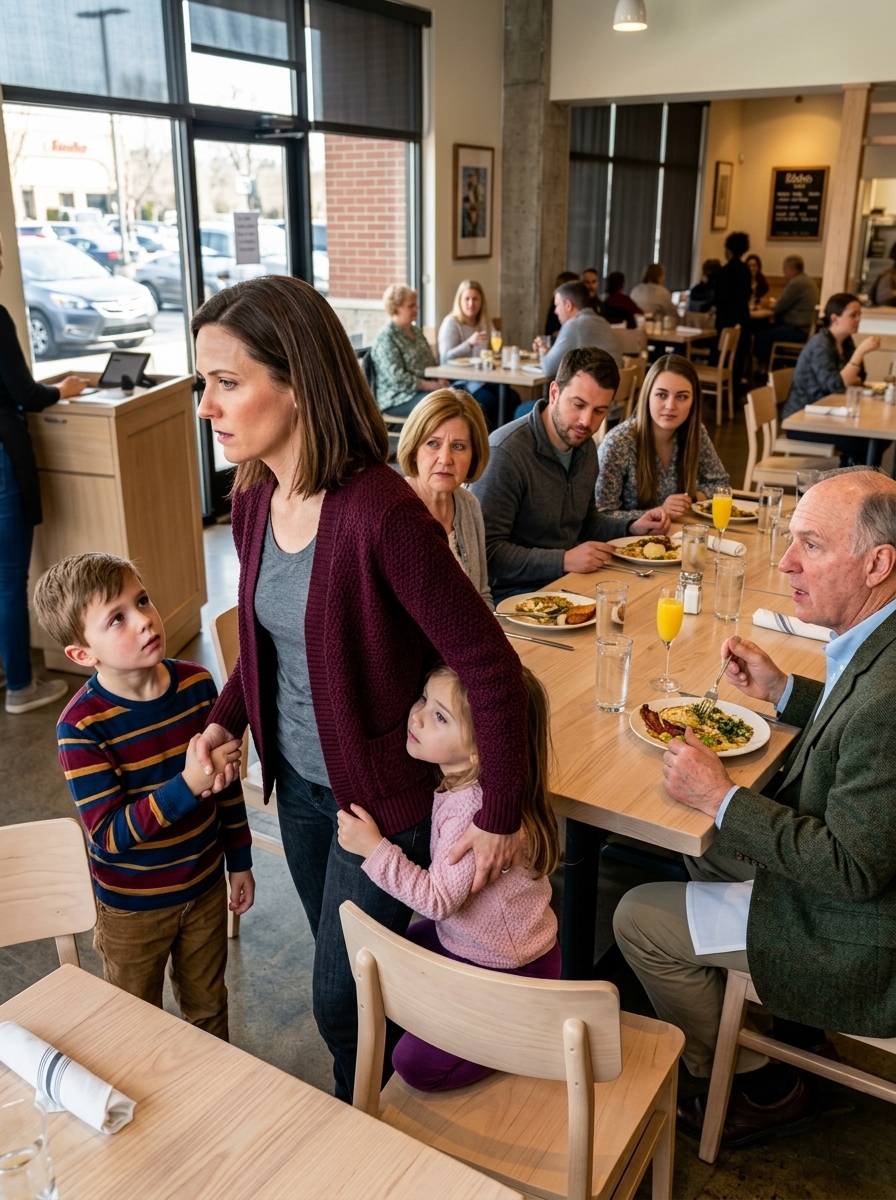
And yet my children had just been treated like unwanted strangers by the very people whose celebration I was financing.
I started the car.
We went somewhere else for brunch.
A small diner fifteen minutes away.
The server gave my daughter extra whipped cream on her pancakes.
My son ordered chocolate milk.
Nobody looked annoyed when we walked in.
Nobody acted like my children had ruined the atmosphere.
Advertisement
My son slowly became himself again.
By the time we left, both kids were laughing.
But I wasn’t.
Because the more normal that diner felt, the less normal my family’s behavior became.
We went home.
I gave the kids fruit later that afternoon.
They watched cartoons.
Shoes landed beside the front door.
Backpacks went on their hooks.
There were dishes in the sink.
Laundry waited upstairs.
Life continued in all its ordinary little ways while something inside me quietly changed shape.
Advertisement
My phone buzzed several times.
I ignored it until bedtime.
My mother had sent two messages.
“Dad shouldn’t have said that.”
Then twenty minutes later:
“You know how he is.”
That second message erased the first.
You know how he is.
The family motto.
The sentence that excused everything.
After baths, pajamas, and two bedtime stories, I sat at the kitchen table.
The house was quiet.
I opened the family group chat.
My stomach twisted.
At the top was a picture my mother had posted before we arrived.
Advertisement
Everyone was seated around the table.
Plates full.
Glasses raised.
My father was smiling.
Austin and his fiancée were leaning together.
My mother looked happy.
The photograph looked warm.
Perfect.
Complete.
My children and I were missing.
We were the interruption that came after the picture.
I stared at that image for a long time.
Then I opened my banking app.
I searched Austin’s name.
Transaction after transaction appeared.
Venue.
Bakery.
Band.
A smaller payment Austin had asked me to send for invitation printing.
Advertisement
Another transfer he promised he would repay after his annual bonus.
He never had.
I opened my email.
I found the contracts.
I read the payment schedules.
The next venue installment was due Monday.
Tomorrow.
The final band payment was due in three weeks.
Cake balance after that.
My name was not on the marriage license.
My name would not be announced at the reception.
But financially, I was carrying a terrifying portion of the wedding.
I took out a notebook and wrote everything down.
May you like

Texas Deputies Arrested the Wrong Woman—Then the Fingerprint Scanner Turned Red
Every dollar already paid.
Every future payment they expected.
Then I opened the family group chat again.
I typed slowly.
“I will not continue financing a celebration for people who can watch my children be humiliated and say nothing.”
I stopped.
Read it again.
Then continued.
“Austin, effective immediately, you and your fiancée are responsible for every remaining wedding expense. I will not make tomorrow’s venue payment. I will not pay the remaining bakery balance. I will not pay the band. Anything I have already paid will stay paid, but there will be no more money from me.”
Advertisement
My thumb hovered over Send.
For years, I would have deleted the message.
I would have imagined my mother crying.
My father getting angry.
Austin accusing me of ruining something.
Then I would have paid.
That was the version of me they knew.
She no longer existed.
I pressed Send.
The first reply came before I could lock my phone.
Austin.
“You can’t do this. The next venue payment is due tomorrow.”
I stared at the screen.
Then typed:
“I know.”
Advertisement
Three dots appeared immediately.
“You KNOW? Then what are we supposed to do?”
I answered:
“Pay it.”
His response came so fast I could practically hear him shouting.
“We don’t have that kind of money sitting around!”
I almost laughed.
That was the first time anyone in my family had admitted the obvious.
They had planned a wedding they could not afford because they assumed I would.
Austin called.
I declined.
He called again.
I declined again.
Then his fiancée entered the chat.
Advertisement
“This is incredibly unfair. Whatever happened at brunch has nothing to do with our wedding.”
I looked at those words.
Whatever happened.
As though my children had spilled juice.
As though my father hadn’t announced that their presence ruined the day.
I typed:
“You were sitting there.”
She replied:
“So?”
That one word did more damage than an entire paragraph could have.
So?
I took a screenshot.
Then I answered.
“So now you pay for your own cake.”
My phone exploded.
Advertisement
Austin called.
Mom called.
Austin again.
Dad called.
Mom again.
Then the messages started stacking faster than I could read them.
My mother wrote:
“Please don’t make a permanent decision because Dad made one stupid comment.”
I replied:
“This isn’t about one comment.”
Dad finally typed:
“Oh please. The kids probably forgot about it already.”
I stared at the message until my hands started shaking.
Then I wrote:
“My son asked me if he was unwanted.”
No response for almost a full minute.
Advertisement
Then Dad wrote:
“You’re teaching them to be oversensitive.”
That was it.
I muted the chat.
The next morning, Austin was at my front door at 7:12.
I knew because my doorbell camera alerted me.
He stood there in sweatpants and a jacket, pressing the bell repeatedly.
I didn’t open the door.
He called.
This time I answered.
“What?”
“Open the door.”
“No.”
“Are you serious?”
“Yes.”
“The payment is due today.”
“I remember.”
“You have to fix this.”
Advertisement
The sentence stunned me.
Not help.
Not reconsider.
Fix this.
Like I had broken something that belonged to him.
“I didn’t create your bill, Austin.”
“You agreed to pay.”
“I agreed to help my brother. I didn’t agree to bankroll people who treat my children like garbage.”
“This isn’t about the kids.”
“It is to me.”
He lowered his voice.
“You’re going to ruin my wedding over Dad making a joke?”
“It wasn’t a joke.”
“He says stupid things.”
“Then he can pay the venue.”
Advertisement
Austin went silent.
We both knew Dad wouldn’t.
Dad believed generosity was something other people owed him.
Austin tried another angle.
“You’ve already paid so much. Why stop now?”
That question told me everything.
He wasn’t asking because he valued what I had done.
He was asking because my past generosity had become evidence that he deserved more.
“Because I finally learned something,” I said.
“What?”
“That paying once does not obligate me to pay forever.”
Then I hung up.
Advertisement
The venue deadline passed.
At 4:18 that afternoon, Austin texted that he and his fiancée had emptied part of their savings and used a credit card to make the payment.
He added:
“I hope you’re happy.”
I didn’t respond.
Apparently paying for your own wedding was now something done to you by another person.
The next several days became a campaign.
My mother called it reconciliation.
It wasn’t.
It was pressure.
She came to my house Wednesday evening without asking.
Advertisement
I opened the door but did not invite her in.
She immediately started crying.
“Your brother is falling apart.”
“What happened?”
“You know what happened.”
“He had to pay his bill?”
She flinched.
“Why are you being like this?”
There it was.
Not why was Dad cruel?
Not why didn’t anyone defend the kids?
Why are you being like this?
I folded my arms.
“Did Dad apologize to my son?”
Mom looked away.
“He doesn’t think talking to a child about adult conflict is appropriate.”
“There was no adult conflict until he created one.”
“He was irritated.”
“At children?”
“At the situation.”
“What situation?”
She couldn’t answer.
Because there hadn’t been one.
We had walked into a restaurant at the time we were invited to arrive.
That was the situation.
Mom sighed.
“He feels like you’re always judging him.”
“I didn’t say anything to him.”
“You walked out.”
“My son asked if he was unwanted.”
“He’s sensitive.”
I felt my jaw tighten.
“No. He’s observant.”
Mom’s expression changed.
“You’ve become very hard.”
“No. I stopped volunteering to be hurt.”
She started crying again.
Usually, that would have worked.
I would have softened.
Invited her inside.
Made coffee.
Ended up comforting the person who came to pressure me.
This time, I waited.
Eventually she said, “The band wants the final balance soon.”
“I know.”
“You’re really not paying?”
“No.”
“What are they supposed to do?”
I looked at her.
“Why does everyone keep asking me that?”
“Because you’re his sister.”
“And he’s my brother.”
“Yes.”
“Then why doesn’t that relationship require anything from him?”
Mom stared at me.
I continued.
“I’m his sister when he needs a venue deposit. I’m his sister when he wants an expensive cake. I’m his sister when the band costs more than he expected. But apparently I’m nobody when Dad humiliates my children.”
“That’s not fair.”
“It’s exactly fair.”
She left ten minutes later.
Friday afternoon, I received an email from the bakery.
It wasn’t threatening.
It was professional.
They were confirming the due date for the remaining balance.
My email had been listed as the payment contact.
I forwarded it to Austin.
That was all.
He replied:
“You’re enjoying this.”
I wrote:
“No. I’m just no longer preventing you from experiencing your own expenses.”
He didn’t answer.
The wedding plans began changing almost immediately.
The upgraded lighting disappeared.
The premium linens disappeared.
Austin canceled the late-night food station.
His fiancée sold several decorations she had already purchased.
They reduced the number of specialty cocktails.
Then came the cake.
The famous four-tier cake with imported sugar flowers became three tiers.
Apparently the wedding would survive.
That revelation did not improve Austin’s mood.
He told relatives I had “pulled funding at the last minute.”
What he didn’t mention was why.
So when an aunt called to tell me I was being cruel, I asked one question.
“What did Austin tell you happened at brunch?”
Silence.
Then:
“He said there was an argument.”
“There was no argument.”
I told her exactly what Dad said.
I told her exactly what my son asked.
I told her nobody defended them.
Her tone changed.
“Oh.”
“Yes.”
“I didn’t know that.”
“I know.”
That pattern repeated three times.
Each person had been given a version where I suddenly became unstable over “family tension.”
Each person changed their tone when they heard what actually happened.
Eventually Austin stopped recruiting relatives.
Then, one week before the wedding, my mother asked me to come to her house.
She said Dad wanted to “put everything behind us.”
I almost refused.
But there was one thing I wanted to know.
Could he look me in the face and understand what he had done?
So I went.
Alone.
The moment I walked into the living room, I knew it was not an apology.
Austin and his fiancée were already there.
Dad was sitting in his chair.
Mom stood beside the fireplace.
It was an ambush disguised as reconciliation.
Dad spoke first.
“This has gone far enough.”
I almost smiled.
Of course that was his opening.
Not I’m sorry.
Not I hurt my grandson.
This has gone far enough.
I remained standing.
He continued.
“Austin is getting married. Families are supposed to come together during events like this.”
I looked around the room.
“That’s interesting.”
His eyes narrowed.
“What’s that supposed to mean?”
“It means family suddenly matters a lot when somebody needs my money.”
Austin stood.
“For God’s sake, this is not about your money.”
“Then why am I here?”
Nobody answered.
His fiancée finally spoke.
“We need to know whether you’re paying the band.”
I actually laughed.
I couldn’t help it.
It came out once.
Short.
Disbelieving.
Dad’s face went red.
“You think this is funny?”
“I think it’s clarifying.”
Mom stepped forward.
“Can we please calm down?”
“I am calm.”
Austin pointed at me.
“You promised.”
“I changed my mind.”
“Because Dad insulted you.”
“No.”
My voice sharpened for the first time.
“Because Dad humiliated my children and every adult at that table decided keeping him comfortable mattered more than protecting them.”
Dad leaned forward.
“Oh, stop using your kids as a weapon.”
Everything inside me froze.
I looked directly at him.
“My children are not weapons.”
“You know what I mean.”
“No. Explain it.”
He opened his mouth.
Nothing came out.
I stepped closer.
“My son asked if he was unwanted, Dad. You heard him.”
He looked away.
“You could have corrected it immediately. You could have said, ‘Of course you’re wanted. Grandpa said something stupid.’”
Silence.
“You didn’t.”
Dad’s jaw tightened.
“You walked away before anyone could say anything.”
“No. I waited long enough.”
Mom whispered my name.
I turned toward her.
“You didn’t say anything either.”
Her eyes filled.
“I froze.”
“You always freeze when Dad hurts me.”
“That’s not true.”
“It is. And I accepted it when it was me. I won’t accept it for them.”
Austin threw his hands up.
“So what do you want? Dad to get on his knees?”
“No.”
“What, then?”
I thought about it.
And realized the answer was simple.
“Nothing.”
That confused them.
Austin stared.
“What do you mean, nothing?”
“I don’t need anything from any of you anymore.”
Dad scoffed.
“Then why are you still punishing everybody?”
“I’m not punishing you.”
I looked at Austin.
“You’re paying for your own wedding.”
Then at Dad.
“You’re experiencing the consequences of speaking to my children that way.”
Then at Mom.
“And you’re experiencing what happens when you stay silent long enough that silence becomes a choice.”
The room went quiet.
Austin’s fiancée crossed her arms.
“So you’re still coming to the wedding?”
That question surprised me.
I hadn’t decided.
Then Austin said, “Of course she’s coming. She already bought the kids’ clothes.”
Not I want my sister there.
Not I want my niece and nephew there.
She already bought the clothes.
That made the decision for me.
“No.”
Austin blinked.
“What?”
“We won’t be attending.”
Mom gasped.
“You can’t mean that.”
“I do.”
Austin’s face turned dark.
“You’re skipping my wedding?”
“I’m keeping my children away from people who make them feel unwanted.”
“This is ridiculous.”
“No. This is finished.”
I left.
The wedding happened the following Saturday.
I know because my phone started buzzing around noon.
Pictures appeared online.
The lake glittered behind the venue.
The ballroom still looked beautiful.
The flowers were beautiful.
The smaller cake was beautiful.
The world did not end because I stopped paying.
My kids and I spent the day at an indoor water park two towns over.
It hadn’t been planned as revenge.
I just didn’t want us sitting at home thinking about where we weren’t.
My daughter went down the same slide eleven times.
My son finally worked up the courage to jump from the diving platform.
The first time he surfaced, he looked for me.
I was standing exactly where I promised I would be.
He grinned.
That smile was worth more than every dollar I had put toward Austin’s wedding.
Late that evening, after the kids fell asleep in the car on the drive home, I checked my phone.
There were twenty-three unread messages.
Most were photographs.
A few relatives sent polite notes saying the wedding had gone well.
Then I saw the family group chat.
Austin had posted:
“Hope making your point was worth missing your brother’s wedding.”
I stared at it.
Before I could decide whether to respond, Dad added:
“Some people care more about pride than family.”
Mom wrote nothing.
Austin’s fiancée added a heart emoji under Dad’s message.
Six months earlier, that would have destroyed me.
I would have typed paragraphs.
Defended myself.
Explained myself.
Begged them to acknowledge my side.
Instead, I placed my phone on the counter and carried my sleeping daughter upstairs.
Then I came back for my son.
As I tucked the blanket beneath his chin, he opened his eyes.
“Mom?”
“Yeah?”
“Did Uncle Austin get married today?”
“Yes.”
“Were you sad we didn’t go?”
The question surprised me.
I sat on the edge of his bed.
“A little.”
He thought about that.
Then he asked, “Did Grandpa want us there?”
I could have lied.
Maybe the old version of me would have.
But children deserve truth delivered gently.
“I think Grandpa has some things he needs to learn about how he treats people.”
My son nodded sleepily.
Then he said something I will never forget.
“I liked today better.”
I swallowed.
“So did I.”
After both kids were asleep, I returned downstairs.
The family chat had continued without me.
Dad wrote that I was “tearing the family apart.”
Austin said he didn’t know whether he could ever forgive me.
My mother finally sent:
“Can everyone please stop?”
Then Austin posted something that caught my attention.
“For the record, she offered to pay. Nobody forced her.”
I stared at those words.
He was right.
Nobody had put a gun to my head.
Nobody had stolen my card.
The truth was more uncomfortable.
They had trained me.
Slowly.
For years.
Every time I solved a problem, another one appeared.
Every time I paid, gratitude lasted less time.
Every sacrifice became precedent.
Being dependable had slowly turned into being available for exploitation.
And I had helped create that pattern by never stopping it.
So I finally replied.
One message.
“You’re right, Austin. I offered to help. And you taught me the difference between helping someone and being taken for granted. I hope you had a beautiful wedding. I genuinely mean that. But my financial involvement in this family ends here.”
Dad immediately started typing.
I wasn’t finished.
“And because this apparently still needs to be said: my children will never again sit at a table where they are treated like their presence ruins the day. Anyone who wants a relationship with them will treat them with kindness. That is not revenge. That is the minimum.”
I sent it.
Then I left the group chat.
My mother called the next morning.
I almost didn’t answer.
But I did.
Her voice was quiet.
“Your father is furious.”
“I assumed.”
“Austin is too.”
“I assumed that too.”
She paused.
Then she said something I had never heard from her before.
“I should have said something at brunch.”
I sat down.
“Yes.”
“When your son asked if he was unwanted… I should have answered.”
“Yes.”
“I kept thinking your father would realize how bad it sounded.”
“He didn’t.”
“No.”
Another pause.
“I’m sorry.”
There were no excuses after it.
No “but.”
No “you know how he is.”
Just the words.
I’m sorry.
For the first time in a long time, I believed her.
“That’s a start,” I said.
Not forgiveness.
Not restoration.
A start.
Dad never apologized.
Not then.
Not properly.
For weeks, he sent messages through Mom.
He said I was holding a grudge.
He said modern parents made children too fragile.
He said nobody could joke anymore.
I didn’t argue.
I had finally learned that not every accusation deserves a defense.
Austin barely spoke to me.
That was painful.
He was still my brother.
I still remembered him at ten years old following me around the house.
I remembered teaching him to drive.
I remembered sitting beside him in the emergency room when he broke his wrist.
Love doesn’t disappear just because someone disappoints you.
But love also doesn’t require unlimited access to your wallet.
Three months after the wedding, Austin called.
No greeting.
He said, “Can I ask you something?”
“You just did.”
He sighed.
Then, unexpectedly, laughed.
A little.
It was the first normal sound between us in months.
“I got the credit card statement.”
“I’m sorry.”
“No, you’re not.”
“I’m sorry credit card interest exists.”
Another short laugh.
Then silence.
Finally he said, “I didn’t realize how much you were paying.”
I leaned against the kitchen counter.
“You had the invoices.”
“I never added it all up.”
Of course he hadn’t.
He didn’t need to.
I had.
He continued.
“When we had to start covering everything ourselves, we cut almost twelve thousand dollars.”
I closed my eyes briefly.
Twelve thousand.
Money I would have spent simply because nobody had been forced to question whether those upgrades mattered.
Austin spoke again.
“I think I got used to you fixing things.”
“Yes.”
“That doesn’t mean what Dad said was okay.”
“No.”
“I should have said something.”
“Yes.”
He exhaled.
“You’re really making me work for this apology.”
“I’m letting you finish it.”
Another silence.
Then he said, “I’m sorry.”
My throat tightened.
Not because it fixed everything.
It didn’t.
But accountability sounded different when nobody had to drag it out of someone.
“I’m sorry I sat there,” he continued. “I’m sorry I acted like the wedding mattered more afterward. And I’m sorry I made it sound like you owed me the rest of the money.”
“Thank you.”
“I don’t know if the kids even want to see me.”
“That will be their choice.”
“I understand.”
And for once, I thought he actually did.
Things didn’t magically return to normal.
I didn’t want them to.
Normal had been the problem.
We built something different.
Slowly.
Austin started visiting occasionally without asking me for anything.
My mother began seeing the children separately from Dad.
Dad remained stubborn.
For a while, he seemed convinced everyone else would eventually pressure me into pretending nothing happened.
Nobody did.
Because once I stopped holding the family’s emotional and financial structure together, everybody had to start carrying their own weight.
Then, several months after the brunch, my mother asked if she could take the kids for ice cream.
I said yes.
When she brought them home, my son ran inside holding a paper bag of candy.
My daughter followed him.
Mom stayed on the porch.
“There’s something I need to tell you.”
“What?”
“Your father asked why he never sees them anymore.”
I waited.
“I told him.”
My eyebrows lifted.
“Told him what?”
“That they don’t come over because he never apologized.”
For perhaps the first time in my life, my mother had confronted my father without asking me to absorb the consequences.
“What did he say?”
“He got angry.”
I nodded.
“Then he got quiet.”
That surprised me.
Mom looked toward the driveway.
“He asked what he was supposed to say.”
I almost laughed.
“The truth would work.”
“I told him that.”
I looked at her.
She gave a tiny smile.
Progress.
Two days later, Dad called.
I almost let it go to voicemail.
Then I answered.
“Hello?”
He cleared his throat.
For several seconds, neither of us spoke.
Finally he said, “Your mother says I owe your son an apology.”
There were a thousand possible responses.
I chose the simplest.
“You do.”
Another silence.
“I shouldn’t have said what I said.”
“No.”
“I was in a bad mood.”
I said nothing.
He seemed to realize the explanation wasn’t helping.
Then his voice changed.
“I made him think I didn’t want him there.”
“Yes.”
“That wasn’t true.”
“Then tell him.”
Dad hesitated.
“Can I?”
I looked through the kitchen doorway.
My son was on the living room floor building something from blocks.
My daughter was beside him, organizing pieces by size.
“You can ask him.”
Dad came over the following Sunday.
He stood awkwardly in my living room.
No grand speech.
No flowers.
No audience.
My son stayed close to me.
Dad crouched.
“I said something mean at brunch.”
My son watched him.
Dad continued.
“You asked your mom if you weren’t wanted.”
My son nodded.
Dad swallowed.
“You were wanted. I was wrong. I’m sorry.”
My son looked at me.
I let him decide.
After a few seconds, he said, “Okay.”
Then went back to his blocks.
That was it.
Children can sometimes accept a sincere apology more cleanly than adults can.
Dad stood.
He looked strangely smaller.
Maybe because for once, nobody had rescued him from the discomfort of admitting he was wrong.
Before he left, he looked at me.
“I’m sorry to you too.”
I nodded.
“Thank you.”
I didn’t hug him.
I didn’t announce that everything was forgiven.
Some wounds don’t need dramatic endings.
They need changed behavior.
Time would determine whether his apology meant anything.
But something else had already changed permanently.
Me.
I no longer believed peace meant preventing other people from experiencing consequences.
I no longer believed being a good daughter meant funding disrespect.
I no longer believed family loyalty required my children to endure the same things I had spent my childhood learning to tolerate.
That Sunday brunch cost my family far more than anyone expected.
Austin had to pay for his own wedding.
My parents had to confront years of behavior they preferred to ignore.
And I had to confront the hardest truth of all.
Nobody had forced me to keep saying yes.
I had simply been afraid of what would happen if I finally said no.
Then I said it.
The family survived.
The wedding survived.
Austin survived his credit card bill.
My father survived apologizing.
And my children learned something I wish I had learned much younger.
Being related to someone does not give them permission to make you feel unwanted.
A beautiful table is not worth sitting at if your presence is treated like a burden.
And sometimes walking away quietly sends a louder message than any argument ever could.
The morning after Dad finally apologized, I opened my banking app.
For months, I had avoided looking at the total I spent on Austin’s wedding because it irritated me.
This time I looked.
Then I looked at my savings.
At the money that had stayed there after I stopped making everyone else’s problems mine.
I opened a new savings account.
I named it after my children.
Then I set up an automatic transfer.
The amount was almost identical to what I had once been sending toward Austin’s wedding expenses.
Only now it was going somewhere that actually mattered to me.
A few minutes later, my son wandered into the kitchen.
His hair was messy.
His pajamas were crooked.
He climbed onto a chair.
“Mom?”
“Yes?”
“Are we having pancakes?”
I smiled.
“Absolutely.”
My daughter appeared behind him.
“With whipped cream?”
“Obviously.”
I started pulling ingredients from the cabinet.
Nobody was dressed nicely.
There were no champagne glasses.
No perfect lake view.
No expensive centerpiece.
No family photograph designed to prove how happy we were.
Just three people in a messy kitchen on a quiet Sunday morning.
My son started laughing because his sister spilled flour across the counter.
She yelled that he had done it.
He insisted she had.
I looked at them both.
And I thought about that restaurant.
The long table.
My father’s voice.
This day was going fine until now.
For years, words like that would have followed me home.
I would have spent days wondering what I could have done differently.
Arrived earlier.
Spoken softer.
Tried harder.
Given more.
Now I finally understood.
There had never been anything wrong with us walking through that door.
The problem was that I had spent too many years sitting at tables where people benefited from my presence while acting burdened by it.
That was over.
My phone buzzed on the counter.
A message from Austin.
A picture.
He and his wife were eating breakfast at home.
Burnt toast.
Two mugs of coffee.
No lakefront ballroom.
No custom cake.
No live band.
Under the picture, he had written:
“Turns out married life is cheaper after the wedding.”
I laughed.
Then another message appeared.
“And for what it’s worth, I’m glad you made me pay the rest myself.”
I raised an eyebrow.
A third message arrived.
“Okay, ‘glad’ might be too strong. But I understand now.”
I typed back:
“That sounds more believable.”
He sent a laughing emoji.
Then:
“Can I take the kids for pizza next weekend?”
I looked toward the kitchen table.
My son and daughter were arguing about who got the pancake shaped most like a dinosaur.
For once, a family request didn’t feel like an obligation.
It felt like a question.
A real question.
One I was allowed to answer.
I walked over to the kids.
“Uncle Austin wants to know if you’d like pizza with him next weekend.”
My daughter shouted yes immediately.
My son thought about it.
Then nodded.
“Can we get the big cookie too?”
“I’ll tell him that’s part of the deal.”
My son smiled.
And that was when I realized the most important thing had never been canceling wedding payments.
It wasn’t the exploding group chat.
It wasn’t watching Austin learn the real price of his own wedding.
It wasn’t even hearing my father finally apologize.
It was this.
My children had watched me choose them.
When a room made them feel unwanted, I took them somewhere they were welcome.
When adults dismissed their pain, I believed them.
When keeping the peace required sacrificing their dignity, I stopped keeping the peace.
Maybe years from now they won’t remember the restaurant.
Maybe my daughter will forget the way she clung to my sweater.
Maybe my son won’t remember asking me whether we were unwanted.
I hope they forget.
But I hope they remember what happened next.
Their mother took their hands.
She walked them out.
And she never again paid the price of admission to a family that expected her children to feel grateful just for being tolerated.