I pressed a hand over my mouth.
That was exactly what he used to say.
The assistant continued.
“He kept pictures of both of you inside one of his cases. Every few months, I’d see him writing letters between jobs.”
My voice barely came out.
“Letters to us?”
She nodded.
“He said he kept getting them back.”
Hannah started crying.
Not loudly.
Just silently, tears rolling down her face while she stood in her wedding dress.
I looked toward the hallway.
Advertisement
Our mother was somewhere inside the ballroom.
All afternoon, she had been telling guests the story she had repeated for most of our lives.
How hard it had been raising two daughters alone.
How our father had disappeared.
How she had learned not to depend on anyone.
How she had “done the job of two parents.”
People had hugged her.
Praised her.
Called her strong.
Now I was standing beside my sister’s wedding flowers holding a message from the man she had taught us to hate.
Advertisement
The assistant suddenly seemed to remember something.
Her expression changed.
“There’s more.”
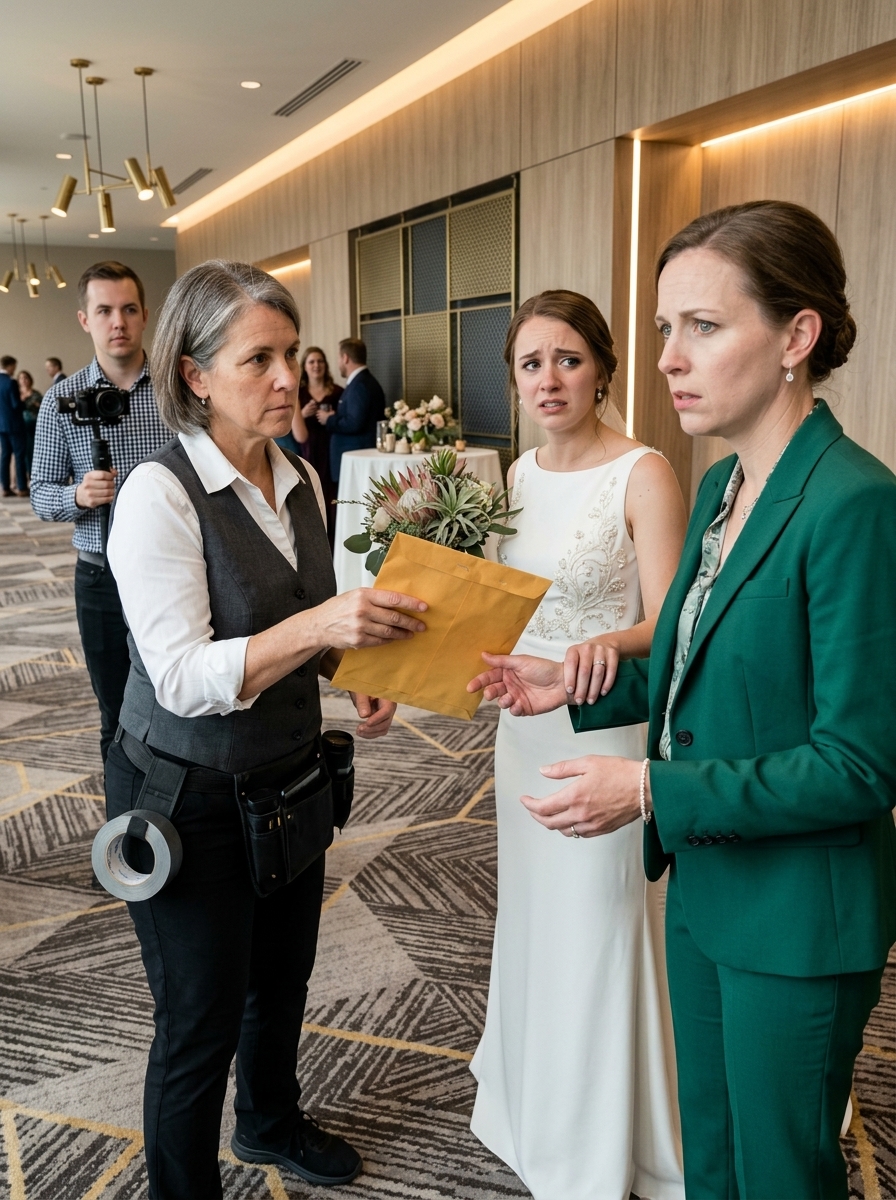
She crossed to a battered black equipment case and opened the side compartment.
Then she pulled out a thick stack of envelopes held together with an old rubber band.
My name was on the first one.
Hannah’s was on the second.
Then mine again.
Different years.
Different stamps.
Different levels of faded ink.
Same handwriting.
Dad’s.
Every envelope had been returned unopened.
My legs went weak.
Hannah caught me.
Advertisement
The photographer pulled over a chair.
I didn’t sit.
I couldn’t.
I counted the envelopes.
Then counted again.
Twenty-three.
Twenty-three letters.
Not one forgotten birthday card.
Not one desperate attempt made after years of silence.
Twenty-three separate attempts.
The assistant explained that the letters had been found in a cardboard box packed with the old lighting equipment. The photographer had bought the kit almost a year earlier and nearly discarded the envelopes because they looked personal.
She had stopped him.
Advertisement
“I recognized the handwriting,” she said.
“Why didn’t you contact us?”
“I didn’t know where you were.”
She looked toward Hannah.
“Then I saw the wedding schedule.”
Hannah’s name.
Our mother’s name.
Mine listed under maid of honor.
The assistant had wondered if it could possibly be the same family.
Then the old photograph appeared.
Hannah looked down at the blue envelope.
“I found this in my mailbox three weeks ago.”
I looked at her.
“You never told me.”
“I didn’t know what it meant.”
Advertisement
“You recognized the handwriting.”
“Yes.”
“And you still didn’t tell me?”
Her chin trembled.
“I was scared.”
“Of what?”
“Of ruining everything.”
She glanced toward the ballroom.
“Mom has spent our whole lives saying he abandoned us. Then this showed up. I thought maybe someone was playing some horrible joke. I wanted to wait until after the wedding so we could investigate together.”
I wanted to be angry.
But Hannah looked terrified.
And suddenly I understood.
Because I was terrified too.
Advertisement
The assistant removed the rubber band.
She carefully separated the oldest envelope.
The front had yellowed.
The stamp was nearly faded.
My childhood address was written clearly.
The same little house where we had lived for three more years after Dad supposedly disappeared.
The assistant handed it to me.
“Open it.”
I stared at the envelope.
For twenty years, I had imagined what I would say if I ever saw my father again.
I had imagined screaming at him.
Asking why I wasn’t worth staying for.
Advertisement
Asking why he had missed my graduation.
Why he never taught me to drive.
Why he wasn’t there when I turned sixteen.
Why he didn’t know about my first apartment.
My first serious relationship.
My broken engagement.
My promotion.
The night I sat in an emergency room alone because Mom was out of state and Hannah was at college.
I had spent years being angry at a man who wasn’t there.
Now I was holding proof that maybe he had been trying to reach me the entire time.
May you like

My finger slid beneath the flap.
The paper inside had been folded twice.
The date at the top made my heart stop.
It was written six weeks after Dad “left.”
Birdie,
I came to the house again today.
Your mother would not let me see you.
She says you don’t want to talk to me.
I don’t believe that.
Maybe I’m wrong, but I don’t believe it.
I left your birthday present with Mrs. Campbell next door because I was afraid your mother would throw it away.
Advertisement
I am trying to get the court to give me regular weekends with you and Hannah.
None of this is your fault.
None of it.
I did not leave you.
I need you to remember that.
I love you bigger than the sky.
Dad.
I stopped reading.
The paper shook violently between my fingers.
Mrs. Campbell.
I remembered Mrs. Campbell.
She lived beside us until I was eleven.
And suddenly a memory surfaced.
A red bicycle.
I had wanted one desperately for my tenth birthday.
Advertisement
Two days after my birthday, Mrs. Campbell had tried to speak to Mom on the front porch.
Mom had come inside furious.
Later that night, I saw a red bicycle in the back of Mrs. Campbell’s garage.
I had assumed it belonged to her grandson.
I looked at Hannah.
“He bought me the bicycle.”
She stared at me.
“What bicycle?”
“The red one.”
My voice cracked.
“I think Dad bought it.”
I grabbed another envelope.
Then another.
One was addressed to Hannah.
Advertisement
Her seventh birthday.
Sweet Hannah,
I saw your school picture.
You lost your front tooth.
I wish I had been there when it happened.
Did Birdie make fun of you?
If she did, tell her Dad says she owes you one ice cream.
I sent money for both of your school clothes.
Please tell me if you didn’t receive it.
I love you.
Dad.
Hannah made a sound I had never heard before.
Half sob.
Half gasp.
“I didn’t get anything.”
Advertisement
Neither had I.
The third letter had been returned with a postal sticker.
REFUSED.
The fourth had the same marking.
The fifth said RETURN TO SENDER.
The sixth had handwriting across the front.
NOT AT THIS ADDRESS.
I knew that handwriting too.
Not Dad’s.
Mom’s.
I felt something inside me turn cold.
“We lived there.”
Hannah looked at the envelope.
“What?”
“When this was sent, we still lived there.”
I checked the date.
We had lived in that house for almost two more years.
Advertisement
Mom had written NOT AT THIS ADDRESS.
She had sent it back.
Deliberately.
Hannah whispered, “Oh my God.”
A voice sounded behind us.
“What are you doing?”
I froze.
Mom stood at the end of the hallway.
She was wearing the dark blue dress Hannah had chosen for her months earlier.
A corsage rested on her wrist.
Her makeup was perfect.
Her smile was gone.
She looked at me.
Then Hannah.
Then the letters.
And I watched recognition flash across her face.
Advertisement
Not confusion.
Recognition.
She knew exactly what they were.
“Where did you get those?”
I heard Hannah inhale sharply.
Mom stepped closer.
“Give them to me.”
I almost laughed.
Not because anything was funny.
Because after twenty years of believing I had been abandoned, my mother’s first instinct wasn’t to ask what we had discovered.
It was to take the evidence.
“No.”
Her expression hardened.
“This is Hannah’s wedding.”
“I know.”
“You are not doing this today.”
“I’m not doing anything.”
Advertisement
I held up the letter.
“He did.”
Mom glanced toward the assistant.
Then the photographer.
Her face tightened.
“You have no idea what you’re talking about.”
“Then explain it.”
“Not here.”
“Why does this envelope say ‘refused’?”
“Lower your voice.”
“Why did you write ‘not at this address’ when we still lived there?”
Hannah stepped beside me.
“Mom.”
Her voice was shaking.
“Did Dad send these?”
Mom closed her eyes.
Only for a second.
But it was enough.
Hannah’s face crumpled.
Advertisement
“You knew.”
Mom opened her eyes.
“It was complicated.”
Three words.
After twenty years.
It was complicated.
I laughed again.
This time I could hear the anger in it.
“You told us he abandoned us.”
“He did abandon the marriage.”
“That isn’t what I asked.”
“You were children.”
“That isn’t what I asked.”
People were beginning to glance down the hallway.
The photographer quietly closed the ballroom door.
Mom noticed.
Her shoulders dropped.
And for the first time in my life, she looked cornered.
Advertisement
“He hurt me,” she said.
I waited.
“How?”
“He wanted the divorce.”
My chest tightened.
“That’s why?”
“No.”
She rubbed her forehead.
“It wasn’t that simple.”
“Then make it simple.”
She looked at me.
“We fought constantly. He was never home. Weddings, parties, events. Every weekend there was another job. I was tired of being alone.”
That might have explained a failed marriage.
It did not explain twenty-three returned letters.
Hannah seemed to realize the same thing.
“So you stopped him from seeing us?”
“I was angry.”
“For twenty years?”
“I thought it was better if there was a clean break.”
I felt like she had slapped me.
“A clean break?”
“You were both devastated every time he promised to come.”
“Did he promise?”
Silence.
“Mom.”
I stepped closer.
“Did he promise to visit and then not show up?”
She said nothing.
Suddenly, another childhood memory rearranged itself.
Friday afternoons.
Mom telling me not to get excited.
“He probably won’t come.”
Then later:
“See? I told you.”
But what if Dad had come?
What if he had been outside?
What if she had simply never opened the door?
I grabbed another letter.
This one was thicker.
Inside was a photocopy of a court document.
Petition for visitation.
My father’s name at the bottom.
Dates.
Requests.
Multiple attempts.
A handwritten paragraph underneath.
Birdie and Hannah,
I went back to court today.
Your mother says seeing me is confusing you.
I don’t want to hurt either of you, so I am trying to do this the right way.
Please believe me when I say I am trying.
One day, if you ever read these, maybe you’ll know the truth.
I looked at Mom.
“You told us he never fought for us.”
Her mouth trembled.
“I thought I was protecting you.”
“From what?”
“From hoping.”
Hannah wiped tears from her cheeks.
“You taught us to hate him so we wouldn’t hope?”
Mom flinched.
“I was thirty-two years old. I was furious. I was scared. I had two children and no idea what my life was going to look like.”
For the first time, I could see something other than defensiveness in her face.
Shame.
But shame did not erase consequences.
“You could have told us later.”
“I know.”
“When we were twelve.”
“I know.”
“When we were eighteen.”
“I know.”
“When Hannah asked you if Dad knew about her graduation.”
Mom began crying.
“I know.”
“When I asked if he had ever sent a birthday card.”
“I know.”
My voice broke.
“When I spent years wondering what was wrong with me.”
Mom looked at me.
Nothing came out.
That silence answered more than words could.
I turned away before I said something I could never take back.
The assistant quietly approached us.
“There’s something else you should know.”
Mom stiffened.
The assistant looked at Hannah and me.
“Your father stopped working weddings with me about twelve years ago, but I ran into him occasionally.”
“When was the last time?” I asked.
“About eighteen months ago.”
My heart kicked.
“He’s alive?”
The assistant stared at me.
“Yes.”
The word nearly knocked the air from my lungs.
Alive.
Not a memory.
Not a grave.
Not someone I could only confront inside my imagination.
My father was alive.
“Where?”
“I don’t know exactly.”
She looked toward the equipment case.
“But the photographer bought this kit from him directly.”
Every head turned toward the photographer.
He looked suddenly uncomfortable.
“I didn’t realize the connection until today.”
“Do you have his number?”
“I might.”
Mom whispered my name.
I didn’t look at her.
The photographer pulled out his phone.
He searched old messages.
My heartbeat became so loud I could barely hear anything else.
Finally, he stopped scrolling.
“I have a number.”
Hannah grabbed my hand.
“Call it.”
Mom stepped forward.
“Hannah.”
My sister turned.
She was still wearing her veil.
Mascara had begun smudging beneath her eyes.
But her voice was steady.
“No.”
Mom froze.
“For once,” Hannah said, “you don’t get to decide whether we speak to him.”
The photographer pressed the number.
Speakerphone.
One ring.
Two.
Three.
Four.
Voicemail.
My body sagged.
Then the assistant said, “Try again.”
He did.
This time someone answered on the fifth ring.
“Hello?”
I forgot how to breathe.
Older.
Rougher.
But I knew the voice.
A voice can change over twenty years.
It can become slower.
Deeper.
More tired.
But some sounds live inside you.
I was nine years old again.
Sitting on a pickup tailgate.
Refusing to smile.
Hearing someone laugh behind a camera.
The photographer swallowed.
“Sir, this is going to sound strange. I bought some photography equipment from you last year.”
There was a pause.
“Yes?”
“One of your old lights broke today.”
Another pause.
“And there was writing underneath the casing.”
Silence.
The photographer looked at me.
I nodded.
He continued.
“It said, ‘Birdie — I never stopped looking.’”
Nothing came through the speaker.
For several seconds, I thought the call had disconnected.
Then I heard a breath.
Sharp.
Shaking.
“Where are you?”
The photographer gave the venue name.
The man on the phone stopped breathing again.
Then he whispered something.
“Hannah’s wedding?”
My sister began crying.
Dad knew.
He knew today was her wedding.
I leaned closer to the phone.
“How did you know?”
Silence.
Then:
“Birdie?”
My knees buckled.
Hannah caught me.
No one else had called me that in more than twenty years.
My throat closed.
“Yeah.”
On the other end of the phone, my father started crying.
Not quietly.
Not politely.
The sound ripped straight through me.
“Oh, God.”
I pressed my fist against my mouth.
“Birdie.”
I hated him.
I loved him.
I didn’t know him.
I remembered him.
All of those things existed at once.
“Why didn’t you find us?”
The question came out harder than I intended.
Dad was silent.
Then he said, “I tried.”
I looked at the stack of letters.
“I know that now.”
“I tried for years.”
“Why did you stop?”
That silence lasted longer.
“Because I was told you wanted me to.”
I looked at Mom.
Her face drained.
“What?”
Dad continued.
“I received a letter when you were fifteen.”
My mother closed her eyes.
“A letter from who?”
“From you.”
My skin went cold.
“I never wrote you a letter.”
Mom’s knees nearly gave way.
That was when I knew.
Before Dad even explained.
Before Hannah turned toward her.
Before anyone said another word.
I knew.
Dad’s voice shook through the speaker.
“It said you remembered everything. It said you knew why the marriage ended. You wrote that you hated me and wanted me to stop contacting you. You asked me to leave Hannah alone too.”
“I never wrote that.”
“I know that now.”
My eyes locked onto Mom.
“Did you?”
She covered her mouth.
Hannah stared at her.
“Mom.”
No answer.
“Did you write that letter?”
Mom began sobbing.
“I wanted it to stop.”
Something inside me broke.
“You forged a letter from me?”
“I was afraid he would take you.”
“He was our father!”
“You were my daughters!”
“And we were his too!”
My voice echoed down the hallway.
Nobody tried to quiet me.
Dad spoke through the phone.
“I believed it.”
I closed my eyes.
“I thought maybe I had damaged you by continuing to push. I thought every letter I sent was reopening something you wanted closed.”
“So you stopped?”
“For a while.”
I looked at the stack.
There were later envelopes.
“You started again.”
“Yes.”
“Why?”
“Because fathers don’t stop wondering whether their children are okay.”
I couldn’t speak.
He continued.
“I wrote on birthdays. Christmas. Graduations I only guessed at. When social media became something everyone used, I searched there. Your mother had changed your last names for school records for a while. You both moved. Hannah used a shortened name online. You had almost nothing public.”
I remembered Mom insisting we use her maiden name after the divorce.
Another detail that had seemed ordinary.
Until now.
“How did you find Hannah?”
“A wedding registry.”
Hannah gasped.
Dad gave a broken laugh.
“I searched both of you every few months. Then one night her name appeared beside the venue.”
“And the photograph?”
“I sent it.”
“Why didn’t you include your number?”
“Because I didn’t know whether the letter from you had been real.”
My chest tightened.
“I wanted Hannah to have a choice.”
The sentence destroyed me.
A choice.
The thing our mother had taken from us.
Dad continued.
“I thought if she recognized the photograph, she could decide whether to respond. I wrote that the letters had been sent back because I needed you both to know one thing before deciding whether I deserved to be in your lives.”
“What?”
“That silence wasn’t my choice.”
Nobody spoke.
The reception music started faintly through the doors.
Hannah looked toward the ballroom.
More than a hundred guests were waiting.
Her new husband was somewhere inside.
Her wedding cake hadn’t been cut.
Her first dance hadn’t happened.
And somehow, in less than thirty minutes, the entire history of our family had changed.
Dad spoke again.
“Hannah?”
She leaned toward the phone.
“I’m here.”
“I’m sorry.”
She covered her mouth.
“I’m sorry I’m doing this on your wedding day.”
“You didn’t.”
Her eyes moved to Mom.
“You didn’t do this.”
Dad was quiet.
Then Hannah asked the question I knew she was afraid to ask.
“Where are you?”
There was a pause.
“About forty minutes away.”
My heart stopped again.
“Why?”
“I drove here this morning.”
Mom looked up.
Dad continued.
“I knew the wedding was today.”
My sister gripped my arm.
“You came?”
“I didn’t go inside.”
“Why not?”
“I sat in my car across from the park for almost two hours.”
Hannah started shaking.
“I wanted to see you walk in. Just once.”
My eyes burned.
“I told myself that would be enough.”
He gave a sad laugh.
“It wasn’t.”
I looked at my sister.
She looked at me.
No discussion was necessary.
“Come here,” Hannah said.
Dad stopped breathing.
“What?”
“Come to the wedding.”
“Hannah—”
“Come.”
“I don’t want to ruin—”
“You’re not ruining it.”
Her voice broke.
“You already missed every other important day.”
Dad started crying again.
Hannah wiped her face.
“You’re not missing this one too.”
Forty-seven minutes later, the ballroom doors opened.
Most guests had no idea what had happened.
Hannah had asked her husband to delay the first dance without explaining everything.
Mom sat alone at a table near the back.
For the first time all day, nobody surrounded her telling her what an incredible mother she was.
I stood beside Hannah near the entrance.
My hands wouldn’t stop shaking.
Then I saw him.
For twenty years, my father had remained thirty-something in my memory.
Dark hair.
Broad shoulders.
Camera bag hanging against his hip.
The man walking toward us had gray at his temples.
Deep lines around his eyes.
A slight limp.
And no camera.
He stopped several feet away.
His eyes went immediately to me.
I watched recognition move across his face.
Not uncertainty.
Recognition.
“You still lean on your right foot when you’re nervous,” he said.
That did it.
I started crying.
Dad did too.
For one terrible second, neither of us moved.
Twenty years stood between us.
Twenty-three returned letters.
Missed birthdays.
Missed graduations.
Anger.
Lies.
Court documents.
A forged goodbye.
Then Dad opened his arms.
But he didn’t step forward.
He waited.
He gave me the choice.
So I crossed the distance.
The moment his arms closed around me, I remembered his jacket smelling like coffee and camera equipment.
I remembered falling asleep against his shoulder after fireworks.
I remembered him carrying me inside.
I remembered being loved before someone convinced me I had been left.
Hannah joined us.
Dad held both of us while the three of us cried in the hallway outside her wedding reception.
He kept saying the same words.
“I’m sorry.”
“I’m sorry.”
“I’m sorry.”
Eventually I pulled back.
“You kept the letters?”
“All of them.”
“Why?”
“Because they were the only proof I had that I kept trying.”
I thought of the old equipment case.
“The ones we found?”
“Those were only some.”
My breath caught.
“How many are there?”
Dad looked at me.
“Boxes.”
Hannah covered her mouth.
“Boxes?”
“Every letter that came back.”
He looked toward Mom.
“Every photograph. Every returned package. Copies of court filings. Birthday cards. Christmas cards.”
Mom began crying again.
Dad didn’t yell at her.
That surprised me most.
He simply looked exhausted.
She stood slowly.
“I’m sorry.”
Dad stared at her for a long moment.
Then he said something I will never forget.
“You don’t owe that apology to me.”
His eyes moved toward Hannah.
Then me.
“You owe it to them.”
Mom lowered her head.
There was no dramatic forgiveness.
No sudden family embrace.
Some wounds are too old to close in one conversation.
Some apologies arrive after consequences have already shaped an entire life.
Hannah chose to continue her reception.
Dad sat near the back at first.
Then Hannah’s husband quietly moved him to the family table.
Mom remained on the opposite side.
The room felt strange.
Fragile.
But real.
When the DJ announced the father-daughter dance, Hannah froze.
That dance had originally been removed from the schedule.
She had always said there was no point.
Our father was gone.
The DJ looked uncertain.
Hannah turned toward Dad.
He didn’t move.
Again, he waited.
Again, he let her choose.
She walked across the floor.
Held out her hand.
And said, “You owe me about twenty years of dances.”
People laughed through tears.
Dad took her hand.
I watched my sister dance with the man she had been told never wanted her.
Halfway through the song, Dad whispered something.
Hannah buried her face against his shoulder.
Later she told me what he had said.
“I watched your kindergarten recital from the parking lot because your mother wouldn’t let me inside.”
Hannah remembered that recital.
She had spent years believing he didn’t care enough to come.
He had been fifty yards away.
After the wedding, Dad gave me a small key.
“What’s this?”
“Storage unit.”
I stared at him.
“The boxes?”
He nodded.
“And something else.”
“What?”
His eyes filled.
“Your life.”
I didn’t understand until the following morning.
Hannah came with me.
So did Dad.
The storage unit was small.
Metal walls.
Concrete floor.
Nothing remarkable.
Until Dad rolled up the door.
Boxes lined one entire side.
Each was labeled by year.
My chest tightened.
Inside were copies of every letter he had sent.
Returned birthday cards.
School photographs he had purchased from old neighbors.
Newspaper clippings mentioning our school events.
A graduation announcement somebody had mailed him.
A printed screenshot of my company website from years later because my name had appeared beneath a staff photograph.
There were notebooks filled with dates.
Tried calling.
Number disconnected.
Letter returned.
Spoke to old neighbor.
No forwarding address.
Searched online.
No result.
Found Hannah’s college listing.
Sent letter.
Returned.
Again.
Again.
Again.
Dad had documented losing us one attempt at a time.
At the bottom of the final box was a photograph.
Not Hannah’s.
Mine.
I was eight years old.
Standing in the backyard.
Hair everywhere.
One shoe untied.
Laughing too hard to look at the camera.
On the back, Dad had written:
My Birdie.
Impossible to photograph.
Impossible not to love.
I sat on the concrete floor and cried until my chest hurt.
Dad sat beside me.
He didn’t touch me until I reached for his hand.
“I wasted so much time hating you,” I whispered.
He shook his head.
“You were a child.”
“I believed her.”
“You were supposed to believe your mother.”
That hurt more than anger would have.
Hannah sat on my other side.
For a while, nobody spoke.
Then I remembered the broken light.
“Why did you scratch that message into the frame?”
Dad looked surprised.
Then embarrassed.
“That?”
“Yes.”
He smiled faintly.
“I was angry.”
“At Mom?”
“At myself.”
He looked toward the boxes.
“One night another letter came back. I was repairing that light before a wedding. I kept thinking that if you ever saw my equipment somehow, you should know I hadn’t stopped looking.”
He laughed softly.
“It was stupid.”
“No.”
I squeezed his hand.
“It wasn’t.”
Because twenty years later, at my sister’s wedding, that old light had exploded.
The tape had fallen away.
And five scratched words had done what dozens of letters had never been allowed to do.
They reached me.
Mom and I still have a relationship.
But it is different now.
There are boundaries where trust once existed.
She has apologized more than once.
She has admitted that at first she returned the letters because she was angry at Dad.
Later, she continued because admitting the truth would have meant admitting the lie.
One year became three.
Three became ten.
Eventually, the story that our father had abandoned us became easier for her to maintain than the truth.
I understand how it happened.
Understanding is not the same as excusing it.
Hannah feels the same.
Dad never tried to make us choose sides.
Maybe that helped more than anything.
He never asked us to hate Mom.
Never demanded that we punish her.
He simply opened the boxes.
Answered our questions.
And let the evidence speak.
There is one photograph from Hannah’s wedding that means more to me than all the others.
The photographer took it near the end of the night.
Hannah is still in her wedding dress.
Dad stands on one side.
I stand on the other.
All three of us have red eyes from crying.
Nobody is perfectly posed.
Hannah is laughing.
Dad is looking toward her instead of the camera.
And I’m half-turned, caught in motion, because apparently twenty years still wasn’t enough to teach me how to stand still for a picture.
When the photographer sent me the image, Dad called five minutes later.
“You did it again,” he said.
“What?”
“You almost flew out of the picture.”
I laughed.
And for the first time since I was nine years old, someone called me Birdie and it didn’t hurt.
A month later, Dad gave me the broken metal ring from the wedding light.
The photographer had replaced the equipment and told him to keep it.
I have it framed now.
Not because I want to remember everything we lost.
But because sometimes the truth arrives in the strangest way.
Sometimes it waits inside an old equipment case.
Sometimes it survives beneath layers of black tape.
Sometimes it sits unopened inside twenty-three envelopes because the people meant to receive it were never given the chance.
And sometimes, after twenty years of believing someone chose to disappear, a broken wedding light reveals that they had been trying to come home the entire time.
The scratched message is still visible.
Crooked letters.
Uneven lines.
The R leaning too far forward.
Five words that changed everything:
BIRDIE — I NEVER STOPPED LOOKING.