They had no idea he had purchased that house with years of military pay.
They didn’t know every mortgage payment had come from David’s account.
They didn’t know his name was on the deed beside mine.
They didn’t know he had replaced the cabinets with his own hands.
Rebuilt the kitchen between deployments.
Repaired the roof after a storm.
Planted the maple tree by the driveway.
He had stood beneath that tree one summer evening, looked at me, and said, “One day our kid is going to complain that this yard is too small.”
Advertisement
I had laughed.
“We don’t have a kid.”
“Yet.”
Now our daughter moved beneath my heart.
And my family was attempting to evict me from David’s bedroom inside David’s house.
Because Julian wanted better lighting for video calls.
What they also didn’t know was that I was still active duty.
Senior command.
My emergency bereavement leave had officially ended at 6:00 p.m. the previous evening.
At 6:14, an encrypted message had appeared on the secure device locked inside my travel case.
Advertisement
STATUS CHANGE EFFECTIVE IMMEDIATELY.
REPORT FOR SECURE TRANSFER.
TRANSPORT AUTHORIZED.
PROTECTIVE DETAIL ASSIGNED.
There had been additional orders beneath those words.
Orders connected to David’s final mission.
Orders I still wasn’t ready to think about.
Because one phrase had appeared three times.
Recovered materials.
Not remains.
Materials.
Whatever David had done before he died, the mission had not ended with his funeral.
And an extraction team was already coming for me.
I looked around the kitchen.
My father behind his newspaper.
Advertisement
My mother beside the sugar bowl.
Harper waiting for an argument.
Julian spinning those ridiculous keys.
None of them knew what was coming.
None of them knew who I was.
I placed my mug down.
Then I smiled.
Quiet.
Controlled.
“Okay.”
Harper blinked.
“What?”
“I said I’ll move.”
Relief crossed all four faces so quickly it almost embarrassed me for them.
My father lifted his newspaper again.
“Good. Finally.”
Harper smirked.
“I knew you’d be reasonable.”
Julian pointed toward the hallway.
Advertisement
“I’d like the room cleared before nine.”
Of course he would.
I walked upstairs.
No one followed.
Inside my bedroom, the silence felt different.
David’s uniform hung inside the closet behind my civilian clothes.
His boots sat beneath it.
The folded flag rested on the dresser.
Beside it stood our wedding photograph.
David smiling.
Me laughing because the photographer had told him not to blink and he had deliberately crossed his eyes.
I touched the frame.
“You would absolutely hate this,” I whispered.
Advertisement
My throat tightened.
For seven months, everyone told me grief arrived in waves.
They were wrong.
Grief was the ocean.
You simply learned how to breathe underwater.
I opened the bottom drawer of the dresser.
Under two sweaters was a locked black case.
I pressed my thumb against the scanner.
Click.
Inside rested my service identification.
A sidearm secured according to regulation.
My encrypted communications device.
Orders.
And the silver insignia my family had never seen.
Colonel Claire Mercer.
United States Army.
Advertisement
Senior operations command.
Twelve years of service.
Multiple overseas assignments.
Three commendations I had never mentioned at Thanksgiving dinner because my work had never been Thanksgiving conversation.
David used to tease me about that.
“You could land a helicopter in the backyard,” he once said, “and your dad would ask Harper whether she wanted more mashed potatoes.”
I almost smiled.
Then my secure device flashed.
CONVOY TWO MINUTES OUT.
I locked the case again.
There was nothing I actually needed to move.
Advertisement
Not today.
Still, I found an empty cardboard box and placed a sweater inside.
Then David’s old baseball cap.
Then a pair of boots.
I carried the box downstairs.
My mother watched from the kitchen.
“That wasn’t so hard, was it?”
I kept walking.
The garage door rattled upward.
Cold air rushed over me.
The concrete floor burned through my socks.
My breath immediately became visible.
I set the box beside the interior door.
Julian followed me outside.
“Put your things against that wall.”
May you like

THE SECRET ARMY TATTOO AT MY SON’S GRADUATION EXPOSED THE UNIT THAT NEVER EXISTED
U.S. Army Colonel Father Finds His Pregnant Daughter’s Bruises — Then Soldiers March Down the Hall
My Husband Hit Me on Our Wedding Night—He Had No Idea the $120 Million Saving His Company Was Mine
He pointed.
“I need enough room to get the Audi in.”
I looked at him.
“Of course.”
Something in my voice made him hesitate.
Then the baby moved.
A strong rolling motion beneath my ribs.
I pressed one hand against my stomach.
“You okay?” Julian asked.
Not because he cared.
Because a pregnant woman collapsing beside his Audi would have been inconvenient.
“I’m fine.”
Then I heard it.
An engine.
Low.
Heavy.
Controlled.
Julian turned toward the driveway.
Another engine followed.
Advertisement
Then another.
Dark military vehicles passed the mailbox one after another.
No flashing lights.
No sirens.
They didn’t need them.
They entered the driveway in tight formation.
Julian stopped with one hand resting on his car.
The first vehicle halted near the garage.
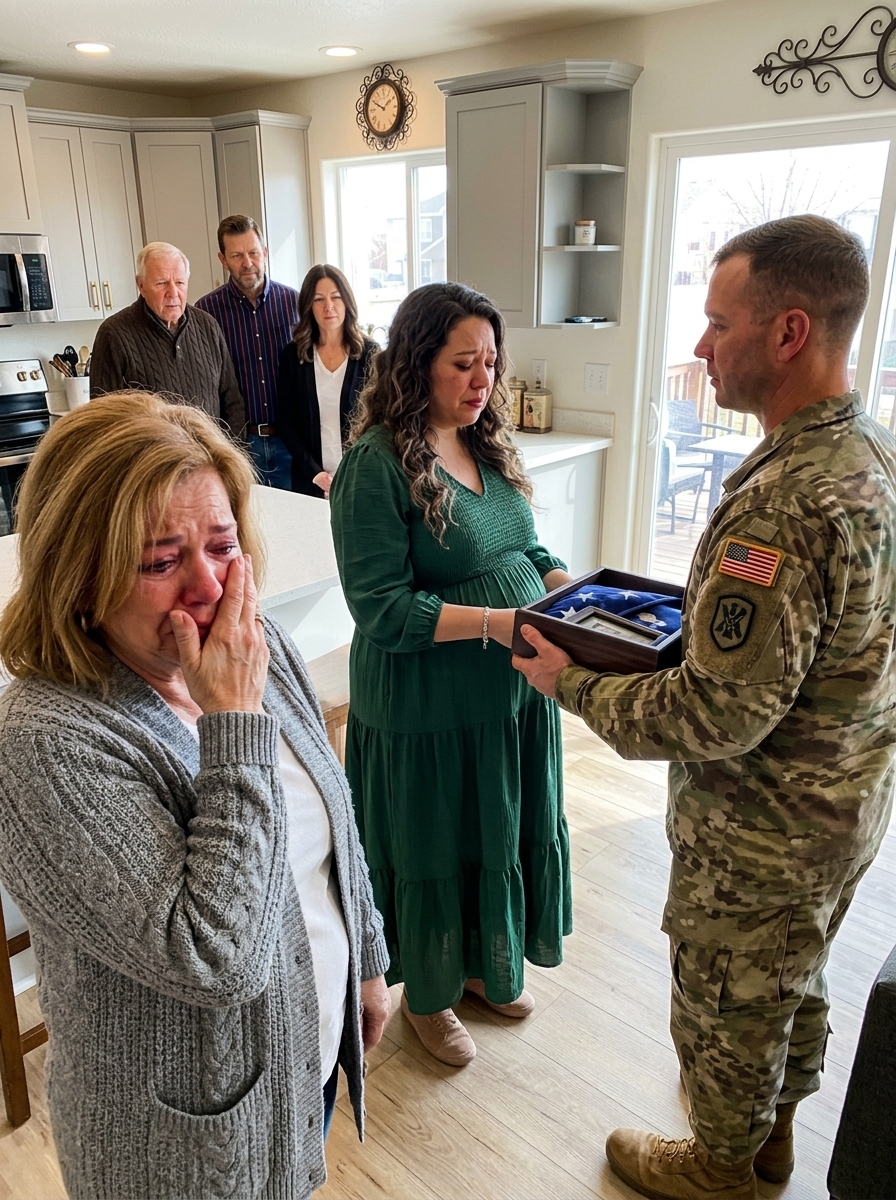
The second positioned behind it.
A third stopped by the road.
My mother appeared at the front door.
“What on earth?”
Harper pushed beside her.
My father came out carrying his newspaper.
It slowly lowered against his chest.
Advertisement
The driver’s door of the lead vehicle opened.
A soldier stepped out.
Then another.
Then a third.
Uniforms.
Insignia.
Purpose.
No confusion about why they were there.
Julian took a step forward.
“Can I help you?”
Nobody answered him.
The first soldier walked past him.
Straight toward me.
Captain Daniel Reeves.
I recognized him immediately.
He had served under David three years earlier.
He stopped at the entrance of the garage.
His boots struck the concrete.
His shoulders squared.
His eyes met mine.
Advertisement
Then he raised a sharp, precise salute.
“Colonel Mercer.”
Everything behind me went silent.
I returned the salute.
“Captain.”
I had spent seven months learning how to be alone.
That salute was the first sign that I wasn’t.
When I lowered my hand, my father laughed once.
A strange, confused sound.
“Colonel?”
Captain Reeves looked past me toward him.
His expression did not change.
Harper stepped closer.
“Claire?”
I turned.
Four faces stared back at me.
For the first time in my life, nobody in my family knew what to say.
Advertisement
My father recovered first.
“What is this?”
I didn’t answer him immediately.
Captain Reeves did.
“Ma’am, transportation is ready. General Whitmore is waiting at the secure facility.”
My mother gripped the doorframe.
“General?”
Harper stared at my uniform case, which another soldier was now carrying from the hallway.
“How did he get inside?”
I almost laughed.
“He didn’t.”
She looked confused.
I pointed toward the soldier.
“I gave him access.”
Julian stepped forward.
“This has to be some misunderstanding. Claire works in administration.”
Advertisement
Captain Reeves glanced at him.
“No, sir.”
Two words.
Nothing more.
But Julian went silent.
My father’s face reddened.
“Claire, explain this.”
I looked at him.
“I’m an Army officer.”
“We know you work for the Army.”
“No.”
I met his eyes.
“You know the story David and I were permitted to tell you.”
Silence.
Harper shook her head.
“What rank did he say?”
“Colonel,” Julian murmured.
My mother looked suddenly pale.
“You’re a colonel?”
“Yes.”
“For how long?”
“Long enough.”
Advertisement
My father glanced toward the vehicles.
Then toward the soldiers.
Then at me.
“You lied to us.”
That almost made me smile.
“You never asked.”
His mouth opened.
Closed.
Captain Reeves stepped closer.
“Colonel, we need to depart soon.”
“I know.”
Then another vehicle appeared at the end of the driveway.
This one was not part of the original convoy.
A black government SUV stopped near the curb.
A man in dress uniform emerged from the passenger side.
My father’s expression changed immediately.
Advertisement
Even civilians recognized stars.
Two of them gleamed on the man’s shoulders.
Major General Thomas Whitmore walked toward us.
My family moved aside without anyone telling them to.
He stopped in front of me.
His eyes softened.
“Claire.”
For the first time that morning, my control nearly broke.
“Sir.”
He didn’t salute.
Not yet.
Instead, he stepped forward and quietly said, “I’m sorry I couldn’t tell you yesterday.”
I felt my heartbeat shift.
“Tell me what?”
His gaze moved briefly toward my family.
Advertisement
“This conversation should happen privately.”
My father immediately spoke.
“This is our house. Anything said here—”
General Whitmore turned his head.
My father stopped.
The general didn’t raise his voice.
“Sir, with respect, you are not involved in this matter.”
No one had ever silenced Richard Bennett that quickly.
I looked at Whitmore.
“What happened?”
He reached inside his coat and removed a sealed envelope.
My name was printed across the front.
Not Claire Bennett.
Not Claire Mercer.
COLONEL CLAIRE MERCER.
Advertisement
OFFICIAL EYES ONLY.
My hands began to shake before I even opened it.
David’s handwriting was inside.
I knew it instantly.
Claire,
If you are reading this, something went wrong.
The driveway disappeared.
The garage disappeared.
Everyone around me blurred.
I read faster.
I couldn’t stop.
David had written the letter three days before his final mission.
He had known the operation carried unusual risk.
He had also known I was pregnant.
Only nine weeks then.
We had agreed not to tell my family until after the first trimester.
Then he deployed.
Then he never returned.
I forced myself to continue.
Do not let them turn my death into the end of your life.
Raise our child loudly.
Teach her that courage is usually quiet.
And if you ever start believing you are alone, remember that somewhere a soldier still knows your name.
My vision broke.
I turned away.
One tear fell.
Then another.
I hated crying in front of soldiers.
David would have told me that was ridiculous.
General Whitmore gave me time.
No one else moved.
Finally I looked at him.
“Why didn’t I receive this yesterday?”
“Because the letter was stored with materials recovered from the mission site last week.”
My stomach tightened.
“Recovered?”
He nodded.
“David hid a data package before the team was compromised. We located it after seven months.”
Harper whispered behind me.
“What kind of data?”
Whitmore ignored her.
“The package contained operational intelligence, his personal effects, and this letter.”
“Was his death connected to the package?”
“We believe so.”
I closed my eyes.
The final piece.
The answer I had spent seven months waiting for.
Not every detail.
But enough.
David had not simply died on a mission.
He had completed it.
Even knowing he might not come home.
General Whitmore continued.
“The intelligence he protected prevented a serious security breach involving personnel identities and planned attacks against deployed units.”
I pressed David’s letter against my chest.
“He saved them?”
Whitmore held my gaze.
“Yes.”
My knees nearly failed.
Captain Reeves moved instinctively closer.
I steadied myself against the garage wall.
My father finally found his voice.
“So David was military too?”
I turned slowly toward him.
“Yes.”
“What rank?”
“Lieutenant colonel.”
Harper stared at me.
“But he told us he was a consultant.”
“That was his cover.”
Julian stopped spinning his keys.
For the first time since I had known him, he looked small.
My mother whispered, “Why would you hide something like that from family?”
The question hurt more than it should have.
I looked at her.
“Because people trusted us with their lives.”
Then I added quietly, “And because every time I tried to talk about my work, you changed the subject to Harper.”
Nobody answered.
The wind pushed colder air through the garage.
General Whitmore’s eyes moved toward the cardboard box beside my feet.
“What is that?”
I looked down.
“My belongings.”
His brow tightened.
Captain Reeves glanced at the box.
Then at the garage.
Then at my family.
“What do you mean?”
My mother immediately rushed in.
“It’s nothing.”
Harper crossed her arms.
“Julian needed the upstairs bedroom.”
General Whitmore stared at her.
“So Colonel Mercer was moving?”
“Just temporarily.”
“Where?”
Nobody answered.
The general looked at me.
I didn’t protect them.
Not anymore.
“The garage.”
Captain Reeves’ jaw tightened.
Whitmore’s expression became unreadable.
He looked at the frost along the driveway.
Then at my stomach.
Then back toward my family.
“The garage.”
My father stepped forward defensively.
“This is a private family matter.”
“It is,” I said.
Everyone turned toward me.
“And I should have handled it a long time ago.”
I stepped inside the house.
My family followed.
The soldiers did not.
They waited outside.
This was not their battle.
It was mine.
I walked into the kitchen where the Thanksgiving turkey sat thawing in the sink.
Where my father’s newspaper remained folded on the table.
Where my mother’s coffee had gone cold.
Then I opened the drawer beside the refrigerator.
Inside was a folder.
I placed it on the counter.
Julian frowned.
“What’s that?”
“The deed.”
Nobody moved.
I opened it.
“David and I own this house.”
Harper blinked.
“What?”
“You heard me.”
My father shook his head.
“That’s impossible. We’ve lived here for years.”
“Yes.”
I looked at him.
“Because David let you.”
Years earlier, my parents had lost their home after my father’s business collapsed.
David had offered them our guest rooms.
Temporary, he had said.
Six months.
They stayed.
Then Harper arrived after breaking her lease.
Then Julian practically moved in after they married.
David never complained.
He told me family mattered.
He told me people needed dignity when they were struggling.
My family had mistaken generosity for ownership.
My father grabbed the deed.
His eyes moved across the names.
Then his face changed.
“No.”
“Yes.”
“You said this was family property.”
“I said this was our family home.”
“That doesn’t mean—”
“It meant exactly what I said.”
Harper stared at the paper.
“So you own everything?”
“The house.”
Her eyes went toward the staircase.
“My room?”
“My house.”
Julian finally stepped forward.
“Now, hold on. There are legal tenancy issues.”
I looked at him.
“I’m aware.”
His confidence flickered.
Of course I was aware.
I had spent twelve years working in environments where mistakes became disasters.
I had already contacted an attorney.
Not because I planned this confrontation.
Because David had taught me to prepare for everything.
I removed another document from the folder.
“Formal notice will be delivered after the holiday.”
My mother gasped.
“You’re throwing us out?”
“No.”
I paused.
“I’m ending an arrangement you decided entitled you to throw me out.”
Harper’s face twisted.
“You can’t do this because we asked you to change rooms.”
“This isn’t about a bedroom.”
My voice remained quiet.
“That’s what none of you understand.”
I looked at my father.
“My husband was buried yesterday.”
He looked away.
I looked at my mother.
“I am carrying his child.”
Her eyes lowered.
Then Harper.
“You called my grief exhausting.”
Her face lost color.
Then Julian.
“You were worried my boxes might inconvenience your Audi.”
He stopped looking at me.
“I would have let all of you stay.”
That got their attention.
“If one person had looked at me this morning and said, ‘Claire, are you okay?’ I probably would have let every one of you stay.”
My mother’s eyes filled.
“Claire—”
“No.”
The word came out sharper than I intended.
But I didn’t take it back.
“You don’t get to become compassionate because uniforms arrived.”
Silence.
That was the truth.
And they all knew it.
My father pointed toward the driveway.
“So what happens now? You disappear with these people and abandon your family?”
I almost couldn’t believe him.
“My family?”
“Yes, your family.”
I placed one hand over my stomach.
“This is my family.”
My father froze.
“And David was my family.”
The room became completely still.
“You treated his funeral like an inconvenience. You treated his home like property you could redistribute. You treated his pregnant widow like clutter that could be moved to the garage.”
My voice cracked.
I let it.
“I won’t forget that.”
My mother began crying.
For once, nobody told her she was ruining Thanksgiving.
I turned away.
General Whitmore was waiting at the front door.
Before I reached him, Harper spoke.
“Claire.”
I stopped.
She looked younger suddenly.
Not confident.
Not cruel.
Just frightened.
“Did David know?”
“Know what?”
“That we were like this.”
The question nearly broke me.
I thought of David cleaning dishes after Thanksgiving while my family watched television.
David fixing Dad’s truck without charging him.
David paying Harper’s emergency dental bill anonymously.
David buying Mom a new refrigerator and telling her it had been on sale.
David telling me again and again not to keep score.
“Yes,” I whispered.
Harper swallowed.
“And he still let us live here?”
“Yes.”
“Why?”
I looked toward the driveway where soldiers stood waiting beneath the gray November sky.
“Because David was kinder than any of you deserved.”
I walked outside.
General Whitmore accompanied me toward the convoy.
Captain Reeves opened the rear door.
Then I stopped.
Something bothered me.
The formation.
The soldiers.
The general.
Too many people for simple transport.
I looked at Whitmore.
“What aren’t you telling me?”
He exhaled.
“I was hoping to do this at headquarters.”
“Do what?”
He glanced at Reeves.
Captain Reeves nodded once.
Then the soldiers near the vehicles moved.
Not randomly.
Deliberately.
They formed two lines along the driveway.
My breath caught.
At the curb, another officer stepped out carrying a small presentation case.
My family gathered silently on the porch.
General Whitmore turned toward me.
“David was recommended posthumously for an award related to his final mission.”
My heart began pounding.
“What award?”
Whitmore’s voice softened.
“That portion remains restricted. But the citation we can release recognizes extraordinary courage under hostile conditions and actions taken to protect American personnel.”
The officer handed him the case.
Whitmore opened it.
Inside lay David’s decoration.
I couldn’t move.
“We intended to present this privately,” he said. “But after yesterday’s funeral, I thought his home mattered.”
His home.
I looked at the house.
The maple tree.
The repaired porch.
The garage David had built shelves inside.
The upstairs window of the nursery he would never see completed.
“Yes,” I whispered.
“It does.”
Whitmore stepped back.
“Attention.”
Every soldier in the driveway straightened.
My family did too, almost instinctively.
The general read David’s citation.
He spoke about duty.
Sacrifice.
Protection of fellow soldiers.
The destruction of sensitive intelligence.
The preservation of lives.
He did not describe how David died.
He did not describe where.
He did not describe the enemy.
He didn’t have to.
For the first time, my family heard who David really was.
Not a consultant.
Not the quiet man who repaired cabinets.
Not the person whose bedroom Julian wanted for investment calls.
A soldier.
A leader.
A husband who had walked into danger knowing there was a child growing inside me.
When the citation ended, General Whitmore placed the decoration in my hand.
Then something happened I had not expected.
Captain Reeves raised his hand.
Salute.
Another soldier followed.
Then another.
Then every uniformed person in the driveway.
One by one.
Until the entire driveway stood frozen in silence.
Saluting David.
Saluting his sacrifice.
Saluting the family he left behind.
I pressed the case against my stomach.
Our daughter kicked.
Hard.
A laugh escaped me through my tears.
It was the first real laugh since David died.
Whitmore glanced at my stomach.
“Strong one?”
“Like her father.”
“God help us.”
That made Reeves smile.
Behind us, someone sobbed.
My mother.
I turned.
My family stood on the porch.
Dad’s newspaper was gone.
Julian’s keys hung motionless in his hand.
Harper’s face was wet.
None of them looked entitled anymore.
They looked like people realizing they had spent years standing beside something valuable without ever recognizing it.
General Whitmore leaned closer.
“There’s one more thing.”
Of course there was.
With David, there was always one more thing.
Whitmore handed me a small encrypted drive.
“This was recovered with his data package.”
“What is it?”
“A personal recording.”
My heart stopped.
“David?”
He nodded.
“We verified it this morning.”
I looked toward the house.
“I want to hear it here.”
Whitmore hesitated.
Then nodded.
Captain Reeves brought a secure tablet.
I sat on the porch step.
The same porch David had rebuilt two summers earlier.
My family remained several feet away.
No one dared come closer.
Reeves inserted the drive.
The screen turned black.
Then David appeared.
Alive.
My lungs forgot how to work.
He was sitting inside what looked like a temporary operations room.
Tired.
Unshaven.
Smiling.
My David.
“Hey, Claire.”
I covered my mouth.
“If you’re watching this, then Whitmore finally ignored my instruction about destroying embarrassing videos.”
General Whitmore muttered, “Typical.”
I laughed and cried at the same time.
David continued.
“I don’t know whether this mission will become anything worth talking about. Hopefully I’ll delete this myself when I get back.”
He looked down briefly.
Then directly into the camera.
“But there are things I should say more often.”
My hand moved over our baby.
“You’re the bravest person I’ve ever met.”
My vision blurred.
“And before you argue with me, bravery has nothing to do with rank. It’s getting up when nobody applauds. It’s choosing decency when nobody is watching. It’s protecting people who may never even know your name.”
He smiled.
“That’s you.”
Harper began crying harder.
David’s voice softened.
“And if the baby gets my stubbornness, I apologize in advance.”
I laughed again.
“If she gets yours, we’re doomed.”
Then his expression changed.
Serious.
Tender.
“If something happens to me, Claire, do not become smaller so other people can feel bigger.”
Every muscle in my body went still.
“Do not apologize for surviving me.”
My father lowered his eyes.
“Do not let anyone convince you that grief means weakness.”
Harper covered her mouth.
“And please don’t spend the rest of your life protecting people from the consequences of how they treat you.”
That line went through me like lightning.
David leaned closer to the camera.
“You’ll know what I mean.”
Of course he knew.
He had always known.
“I love you.”
A pause.
“I love our baby.”
Another pause.
“And wherever you are when you watch this, look around.”
I did.
Soldiers.
The house.
The maple tree.
My family.
Morning light breaking across the frozen yard.
David smiled one final time.
“You’re not alone.”
The screen went dark.
Nobody spoke.
For a long moment, the only sound was wind moving through bare branches.
Then I stood.
I had expected David’s final message to destroy me.
Instead, somehow, it put something back together.
Not everything.
Nothing would ever restore everything.
But enough.
I looked at General Whitmore.
“I’m ready.”
He nodded.
Captain Reeves opened the vehicle door.
Before getting inside, I turned toward my family one last time.
My father took a step forward.
“Claire.”
I waited.
His face looked different.
Older.
Smaller.
“I’m sorry.”
Three words.
I had wanted them for years.
But apologies were not magic.
They did not erase the garage.
Or Thanksgiving.
Or David’s funeral.
Or every smaller cruelty that had come before.
So I nodded.
“I hope you mean that.”
He swallowed.
“I do.”
“Then mean it when there’s nobody in uniform watching.”
He had no answer.
My mother whispered, “Will we see you again?”
“Yes.”
I wasn’t cruel.
I wasn’t interested in revenge.
But forgiveness and access were not the same thing.
“You’ll receive the legal notice. You’ll have time to make arrangements.”
Harper wiped her face.
“What about Thanksgiving?”
I looked toward the kitchen window.
The turkey.
The table.
The house David had built into a home.
Then I looked at the soldiers standing in the driveway.
Men and women who had driven before dawn on Thanksgiving because orders said one of their own needed transport.
Because David had mattered.
Because apparently I mattered too.
“Keep the turkey,” I said.
Julian looked toward his Audi.
Nobody laughed.
I climbed into the vehicle.
Captain Reeves closed the door.
As the convoy began moving, I looked through the window.
The house slowly disappeared behind us.
For months, I had believed losing David meant losing the safest place I had ever known.
I understood now that David had never been the house.
He had never been the bedroom.
He had never been the uniform hanging in the closet or the folded flag on the dresser.
He was the courage he left inside me.
The child moving beneath my heart.
The soldiers who still remembered his name.
The life he had ordered me—lovingly, stubbornly—to keep living.
I looked down at the medal case in my lap.
Then at his wedding ring hanging beside my military identification.
Captain Reeves glanced at me from the front seat.
“You doing okay, Colonel?”
The old answer would have been yes.
Automatic.
Professional.
Safe.
Instead, I told the truth.
“No.”
He nodded.
“I figured.”
I looked out at the frozen landscape.
“But I will be.”
And for the first time in seven months, I believed it.
Three months later, I returned to the house.
Alone.
My parents had moved into a small rental across town.
Harper and Julian had found an apartment.
There had been arguments.
Lawyers.
Angry messages.
Then quieter messages.
Then silence.
I changed the locks.
Not out of revenge.
Because the house needed to become mine again.
I repainted the bedroom.
Finished the nursery.
And kept one wall exactly as David had left it.
Crooked paint line and all.
Our daughter arrived six weeks early.
Seven pounds of fury and lungs.
I named her Evelyn Claire Mercer.
Evelyn had been David’s grandmother’s name.
At the hospital, General Whitmore sent flowers.
Captain Reeves sent a tiny camouflage onesie with COLONEL IN TRAINING printed across the front.
My mother visited once.
She asked before coming.
That mattered.
My father stood at the doorway and waited until I invited him inside.
That mattered too.
Harper came later.
Without Julian.
She held Evelyn for less than five minutes before she started crying.
“I was horrible to you.”
“Yes.”
She flinched.
I wasn’t going to lie anymore just to make other people comfortable.
“I don’t know why.”
“I do.”
She looked at me.
“Why?”
“Because you thought I’d always forgive you.”
That answer stayed between us.
Eventually, she nodded.
“You’re right.”
Maybe one day we would rebuild something.
Maybe we wouldn’t.
Not every broken relationship needed an immediate ending.
And not every apology deserved immediate restoration.
David had taught me that too.
Months later, on the first warm morning of spring, I carried Evelyn outside.
The maple tree beside the driveway had begun growing new leaves.
I stood beneath it and looked toward the garage.
The same garage where I had placed that cardboard box.
The same concrete where my family expected me to sleep while pregnant in freezing temperatures.
The same place where Captain Reeves had stopped, straightened his shoulders, and saluted.
That moment had divided my life in two.
Before the salute, I believed grief had taken everything.
After it, I understood what remained.
I held Evelyn against my chest.
“Your dad planted this tree,” I told her.
She stared up at the leaves.
“He said you’d complain our yard was too small.”
She sneezed.
I laughed.
Then I looked toward the driveway.
For half a second, I could almost see David there.
Boots on the pavement.
Hands in his pockets.
That crooked smile.
I no longer needed to pretend he would walk through the door.
Missing him was not the same as waiting for him.
That had taken me months to learn.
I kissed Evelyn’s forehead.
“Your father was right about something.”
She made a tiny sound.
“We’re not alone.”
And finally, neither was I.