Chapter One: The Night They Threw Me Away
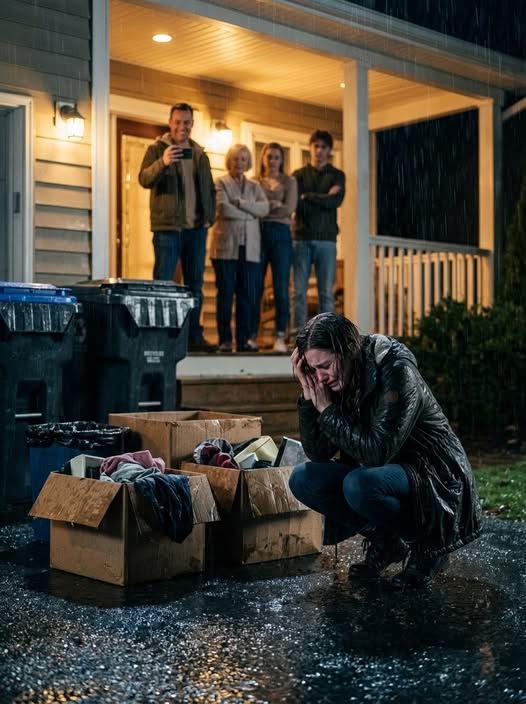
The night my family threw me out of the house, my mother stood underneath the porch light, smiling while freezing rain soaked the last pieces of my childhood.
My brother, Dylan, had just dumped four cardboard boxes beside the overflowing garbage cans. He stepped backward, pulled out his phone, and took a picture.
Then he posted it on Facebook.
“Finally, we got rid of her. No more dead weight.”
Within minutes, my mother had commented.
A fresh beginning!
My father liked the post.
My younger sister, Jessica, responded with champagne emojis.
And somewhere beneath the winter sky, with rain running down my neck and my fingers turning numb, I realized that the people I had spent years protecting had been waiting for an opportunity to discard me.
My name is Mara Whitfield.
I was twenty-eight years old when my family decided I wasn’t worth keeping.
Less than twelve hours later, they would discover that everything they believed about my brother’s success was a lie.
But even then, none of us understood how deep that lie went.
It began on an ordinary Tuesday in November.
I’d spent eleven hours working on the redesign of a commercial development outside Columbus, Ohio. The client wanted a pedestrian courtyard incorporated into a complicated retail and office complex, and I’d finally solved a structural circulation problem that had been bothering our team for weeks.
I was exhausted, hungry, and looking forward to sitting in my bedroom with a cup of tea.
Instead, I opened the front door and found four cardboard boxes stacked beside the living room furniture.
My winter coats were thrown across the top. My professional drafting equipment leaned against the wall.
Dylan stood in the center of the room wearing an expensive wool coat and the expression of a man who had just won something.
My mother, Linda, sat beside Jessica on the couch.
Dad was in his recliner.
Nobody looked surprised to see me.
“What’s going on?” I asked.
Dylan crossed his arms.
“You’re moving out tonight, Mara.”
I actually laughed.
Not because it was funny, but because my brain couldn’t immediately process what he’d said.
“Very funny. What’s really going on?”
“I need your bedroom for my home office,” he replied. “Things are changing at Northline. My career is finally taking off, and I need a proper workspace.”
I glanced toward the empty guest room upstairs.
“Then use the guest room.”
“It’s too small.”
“It’s practically the same size.”
“Mara,” Mom interrupted, “we’ve already discussed this.”
“We?”
“The family.”
That single word hurt more than anything else.
Apparently, a family meeting had taken place about my future, my belongings, and my home.
Nobody had thought to invite me.
Dylan stepped closer.
“We need to start supporting someone with an actual future.”
Dad cleared his throat.
“You’re twenty-eight, sweetheart. It’s time you figured your life out.”
For a moment, I could only stare at him.
Four years earlier, when his construction business had collapsed, he’d sat at our kitchen table with his head in his hands, convinced we would lose the house.
I’d been twenty-four, barely established in my career, and frightened of watching my parents become homeless.
So I’d helped.
Then I’d helped again.
And again.
I’d paid overdue property taxes. Replaced the refrigerator. Covered utility bills. Paid for emergency furnace repairs. Sent money whenever Dad said the mortgage was becoming difficult.
I had postponed vacations, turned down opportunities that required relocation, and continued living in my childhood bedroom because every time I mentioned leaving, my mother reminded me how much my parents needed me.
“You know how much money I’ve given you,” I said.
Dad shifted in his chair.
“That’s different.”
“How?”
“Families help each other.”
I felt something tightening inside my chest.
“Exactly. So why am I standing here looking at my belongings in boxes?”
Dylan laughed.
“Please, Mara. Playing around with drawings on your laptop doesn’t make you successful.”
My mother sighed.
Jessica looked down at her phone, smiling.
I wanted to tell them about the buildings my designs had helped create. The investors who requested my work specifically. The architects who respected my judgment. The clients who trusted me with projects worth millions.
I wanted to explain that I’d earned my architectural license the previous spring and that my independent practice was growing steadily.
But I had spent years trying to make them understand.
They didn’t want to understand.
They wanted Dylan to be extraordinary and me to be ordinary.
My accomplishments complicated that arrangement.
Then I noticed something beside the doorway.
Grandma Rose’s drafting table.
The old wooden table had been moved carelessly, and a deep scratch ran across one corner.
I crossed the room immediately.
“Who did this?”
Dylan shrugged.
“It’s an old table.”
“You damaged it.”
“Get over it.”
I rested my hand against the scarred wood.
Grandma Rose had given me that table on my nineteenth birthday. It was where I’d drawn my first serious floor plans, where I’d studied late into the night, and where I’d discovered that creating spaces for people was more than something I enjoyed.
It was what I wanted to do with my life.
Grandma understood that before anyone else.
Whenever Mom complained that architecture was too difficult or Dad suggested I find something practical to study, Grandma would smile at me.
“Buildings begin as drawings, honey. Don’t let anybody make you ashamed of the beginning.”
She had died six years earlier.
Some days, I still reached for my phone to call her.
Looking at the damaged table, I felt as though somebody had reached into my memories and deliberately broken something irreplaceable.
But instead of crying, I became very calm.
I looked at each member of my family.
“What time do you want me gone?”
Dylan blinked.
“What?”
“You said I’m moving out tonight. What time?”
Mom looked uncomfortable.
“Well, preferably before dinner.”
Before dinner.
As though I were an inconvenient delivery that needed collecting.
I nodded.
“Fine. I’ll go.”
Dylan’s smile disappeared.
They had prepared themselves for an argument.
They hadn’t prepared themselves for my surrender.
Upstairs, I collected my passport, professional records, external hard drive, Grandma’s photographs, and a chipped blue mug she’d given me.
Jessica appeared in the doorway.
“You’re seriously not going to fight for your room?”
I continued packing.
“Fight for what?”
She rolled her eyes.
“Whatever, Mara.”
I looked directly at her.
“A family that only remembers I exist when the bills are due?”
Her expression hardened.
“You’re so dramatic.”
I zipped my bag and walked past her.
Outside, Dylan carried my boxes toward the driveway.
For one brief, foolish moment, I thought he intended to help me load my SUV.
Instead, he walked straight toward the garbage cans and dropped them.
Then he took the photograph.
I stood there in the rain, unable to believe what I was seeing.
“What are you doing?”
He smiled.
“Making memories.”
When his Facebook post appeared, I took screenshots of everything.
His words.
My mother’s comment.
Dad’s approval.
Jessica’s laughing celebration.
I knew my family well enough to understand that eventually, they would rewrite the story.
They would claim I had left voluntarily.
They would say Dylan was joking.
They would insist that I had misunderstood.
This time, I intended to remember exactly what happened.
I loaded my SUV, carefully secured Grandma’s drafting table, blocked all four of their numbers, and drove away.
Nobody followed me.
Nobody called after me.
And when I looked in the rearview mirror, my mother was closing the front door.
Chapter Two: The Call at 8:17
The hotel room smelled faintly of laundry detergent and old carpet.
It cost eighty-nine dollars for the night, and the heater rattled every time it switched on.
I placed Grandma’s blue mug on the nightstand, changed out of my wet clothes, and sat on the edge of the bed.
For the first time all evening, I cried.
Not because I was broke.
I wasn’t.
I had savings, professional contacts, and enough work to support myself.
I cried because I finally understood that no amount of sacrifice would make my family love me the way I loved them.
I’d spent years believing that if I helped enough, worked hard enough, or remained patient enough, they would eventually see me.
Instead, every sacrifice had taught them that they could demand more.
I opened my banking application.
The recurring transfer to Dad was scheduled for Friday.
One thousand four hundred dollars.
Then there was the contribution toward insurance, the automatic payment on their internet account, and several smaller expenses I’d taken responsibility for.
I canceled every payment I controlled.
The confirmation screens seemed strangely ordinary.
After everything that had happened, ending years of financial support required nothing more than pressing a few buttons.
I closed my laptop.
“Grandma,” I whispered into the empty room, “I really wish you were here.”
I slept for perhaps two hours.
At exactly 8:17 the following morning, my phone rang.
Nathan Price.
I recognized the name immediately.
Nathan was the director of development at Northline Development, the company where Dylan worked.
He was also one of my professional contacts. Northline had hired my small practice for architectural design services on several of its commercial projects, although my contracts were administered through its external lead architecture firm.
Nathan had attended presentations where I’d explained my proposals.
He knew I was competent.
But we rarely spoke outside scheduled project meetings.
“Mara,” he said when I answered. “I’m sorry to call so early.”
“It’s fine. Is something wrong with the courtyard design?”
“No. It’s not about that.”
He hesitated.
“I saw what Dylan posted last night.”
My stomach tightened.
“Oh.”
“Did your family really throw you out?”
I stared at the hotel curtains.
“Yes.”
Another silence.
Then Nathan exhaled.
“Unbelievable.”
I rubbed my forehead.
“I’m sorry. I don’t want personal issues affecting our work.”
“Mara, you’re not the person who needs to apologize.”
His tone changed.
“There’s something about Dylan you need to know.”
I sat upright.
“What?”
“Do you remember the three major commercial developments you worked on for us last year?”
“Of course.”
The Westbrook Exchange.
The Mill District Commons.
The Fairview Professional Center.
Together, they’d represented the most significant work of my career.
“Well,” Nathan said carefully, “your brother has been representing himself internally as the person responsible for originating those designs.”
I frowned.
“I don’t understand.”
“He told our executives that the major design concepts were his. That you were helping him translate his ideas into architectural drawings.”
A horrible sensation spread through my stomach.
“That’s not true.”
“I know.”
“Nathan, Dylan doesn’t even know how to use the software.”
“I know that now, too.”
He explained that Dylan had prepared presentations for executive meetings, using sections of my drawings to demonstrate his supposed creativity and development expertise.
The executives understood that architects handled the technical design work, but Dylan had persuaded them that the original concepts belonged to him.
He had claimed responsibility for ideas that came entirely from me.
And management had rewarded him accordingly.
My brother had received substantial performance bonuses and a promotion based partly on work he had never done.
I stood from the bed.
“How long has this been happening?”
“More than a year, possibly longer.”
“And nobody questioned him?”
“Some people did. Including me, eventually. But he had explanations for everything.”
“What changed?”
“We’re negotiating a significant investment partnership. Their due diligence team requested original project records, including development presentations, correspondence, and design histories.”
Nathan paused.
“Your name appeared everywhere.”
I pressed my hand against the wall.
The truth was rearranging years of memories.
Dylan’s expensive watches.
His sudden confidence.
The luxury SUV he had bought the previous summer.
Mom’s constant reminders that her son was becoming a powerful businessman.
Dad’s disappointment whenever I discussed my supposedly modest career.
All of it began to make a sickening kind of sense.
“There’s more,” Nathan said.
“More?”
“Our legal department is reviewing Dylan’s representations. They’ve identified possible issues with documents attributed to you.”
“What documents?”
“I would rather show you in person.”
My phone vibrated.
An unfamiliar number.
Then another.
Then a text message.
Mara, it’s Mom. Call me immediately. This situation with Dylan is getting out of hand.
A second message appeared.
You need to come home and help your brother. Whatever happened yesterday, we are still family.
I almost laughed.
Apparently, the family membership they had revoked the night before had been restored the moment they needed something.
Nathan continued speaking.
“Our CEO would like you to attend an emergency board meeting this afternoon.”
“Me?”
“Yes.”
“Why?”
“She wants to discuss what happened. And there’s something she’d like to offer you personally.”
I looked at my reflection in the dark television screen.
My eyes were swollen. My hair was tangled.
Everything I owned was sitting in a hotel parking lot.
And the chief executive of one of Ohio’s most successful regional development companies wanted to meet me.
“What time?”
“Two o’clock.”
“I’ll be there.”
Before Nathan disconnected, he said something that stayed with me.
“Mara, please don’t speak to Dylan before we meet. Don’t agree to anything. And if anybody asks you to sign a document, don’t.”
I thanked him.
Then I looked down at another incoming message.
This one was from Dylan.
You have no idea what you’re messing with. Call me.
I placed the phone facedown.
For the first time in my life, my brother was afraid of what I knew.
And I didn’t even know everything yet.
Chapter Three: The Woman Behind the Glass Doors
By noon, I’d showered, purchased a clean blouse from a nearby department store, and arranged for my belongings to be placed in a secure storage unit.
Everything except Grandma’s blue mug.
That stayed in my SUV.
I stopped for coffee before driving downtown, but my hands were shaking so badly that I barely touched it.
Northline Development occupied six floors of a modern office building overlooking the Scioto River.
I had visited the building many times.
Dylan had always discouraged me from mentioning that we were related during professional meetings.
“It’s just better to keep family and business separate,” he’d explained.
At the time, I thought that sounded reasonable.
Now I understood that he had been keeping two versions of his life from colliding.
Nathan met me in the lobby.
He was in his early forties, with prematurely gray hair and the tired expression of someone who had spent the morning discovering increasingly unpleasant information.
“I’m glad you’re here,” he said.
“How bad is it?”
He looked toward the elevators.
“Worse than we initially thought.”
We rode to the executive floor.
Inside a large conference room, three people waited around a polished walnut table.
Evelyn Hart, Northline’s CEO, stood when I entered.
She was sixty-two, elegant without being ostentatious, and known throughout the industry for her ability to rescue complicated development projects.
Beside her sat the chief financial officer and Northline’s general counsel, a sharp-eyed woman named Rebecca Sloan.
“Mara,” Evelyn said, extending her hand, “thank you for coming under such difficult circumstances.”
I shook it.
“I’m not entirely sure why I’m here.”
“That’s understandable. Please, sit.”
Rebecca opened a folder.
“We’d like to establish a few things before discussing our findings. Have you ever agreed to transfer ownership of your independent design concepts to your brother?”
“No.”
“Have you ever worked for a company called Whitfield Concepts?”
I shook my head.
“I’ve never heard of it.”
Rebecca and the CFO exchanged looks.
“Are you certain?”
“Absolutely.”
She slid a photocopied document across the table.
At the top was the name Whitfield Concepts LLC.
Below it appeared an agreement stating that architectural concepts developed by Mara Whitfield in association with Dylan Whitfield were to be administered through the company.
The wording was dense.
But the bottom of the page was unmistakable.
My signature.
Or something that looked remarkably like it.
I stared.
“Where did you get this?”
“Your brother supplied it during our documentation review.”
“I didn’t sign this.”
Rebecca leaned forward.
“Would you be willing to state that formally?”
“Yes. Of course.”
She handed me another document.
It contained a portfolio of architectural drawings, including designs I recognized from my own work.
On the cover, beneath the company logo, were the words:
DYLAN WHITFIELD — FOUNDER AND CREATIVE DIRECTOR
My chest tightened.
I turned the page.
The courtyard design I’d presented eighteen months earlier.
Another page.
My pedestrian bridge proposal.
Another.
A mixed-use residential concept I’d developed while working late nights at my parents’ house.
Some drawings had been cropped.
Others had been recolored.
My original project identifiers were missing.
But they were mine.
Every line.
Every detail.
Every solution I’d struggled to create.
I reached one page and stopped.
It was an early concept for an affordable housing development, something I had drawn years before earning my professional license.
“Where did he get this?”
Nathan leaned over.
“You recognize it?”
“I designed it when I was nineteen.”
Evelyn’s expression changed.
“May I see?”
I turned the portfolio toward her.
She studied the drawing for several seconds.
It depicted a collection of modest homes surrounding a central garden, with wide walkways, covered entrances, accessible interiors, and a community building at the heart of the development.
I’d called it Lantern Court.
The concept had begun after Grandma struggled to climb the stairs in her old apartment.
I wanted to imagine a neighborhood where elderly residents could remain independent without becoming isolated.
Evelyn looked up slowly.
“You designed this?”
“Yes.”
“When you were nineteen?”
“Yes.”
She didn’t respond immediately.
Instead, she asked Rebecca to make a note.
Then she closed the portfolio.
“Mara, we brought you here because we need to correct the record and protect your work. We also have a proposal.”
The CFO explained that Northline was preparing a major expansion of its design and development operations.
The company needed someone who could oversee conceptual design, communicate with architects, and ensure that developments remained faithful to their original vision.
Dylan had been positioning himself for that role.
But the work that supposedly qualified him for it belonged to me.
“We would like to discuss bringing you in as our director of design strategy,” Evelyn said. “Or establishing a long-term partnership with your practice, depending on what you prefer.”
I couldn’t speak.
The salary range Rebecca mentioned was more than twice what I had earned the previous year.
There would also be performance incentives, resources, and the opportunity to build a team.
It was the kind of position that could change my entire professional future.
But Evelyn wasn’t finished.
“Before we move forward, however, we need clarity on the rights to certain designs. Someone should represent your interests independently of Northline.”
She slid a business card toward me.
“That’s an attorney who specializes in intellectual property and commercial disputes. You are free to choose your own, of course.”
I picked up the card.
Then I looked again at my forged signature.
“What happens to Dylan?”
Rebecca answered.
“He’s been placed on administrative leave pending the investigation. We haven’t reached our final findings.”
I nodded slowly.
“Does he know I’m here?”
“He knows we’ve contacted you.”
That explained the messages.
Evelyn folded her hands.
“Mara, when I saw your brother’s Facebook post, I was disturbed. But this investigation began before yesterday.”
I looked at her.
“How long before?”
“Six weeks.”
Six weeks.
My brother had known for weeks that questions were being asked about his work.
And last night, he had thrown me out.
The timing suddenly seemed more sinister.
“Was he expecting a promotion?” I asked.
Nathan shook his head.
“There was a promotion under discussion earlier this year. But more recently, he was worried.”
“About what?”
Rebecca glanced at the forged agreement.
“About proving that he had the authority to represent certain designs.”
A cold feeling moved through me.
Perhaps Dylan hadn’t wanted my bedroom because his career was taking off.
Perhaps he had wanted something else entirely.
Chapter Four: The Price of Being Family
When I walked out of Northline’s headquarters, I found thirty-one missed calls from unfamiliar numbers.
I also found a voicemail from my father.
His voice sounded strained.
“Mara, sweetheart, obviously things got a little heated yesterday. Your mother is very upset. We need to sit down and discuss this like adults.”
Adults.
I listened to the message twice.
There was no apology.
No acknowledgment that they had thrown my belongings beside garbage cans.
Not even a question about where I had slept.
Then came a voicemail from Dylan.
“Mara, I don’t know what Nathan told you, but there are things about business you don’t understand. Don’t go making statements that could damage my career. You need to talk to me first.”
I deleted it.
My mother called again.
This time, I answered.
“Mara!” she practically shouted. “Where are you?”
“I’m safe.”
“That’s not what I asked.”
“It’s all you need to know.”
She inhaled sharply.
“Your brother could lose his job over some ridiculous misunderstanding.”
“Then he should explain the misunderstanding to his employer.”
“Don’t be difficult. He told us you might be able to clear everything up.”
“How?”
“Apparently, there’s a document they need.”
I looked at the folder on the passenger seat.
“What document?”
“Oh, I don’t know the technical details. Something about family projects.”
“Mom, did you know Dylan was claiming he designed my work?”
Silence.
I waited.
Finally, she said, “Every successful person needs help getting started.”
“That isn’t what I asked.”
“Mara, you’re making this sound worse than it is.”
“Did you know?”
Her voice sharpened.
“Your brother has a real position with a real company. He has responsibilities. People depend on him.”
“And my responsibilities don’t count?”
“You’ve always been so independent. You don’t need opportunities the way Dylan does.”
Something about the absurdity of that sentence made me laugh.
My independence had become their excuse to take everything from me.
“I’m not signing anything.”
“Mara.”
“No.”
“After everything we’ve done for you?”
I closed my eyes.
“You threw me out beside the garbage last night.”
She sighed.
“Oh, for heaven’s sake. Dylan was joking.”
I thought of the screenshot.
“Have a good afternoon, Mom.”
I disconnected.
Then I called the attorney whose card Evelyn had given me.
His name was Daniel Mercer.
His office was located in a restored brick building near German Village, and he scheduled a consultation for the following morning.
That evening, I rented a furnished apartment on a month-to-month arrangement.
It wasn’t beautiful.
The kitchen cabinets were outdated, and the couch was an unfortunate shade of orange.
But I could close the door without wondering whether somebody might decide I no longer belonged there.
I collected my belongings from storage and began unpacking.
At eight o’clock, someone knocked.
I froze.
The rental manager had my number. Nobody else knew my address.
When I looked through the peephole, Jessica was standing in the hallway.
She was carrying a grocery bag.
I opened the door a few inches.
“How did you find me?”
She looked embarrassed.
“You shared your location with me a long time ago. Remember?”
I had forgotten.
I made a mental note to disable it.
“What do you want?”
“Can I come in?”
“No.”
Her face fell.
“Seriously?”
“Seriously.”
She lifted the bag.
“I brought you some food.”
“Thank you. I’m fine.”
She lowered it again.
For the first time, I noticed how nervous she looked.
“Dylan’s losing it.”
“That isn’t my problem.”
“He came home from work this morning and started shouting. Mom’s been on the phone all day. Dad keeps going into the garage.”
I said nothing.
Jessica leaned closer.
“Mom says if you sign something, it’ll all go away.”
“Something that says my work belongs to Dylan?”
“I don’t know.”
“Then why are you asking?”
She bit her lip.
“Because Dylan said if he loses his job, none of us can afford the house.”
I stared at her.
“What?”
“He said you stopped sending money.”
“Yes.”
“And apparently things are tight.”
“They weren’t tight enough for you to object when they threw me out.”
Jessica looked down.
“I didn’t think you’d actually leave.”
I almost couldn’t believe it.
“Then what did you think would happen?”
She shrugged helplessly.
“Mom said you’d get upset, but eventually you’d agree to what Dylan wanted.”
I felt a sharp chill.
“Agree to what?”
Jessica’s eyes widened.
“I shouldn’t have said that.”
“Jessica.”
She stepped backward.
“Look, I just wanted to check on you.”
“What did Mom think I would agree to?”
“Ask her yourself.”
She turned and hurried down the hallway.
I closed the door.
Then I stood there, staring at the lock.
My sister had just confirmed something I had been afraid to consider.
The eviction hadn’t been a spontaneous act of cruelty. It had been planned.
And whatever my family had expected me to do afterward, I hadn’t done it.
Chapter Five: What Grandma Left Behind
The following morning, Daniel Mercer spent nearly three hours examining the documents Northline had given me.
He was a patient man in his fifties, with wire-framed glasses and an office full of books that looked as though somebody actually read them.
He asked me to explain the history of my work, my business arrangements, and my relationship with Dylan.
When I finished, he removed his glasses.
“Do you have original versions of these drawings?”
“Yes.”
“Project files with dates?”
“Yes.”
“Emails communicating your original concepts?”
“Years of them.”
“Good.”
He tapped the suspicious agreement.
“Do you recognize anything about this signature?”
I studied it again.
“It looks like mine, but it’s wrong.”
“How?”
“I’ve signed documents electronically for years. This looks copied from something handwritten.”
Daniel nodded.
“We’ll have it examined.”
He also reviewed the public registration of Whitfield Concepts LLC.
The company had been formed eight years earlier.
Listed organizer: Linda Whitfield.
My mother.
I stared at the screen.
“That’s impossible.”
Daniel turned the monitor toward me.
“It’s clearly her name.”
Eight years.
I was still in college when the business had been created.
Dylan hadn’t even started his career at Northline.
“Why would my mother establish a design company?”
“That’s an excellent question.”
I felt increasingly nauseated.
My mother had spent years telling people she knew nothing about my drawings.
Whenever I tried explaining a project, she would wave her hand.
“That technical stuff makes my head hurt.”
Yet she had registered a business whose declared purpose included design consultation, concept development, and the management of intellectual property.
Daniel asked whether I had ever received payments from the company.
“No.”
“Did your father have a business relationship with it?”
“I don’t know.”
He made a note.
“We’ll need to investigate.”
Before I left, he asked about my earliest designs.
I remembered Lantern Court.
And suddenly, I remembered something else.
When I was nineteen, Grandma had encouraged me to enter that design in a regional student competition.
Dad had offered to deliver my application because he knew someone associated with the organization.
A few weeks later, he told me that I hadn’t been selected.
I had been disappointed.
Grandma had hugged me.
“One rejection won’t determine your life.”
I told Daniel the story.
He asked whether I had kept the original competition documents.
“Probably. Grandma helped me organize everything.”
“Where might those records be?”
I thought about the boxes in my new apartment.
“I’ll look.”
That afternoon, I unpacked photographs, college notebooks, old sketchbooks, and folders Grandma had preserved.
I found childhood drawings.
Birthday cards.
An acceptance letter from architecture school.
But nothing connected to the competition.
Frustrated, I sat beside Grandma’s drafting table.
The damaged corner bothered me.
I fetched a cloth and carefully wiped the surface, examining the scratch.
The old table had belonged to Grandma for decades.
It had a broad, adjustable wooden top and two shallow drawers beneath it.
One drawer had always been difficult to open.
Grandma claimed it was because the wood had swollen after a basement flood years earlier.
I’d never bothered repairing it.
But when Dylan moved the table, the corner had apparently struck something hard enough to shift part of the frame.
Now the stubborn drawer opened easily.
I pulled it out.
Inside were pencils, an old ruler, a pair of compasses, and a small brass drafting tool.
As I lifted the drawer, something rattled beneath it.
I turned it sideways.
A narrow strip of wood had loosened along the underside.
Curious, I pressed it.
It moved.
There was an opening beneath the drawer’s base, just large enough to hold a flat envelope.
My breath caught.
I pulled it free.
The paper had yellowed slightly around the edges.
On the front, written in Grandma’s unmistakable handwriting, were four words.
For Mara. Not Linda.
I sat down immediately.
My mother’s name seemed to glow on the paper.
With trembling fingers, I opened the envelope.
Inside was a small stack of documents, a photograph, and a handwritten letter.
The photograph showed Grandma standing beside me on my nineteenth birthday.
In the background was the drafting table.
On it lay the original Lantern Court design.
I was smiling at the camera.
Grandma was looking at me.
I unfolded the letter.
My dearest Mara,
If you’re reading this, I hope you are older, stronger, and surrounded by people who appreciate the extraordinary person you are becoming.
There is something I should have told you sooner.
I believed your parents when they said they were helping you. For a long time, I trusted them to do the right thing.
I am afraid that trust was misplaced.
My heart began pounding.
I continued reading.
Your Lantern Court drawings did not lose the competition.
I stopped.
Read the sentence again.
Then continued.
Your drawings were never submitted to the competition at all.
I covered my mouth.
Your father took the original portfolio and entered into discussions with a development company. When I discovered what he had done, your mother assured me that you knew about it and had given your permission.
She said the money was being saved for your education.
I believed her.
Recently, I learned something that made me question everything.
I pulled the remaining documents from the envelope.
One was a copy of a purchase proposal from a company called Halcyon Urban Partners.
Another was a bank receipt.
The receipt showed a payment to Whitfield Concepts LLC.
The amount was printed clearly.
$285,000.
My hands went numb.
Someone had paid nearly three hundred thousand dollars for rights associated with a design I had created at nineteen.
I had never received a cent.
I looked at Grandma’s letter again.
Keep these papers safe. You may need them someday. And remember that what you create belongs to you, unless you freely choose to give it away.
There are people who will take the best parts of you and convince you they did you a favor.
Don’t believe them.
Love always,
Grandma Rose.
I lowered the letter.
For a long time, I couldn’t move.
Then another memory struck me.
Less than a year after the alleged competition rejection, my parents had purchased the house where they had thrown me out.
Dad had claimed his business had received an exceptionally profitable contract.
Mom had called it the beginning of a better life.
I had helped carry boxes into the property.
I had admired its spacious bedrooms, the beautiful backyard, and the covered front porch.
And when Grandma first visited, she had looked around with an expression I hadn’t understood.
Not pride.
Not happiness.
Something closer to suspicion.
I picked up the bank receipt.
The date was six weeks before my parents closed on the house.
The home my family had thrown me out of might have been purchased with money stolen from my own work.
Chapter Six: The House That My Dreams Bought
Daniel called me at seven the next morning.
I had emailed him photographs of Grandma’s documents the previous evening, but I hadn’t expected him to respond so quickly.
“Mara, can you bring the originals to my office?”
“Of course.”
“And would you mind if we brought another attorney into the conversation? Someone experienced in financial fraud?”
The words made my stomach tighten.
“Is it that serious?”
“It could be.”
By ten, I was sitting across from Daniel and his colleague, Priya Shah.
Priya had spent fifteen years handling complicated business disputes. She spoke quietly, asked precise questions, and seemed incapable of being distracted by anything irrelevant.
She examined each document separately.
Then she looked at me.
“Do your parents still own the house they purchased around the time of this payment?”
“Yes.”
“Do you know how much they paid?”
“I think it was around two hundred and sixty thousand dollars.”
Daniel looked at Priya.
She opened her laptop.
Property records confirmed a purchase price of $267,500.
More importantly, there had been no recorded purchase mortgage.
My parents had purchased the property outright.
I leaned forward.
“That can’t be right.”
Priya turned the screen toward me.
“According to the records we can access, it was a cash purchase.”
“But I’ve been helping my father pay their mortgage.”
“Perhaps they borrowed against the property later.”
She searched additional records.
There was indeed a mortgage registered several years after the purchase, connected to Dad’s construction business.
The original loan amount was $90,000.
But another document showed that the mortgage had been released more than two years ago.
I stared at the screen.
“Released?”
“The lender recorded that the obligation had been satisfied.”
I felt as though my chair had disappeared beneath me.
Every month, Dad had called or texted.
Mortgage is coming up, sweetheart.
Could really use your help this month.
Don’t know what your mother and I would do without you.
And every month, I had transferred money.
Even after the mortgage had been paid off.
“Where was my money going?” I asked.
Priya shook her head.
“We won’t know without financial records.”
I thought about Dylan’s new SUV.
His expensive vacations.
Jessica’s shopping trips.
The designer handbag Mom had received for Christmas.
I had complimented it, and she’d laughed.
“Your brother knows how to spoil his mother.”
I remembered skipping a professional conference that spring because Dad needed an additional payment for supposed home expenses.
I remembered eating cheap pasta for weeks while Dylan posted photographs from a resort in Florida.
The anger came slowly.
Then all at once.
I pressed my palms against the conference table.
“They knew.”
Daniel waited.
“They knew exactly what they were doing.”
For years, I had believed my family was taking advantage of my generosity.
That was painful enough.
But this was different.
They had manufactured emergencies, hidden income, and allowed me to sacrifice my future while benefiting from work they had stolen from me.
Priya handed me a tissue.
“Whatever comes next, you don’t need to make decisions today.”
I wiped my eyes.
“I want the truth.”
“We can work toward that.”
“All of it.”
Daniel nodded.
“Then that’s where we begin.”
Two days later, Northline’s legal department agreed to cooperate with our investigation.
The company had its own reasons for wanting answers.
Dylan’s questionable portfolio had been used in presentations connected to a proposed investment partnership worth approximately eighty million dollars.
The investment itself involved multiple developments, construction commitments, and years of future planning.
Among the supporting documents was a proposal from Whitfield Concepts.
The company was requesting a separate licensing and consulting arrangement for a collection of architectural development concepts.
Its requested compensation was $4.2 million over the proposed term.
Daniel called me when he received the information.
I sat speechless on my apartment floor.
“Four million dollars?”
“That’s the amount requested. Nothing had been finalized or paid.”
“And Dylan said he owned the work?”
“His company claimed to have the necessary rights.”
I looked at Grandma’s hidden letter.
“So that’s why they needed my signature.”
“It appears increasingly likely.”
The investment partners had questioned whether Whitfield Concepts actually controlled the work appearing in its portfolio.
They wanted clear agreements from the original designers.
And someone had realized that the most important signature was missing.
Mine.
Daniel explained that the agreement Northline had shown me appeared to have been created recently, despite carrying an earlier effective date.
Dylan and my mother had been trying to establish a history of rights they didn’t possess.
Now they needed me to validate it.
Or remain silent.
Either would have helped them.
I thought about Jessica’s words.
Mom said you’d get upset, but eventually you’d agree to what Dylan wanted.
I remembered Dylan’s insistence that he needed my bedroom.
He didn’t need a home office.
He needed leverage.
They believed that if I became frightened enough, lonely enough, or desperate enough, I would sign whatever they placed in front of me in exchange for being welcomed home.
They had mistaken my loyalty for helplessness.
That mistake was about to cost them.
Chapter Seven: The Family Meeting
Three days after the eviction, I received an email from my mother.
Unlike her earlier messages, this one sounded almost affectionate.
Sweetheart, I think we all need to forgive each other and start fresh. Your father misses you terribly. Jessica hasn’t been herself. Dylan is under tremendous pressure.
Please come to dinner on Sunday. I am making your favorite pot roast.
Your room is still here.
I reread the final sentence.
Your room is still here.
As if my bedroom were a reward she could withdraw and return depending on my behavior.
Daniel advised me not to discuss business matters without him present.
But I wanted to see their faces.
I wanted to hear their explanations.
So I agreed to meet them in a public restaurant rather than at the house.
Sunday afternoon, I walked into a family diner on the outskirts of Columbus.
They were already sitting in a corner booth.
Mom stood immediately, arms extended.
“Mara!”
I stepped aside before she could embrace me.
Her smile stiffened.
Dad looked older than he had a week earlier.
Dylan wore a baseball cap pulled low over his forehead.
Jessica wouldn’t look at me.
I sat down.
“Let’s talk.”
Mom glanced at the other customers.
“First of all, we need to clear up what happened the other night.”
“Go ahead.”
She folded her hands.
“Dylan was frustrated. Your father and I should have handled things better. But families have disagreements.”
“You packed my belongings without telling me.”
“We were trying to encourage you.”
“You threw them beside the garbage.”
Dylan spoke.
“It was a joke.”
I turned toward him.
“Was using my drawings a joke, too?”
He went silent.
Mom looked around nervously.
“Keep your voice down.”
“My voice is fine.”
Dad finally spoke.
“Mara, your brother made some mistakes.”
“Mistakes?”
“He got carried away trying to impress people.”
I studied his face.
“Did he get carried away eight years ago, too?”
My mother’s expression changed.
“What are you talking about?”
“Whitfield Concepts.”
Dylan looked at her.
Mom looked at Dad.
Nobody spoke.
I leaned forward.
“Grandma’s Lantern Court documents.”
Dad’s face drained of color.
“What documents?”
“The purchase proposal from Halcyon Urban Partners. The payment to your company.”
Mom’s mouth opened.
Then closed.
I watched her calculate.
It was an expression I’d seen countless times during my childhood, whenever she was deciding which version of the truth would work best.
Finally, she said, “Your grandmother was confused toward the end.”
“No, she wasn’t.”
“You don’t understand the arrangements your father made.”
“Then explain them.”
Dad rubbed his forehead.
“It was an opportunity, Mara.”
“For whom?”
“For the family.”
I almost laughed.
“Did I get any of the money?”
He looked down.
“Your education was expensive.”
“I had scholarships. I worked during college. I paid my own living expenses.”
“We provided you with a home.”
I took a breath.
“A home you bought with the proceeds from my drawings.”
Mom slammed her hand on the table.
“Enough!”
Several customers turned toward us.
She lowered her voice.
“Do you have any idea how difficult it was raising three children? Your father worked constantly. I gave up everything for this family.”
“And that entitled you to steal my work?”
“You were nineteen!”
“I was an adult.”
“You didn’t know anything about business.”
“Then you should have taught me. Not cheated me.”
Dylan finally pulled off his cap.
“Can we stop talking about ancient history? My career is on the line right now.”
I stared at him.
“Your career?”
“Yes, Mara. My career. You don’t understand how much I’ve worked for this.”
“Then show them your work.”
His jaw tightened.
I continued.
“Show them the original concepts you created. Your sketchbooks. Your design files. Your correspondence. If they’re yours, prove it.”
He looked away.
Mom reached into her handbag and removed a manila folder.
I felt my entire body become alert.
She placed the folder on the table.
“There’s a perfectly reasonable solution.”
I didn’t touch it.
“What is it?”
“A formal agreement acknowledging that Dylan contributed to your projects.”
“He didn’t.”
“It doesn’t have to mean he designed every little thing.”
“He didn’t design anything.”
“Mara, please.”
I opened the folder carefully.
The agreement stated that designs originating from family-related activities were jointly developed and administered through Whitfield Concepts LLC.
It also included language releasing potential claims connected to earlier transactions.
Daniel had warned me to expect something like this.
They weren’t merely trying to save Dylan’s job.
They were attempting to erase their entire history.
At the back was a proposed payment.
Ten thousand dollars.
I looked up.
“Ten thousand dollars?”
Mom nodded encouragingly.
“To help you get settled.”
I nearly laughed aloud.
They were offering ten thousand dollars to secure rights they intended to market for millions.
Dylan looked impatient.
“It’s a good deal.”
“For you.”
“Don’t be greedy.”
Something broke inside me then.
Not my courage.
Not my restraint.
The final piece of hope that my brother might ever regret what he’d done.
I closed the folder.
“I’m not signing.”
Mom leaned forward.
“Mara, if this business arrangement falls apart, it could ruin us.”
“Then you shouldn’t have built it on something you didn’t own.”
Dad’s eyes filled with tears.
“We’re your parents.”
“And I was your daughter when you threw me out.”
He lowered his head.
I stood.
Jessica suddenly reached for my arm.
“Mara, wait.”
I looked down.
She seemed terrified.
“I need to tell you something.”
Mom’s head snapped toward her.
“Jessica.”
My sister withdrew her hand.
But she looked at me again.
“Can I call you later?”
Mom’s face hardened.
“You have nothing to discuss.”
Jessica flinched.
I had never noticed before how quickly she obeyed our mother when Mom used that particular tone.
I looked from one woman to the other.
“Call me whenever you want.”
Then I left.
As I walked across the parking lot, I realized my father had never asked where I was living.
Dylan had never asked whether my belongings had been damaged.
Mom had never apologized.
And Jessica looked as though she were keeping a secret that frightened her more than anything we’d discussed.
Chapter Eight: My Sister’s Confession
Jessica called shortly after midnight.
Her voice was barely audible.
“Are you alone?”
“Yes.”
“Can you come get me?”
I sat up.
“What’s going on?”
“Please, Mara.”
Twenty minutes later, I pulled into a supermarket parking lot.
Jessica stood beneath a streetlamp wearing sweatpants, an oversized coat, and slippers.
She climbed into the passenger seat and immediately began crying.
“What happened?”
“Mom knows I talked to you.”
“About the agreement?”
She nodded.
“She said if I keep interfering, I’ll be responsible for everything that happens.”
I handed her a tissue.
“Why did you ask me to get you?”
She stared at her hands.
“Because I found something.”
From her coat pocket, she removed a small flash drive.
“What’s on that?”
“Copies of files from Mom’s computer.”
I frowned.
“Why were you looking through her computer?”
Jessica wiped her face.
“Because I got scared.”
She explained that for several months, Mom had been asking her to help organize company documents.
Jessica knew basic administrative software and had been willing to help in exchange for occasional spending money.
At first, she’d thought Whitfield Concepts was Dylan’s side business.
Then Mom asked her to scan some of my old college records.
“What records?”
“Applications. Scholarship forms. Stuff you signed.”
My stomach dropped.
“Jessica.”
“I didn’t know what she was going to do with them.”
She looked at me desperately.
“I swear.”
I said nothing.
“Then Dylan started arguing with her about a document that wasn’t good enough. He said the investors might insist on a direct confirmation from you.”
“That’s when they decided to throw me out?”
She nodded.
“Mom said you’d been getting too confident lately. That you needed to remember who’d supported you.”
My jaw tightened.
“She said if you thought you had nowhere to go, you’d listen.”
I stared through the windshield.
Jessica continued.
“Dylan wasn’t going to use your room for an office. They wanted to photograph it.”
“Photograph it?”
“With your table and some old drawings. Make it look like he’d worked there for years.”
The damaged drafting table suddenly made sense.
Dylan hadn’t been throwing away an old piece of furniture.
He had been trying to move a piece of evidence.
But in his arrogance, he’d discarded it instead.
Jessica wiped her eyes again.
“Mom got furious when she realized you’d taken it.”
“Why?”
“I don’t know. She kept asking Dylan if he’d checked the drawers.”
I looked at my sister.
“The drawers?”
“Yes.”
“Did she say anything else?”
Jessica hesitated.
“She said Grandma had been interfering until the day she died.”
I felt physically sick.
Grandma’s hidden letter had not simply been something my mother was unaware of.
Mom had suspected it existed.
Perhaps she’d been looking for it for years.
Jessica placed the flash drive in my hand.
“There’s something else.”
“What?”
“Mom told me I could earn fifty thousand dollars if I helped get everything organized before the big deal.”
I closed my fingers around the drive.
Jessica started crying harder.
“I was stupid. I thought Dylan was making all this money and Mom was finally going to share some of it with me.”
“You helped them.”
She nodded.
“Yes.”
“You laughed at me online.”
“I know.”
The apology she offered then was the first genuine apology any member of my family had given me.
“I am so sorry, Mara.”
I wanted to comfort her.
The instinct came automatically.
But I stopped myself.
Helping Jessica did not mean pretending she hadn’t hurt me.
“I’m going to give this drive to my attorney.”
She nodded.
“Do it.”
“He may need to speak to you.”
“Okay.”
“And you’re going to have to tell the truth, even if it makes you look bad.”
She closed her eyes.
“Okay.”
I drove her to a friend’s apartment where she could stay temporarily.
Before she got out, she turned toward me.
“Mom’s not going to let this go.”
“I know.”
“No, you don’t understand.”
Her voice dropped to a whisper.
“Dylan isn’t the person running everything. Mom is.”
Then she stepped out of my car.
I sat alone beneath the streetlamp, finally understanding why my family had always seemed to move according to invisible instructions.
Dylan had been the golden child.
Dad had been the authority figure.
Jessica had been the obedient younger daughter.
But Mom had been directing everything.
And the woman who had spent years telling me that my career was insignificant had secretly built a business around it.
Chapter Nine: The Women Nobody Credited
Daniel hired a digital forensic specialist to examine the files Jessica had provided.
We agreed that I wouldn’t review everything myself.
Some documents contained information unrelated to my work, and Daniel wanted to handle the material carefully.
For nearly two weeks, I concentrated on my clients while the investigation expanded.
It was strange how ordinary life continued.
Buildings still needed designing.
Deadlines still approached.
People still wanted to know whether a staircase could be relocated or a courtyard widened.
Meanwhile, the family I’d known my entire life was slowly becoming unrecognizable.
Dylan’s Facebook post disappeared.
Then so did several photographs in which he had displayed expensive purchases and celebrated professional achievements.
Mom posted a long message about the importance of forgiveness.
She wrote that certain people allowed money to destroy relationships.
Several relatives responded with sympathetic comments.
I didn’t reply.
The screenshots were enough.
One morning, Evelyn Hart invited me back to Northline.
Nathan met me in the conference room.
This time, Daniel accompanied me.
Evelyn appeared carrying a weathered blue folder.
“I owe you an explanation,” she said.
She placed the folder on the table.
“When you showed me your Lantern Court drawing, I recognized something about it. I wasn’t certain why at first.”
She explained that Northline had acquired assets from Halcyon Urban Partners several years earlier, after that company’s founders decided to retire and dissolve their remaining operations.
Among the assets were development proposals and design concepts that had never been implemented.
Lantern Court had been discussed as a possible future housing initiative.
The proposed investment partnership had brought some of those old ideas back into consideration.
When Dylan discovered the design was in Northline’s archives, he had presented himself as the person who could deliver an updated version.
Apparently, he had known about the original payment from Halcyon.
He recognized an opportunity to profit from the same concept again.
Evelyn opened the folder.
“Halcyon’s agreement with Whitfield Concepts contained representations that the company had obtained permission from the original designer. But something happened after the payment that caused Halcyon to question those representations.”
She handed Daniel a letter.
It was dated approximately six years earlier.
And it was signed by Rose Whitfield.
My grandmother.
Evelyn continued.
“Your grandmother contacted Halcyon directly.”
I looked at the letter.
Grandma explained that she had become concerned about the accuracy of information supplied by Whitfield Concepts.
She identified me as the original designer.
She requested that Halcyon refrain from any further development of the concept until they could establish whether I had actually consented to the arrangement.
“The company suspended the project,” Evelyn said. “They apparently intended to investigate, but it became entangled with other business matters. None of their staff managed to obtain your direct confirmation.”
“Why didn’t they contact me?”
Rebecca answered from across the table.
“They attempted to. We found correspondence directed to an email address supplied by Whitfield Concepts.”
She displayed the address.
It resembled my name, but it wasn’t mine.
I had never seen it before.
“Someone responded as you,” she continued. “The responses were carefully worded and indicated you preferred communications to be handled by your family.”
My mother.
It had to be.
Evelyn removed another document from the folder.
“This is where things become particularly interesting.”
The document was a recorded interview transcript.
Grandma had met with one of Halcyon’s attorneys to discuss Lantern Court.
During the meeting, she’d brought several historical drawings of her own.
I recognized one immediately.
It depicted a brick community center with large windows and a central atrium.
Years earlier, my father’s construction business had renovated a neglected community building using an almost identical design.
He had kept a framed newspaper article in his office.
The headline celebrated his company’s innovative redevelopment proposal.
I looked at Evelyn.
“What is this?”
She answered gently.
“Your grandmother was also questioning the attribution of some of her earlier work.”
I turned another page.
A public library addition.
A medical office conversion.
A small residential development.
I recognized them from Dad’s old project photographs.
Every one of them contained Grandma’s handwritten annotations.
“Your grandmother spent much of her career working as a drafting technician,” Evelyn said. “Apparently, she developed a considerable number of conceptual proposals outside her regular employment.”
My heart ached.
I knew Grandma had worked with architects.
I knew she loved drawing.
But I’d never understood the extent of what she’d created.
Apparently, neither had anyone outside a very small circle.
My father had used her work to establish his construction company’s early reputation.
And years later, my brother had repeated the pattern with me.
Dylan wasn’t the first person in our family to build his success on a woman’s stolen talent.
He was simply the latest.
I picked up the community center drawing.
When I was a child, Dad had taken us to that building’s reopening.
He’d stood in front of a crowd and accepted applause.
Grandma had stood beside me, holding my hand.
I remembered asking whether she was proud of him.
She smiled.
“I’m proud the building will help people.”
At the time, I thought that was a strange answer.
Now I understood.
I covered my face.
For years, Grandma had watched the people she loved receive credit for work she’d created.
And when she discovered the same thing happening to me, she had tried to stop it.
Daniel rested a hand on the table.
“We should obtain copies of all these records.”
“Of course,” Evelyn said.
Then she looked at me.
“Mara, I’m sorry we didn’t uncover this sooner.”
I wiped my eyes.
“Did she ever know whether they stopped using Lantern Court?”
Evelyn nodded.
“The attorney sent her written confirmation that the concept would not move forward until the ownership questions were resolved.”
I looked at Grandma’s handwritten signature.
Six years after her death, she was still protecting me.
And my mother had spent those six years pretending Grandma had never discovered anything.
Chapter Ten: The Golden Child Falls
Northline terminated Dylan’s employment in December.
The company’s investigation concluded that he had misrepresented his contributions to projects, supplied unreliable business documentation, and failed to disclose important conflicts of interest.
Northline also demanded repayment of certain incentive payments and referred the relevant evidence to appropriate authorities for further review.
The proposed licensing agreement with Whitfield Concepts was canceled.
Dylan’s professional reputation collapsed almost overnight.
The man who had treated my work as a hobby now discovered how little he could demonstrate without it.
A week after his termination, he appeared outside Daniel’s office.
I had just finished a meeting when I saw him leaning against the wall near the elevator.
He looked terrible.
His hair was uncombed.
His expensive coat was wrinkled.
He had lost the polished confidence that once seemed inseparable from him.
“Mara.”
I stopped several feet away.
“How did you know I was here?”
“Dad told me this is your lawyer’s office.”
“What do you want?”
He glanced toward Daniel.
“Can we talk privately?”
“No.”
He swallowed.
“Please. Five minutes.”
Daniel looked at me.
I nodded toward the reception area.
We sat in chairs where other people remained nearby.
For several seconds, Dylan said nothing.
Then he whispered, “Mom lied to me.”
I nearly laughed.
“Welcome to the club.”
He flinched.
“She said the business was legitimate.”
“You knew those drawings were mine.”
“I know.”
“You told people you created them.”
“I know.”
“You stood in our living room and called me a failure.”
His eyes filled.
“I know, Mara.”
I waited.
He took a folded piece of paper from his coat.
“There’s something you should see.”
It was a letter from his own attorney.
He explained that his lawyer had obtained documents connected to Whitfield Concepts and was reviewing his potential liability.
One draft agreement named Dylan as the principal party responsible for proving the authenticity of the company’s design portfolio.
Another document described payments to be made following the investment deal.
He’d expected to receive a substantial percentage.
Our parents had expected money for retirement.
But the actual proposed payment structure was different.
Most of the licensing revenue would ultimately flow to a separate holding entity.
The beneficiary?
Linda Whitfield.
Alone.
I studied the document.
“Did Dad know?”
Dylan shook his head.
“I don’t think so.”
“What about Jessica’s fifty thousand?”
“There’s nothing for her.”
He looked at me, devastated.
“Mom told us all different things.”
I remembered Jessica describing the money she’d been promised.
Dad insisting that Dylan’s success would rescue our family.
Dylan imagining his promotion.
Mom had sold each of them a future.
They had all participated because they believed they would receive something in exchange.
But the largest financial reward belonged to her.
Dylan lowered his voice.
“My attorney found something else. Mom put a deposit on a house in Arizona. In her name.”
I stared at him.
“She was planning to leave?”
“I think so.”
The absurdity of it made us both silent.
My mother had spent decades preaching family loyalty.
She had pressured me to remain close to home because family came first.
She had persuaded my siblings to humiliate me in the name of family unity.
And she had been preparing an escape for herself.
If the licensing deal succeeded, she could take the money and disappear into a comfortable new life.
If anything went wrong, Dylan had already signed documents accepting responsibility for claims involving the portfolio.
He was the public face of the business.
He was also its most convenient scapegoat.
Dylan buried his face in his hands.
“She told me I was the only one with potential.”
I felt an unexpected ache.
Not because he deserved sympathy for stealing my work.
But because I understood the precise wound his mother had inflicted.
She had made him believe that love depended on being useful.
She had simply rewarded his usefulness differently than mine.
“Why are you telling me this?” I asked.
He looked up.
“Because I’m scared.”
“Of what?”
“Everything.”
I stood.
“Then tell the truth, Dylan.”
He nodded miserably.
“Will you help me?”
I looked at my brother.
The same brother who had photographed my belongings beside the garbage cans.
Who had laughed while I stood in freezing rain.
Who had used my work to impress strangers and then called me worthless.
“I won’t lie to protect you.”
“I know.”
“I won’t ask Northline to take you back.”
He nodded again.
“And I won’t give you money.”
Tears ran down his face.
“I understand.”
I moved toward the door.
He spoke again.
“Mara?”
I stopped.
“I’m sorry.”
I turned around.
“You should have been sorry before you got caught.”
Then I left.
Chapter Eleven: The Last Document
The investigation continued through winter.
My father eventually cooperated with requests for financial information, partly because he realized his own position could worsen if he refused.
The records showed that a large portion of the money I’d transferred supposedly for mortgage expenses had been used for other purposes.
Some had supported ordinary household spending.
Some had gone toward Dylan’s business-related expenses and personal purchases.
Substantial amounts had been transferred into accounts controlled by my mother.
My father’s supposed financial helplessness hadn’t been entirely fabricated. His construction business had genuinely struggled before closing.
But he had knowingly continued asking me for mortgage contributions long after the recorded loan was satisfied.
He had chosen not to tell me where the money went.
I confronted him privately one afternoon.
We met in a quiet park.
He looked smaller sitting on the bench than I remembered him looking in his recliner.
“Why?” I asked.
He stared at the snow-covered grass.
“Your mother handled the finances.”
“That’s not an answer.”
He nodded.
“I knew you wouldn’t let us struggle.”
“And Dylan?”
“He was always ambitious.”
“So was I.”
Dad swallowed.
“I know that now.”
I shook my head.
“No. You knew it then.”
He closed his eyes.
After a moment, he said, “Your grandmother told me I was making a terrible mistake.”
I looked at him.
“When?”
“After we sold your drawings.”
He admitted that Grandma had confronted him before her death.
She had accused him of repeating what he’d done with her work.
He had promised to set aside money for me.
He never did.
“Your mother said you would eventually benefit from everything anyway.”
“And you believed her?”
He looked at me with unbearable sadness.
“I wanted to.”
There it was.
He had not been ignorant.
He had been comfortable.
The lie gave him a beautiful house, financial relief, and the illusion that his successful son would eventually provide for him.
Believing it had been easier than protecting his daughter.
I stood.
“I hope you understand that I’m not responsible for fixing this.”
“I do.”
“Do you?”
He nodded.
For once, he didn’t argue.
In early spring, our attorneys arranged a mediation involving the family, Whitfield Concepts, and parties with claims connected to the earlier transactions.
The proceedings were difficult, technical, and exhausting.
Multiple interests needed to be addressed. There were questions about prior payments, design rights, inaccurate representations, and financial obligations.
My mother arrived wearing a cream-colored suit.
Her hair was perfect.
She looked as though she were attending a luncheon.
Dylan sat apart from her.
Jessica participated with her own attorney after agreeing to provide truthful information.
Dad barely spoke.
For hours, Mom insisted that everything she’d done had been motivated by love.
She portrayed herself as a hardworking mother who managed opportunities on behalf of her children.
She claimed that I had always understood the family would benefit from my talent.
She suggested Grandma had been vindictive and confused.
Finally, Daniel placed the portfolio, financial records, and surviving correspondence in front of her.
“Mrs. Whitfield, your position is that Mara knowingly agreed to the original Lantern Court arrangement?”
“Yes.”
“Despite never receiving the proceeds?”
“It benefited her indirectly.”
“And you maintain that she authorized the use of her subsequent designs?”
Mom crossed her arms.
“We were a family business.”
Daniel opened another folder.
“Then perhaps you can explain this.”
Inside was a copy of an email chain recovered from the files Jessica had supplied.
Mom had written to Dylan during the weeks before my eviction.
One message contained instructions regarding my portfolio and the new licensing agreement.
Another discussed the need for me to sign the document.
But the final email was the one that changed everything.
It read:
She’ll cooperate once she’s had a few days to think about what living without the family means. Don’t give her the paperwork immediately. Let her come to us first.
I stared at the page.
Daniel continued reading.
She has always been desperate to belong. Use that. If she believes signing is the only way to come home, she’ll sign.
I felt the air leave my lungs.
My mother looked at the table.
Nobody spoke.
I had known the eviction was planned.
I had known they wanted my signature.
But seeing my mother’s private description of me was something different.
She hadn’t merely misunderstood how much I loved her.
She had studied my love and deliberately turned it into a weapon.
Dylan stared at his hands.
Jessica began crying.
Dad looked sick.
Mom finally lifted her chin.
“I was trying to keep this family together.”
I looked directly at her.
“No. You were trying to keep me afraid.”
Her eyes narrowed.
“And look what you’ve done now. You’ve destroyed everything.”
I felt strangely calm.
“You said I was dead weight. Remember?”
She opened her mouth.
I continued.
“You celebrated when I left. All I’m doing now is allowing you to live without me.”
Her face changed.
For the first time, she seemed unable to find a sentence that would frighten me into obedience.
But the most important document of the day was still waiting to be presented.
And it would reveal a final secret that even my mother had never expected me to discover.
Chapter Twelve: The House Was Never Supposed to Be Theirs
Daniel removed a single document from the folder.
It was a supplemental agreement associated with Halcyon’s original purchase proposal.
The agreement had been signed several months after the payment of $285,000, and after Grandma had raised questions about the arrangement.
Halcyon’s attorneys had requested additional safeguards while the ownership dispute remained unresolved.
According to the accompanying correspondence, my mother had persuaded them that the payment had been used for my benefit.
She claimed that purchasing a family residence was part of an arrangement to secure my long-term financial future.
And to support that claim, she had signed a remarkable statement.
Daniel read it aloud.
“The residential property acquired with proceeds from the design agreement is intended to preserve the economic benefit of those proceeds for Mara Whitfield.”
My father looked up.
Dylan stopped moving.
Jessica stared at our mother.
Daniel continued.
“Should the original designer dispute the authorization or decline to ratify the agreement, the undersigned accepts personal responsibility for repayment of the relevant proceeds and agrees to make the property available as a source of restitution, subject to applicable legal requirements.”
Below the statement was a signature.
Linda Whitfield.
My mother had signed it personally.
The document wasn’t a deed transferring the house to me.
But it completely undermined her claim that the money had simply belonged to the family.
Years earlier, to prevent Halcyon from immediately demanding its money back, she had promised that the house would protect my financial interests.
She had acknowledged that I was entitled to benefit from the sale of my work.
She had accepted responsibility if I ever challenged the arrangement.
And then she had spent years hiding that promise.
I turned toward her.
“That’s why you needed the release.”
She said nothing.
“You weren’t just trying to save Dylan’s deal. You were trying to make sure I could never question the money you used to buy the house.”
Her lips trembled.
Dad looked at her.
“Linda, you told me they closed that matter.”
“Be quiet, Richard.”
“You said there was no agreement.”
“I said be quiet!”
The room fell silent.
For the first time in my life, I watched my father look at my mother with the same expression I had worn when I discovered Dylan’s Facebook post.
Disbelief.
Humiliation.
Betrayal.
Then another realization struck me.
The proposed release she had offered me at the diner wasn’t merely an attempt to erase old misconduct.
It specifically addressed claims involving prior transactions and property purchased with their proceeds.
Had I signed it, she would have used my consent to argue that she had satisfied or extinguished her obligations.
The old agreement had become dangerous again when the investment partnership brought Halcyon’s historical files under renewed scrutiny.
My mother needed me to surrender my rights before anyone connected the documents.
And she believed she knew exactly how to force me.
I thought about the freezing rain.
The cardboard boxes.
The damaged drafting table.
The Facebook post.
My mother’s cheerful comment welcoming a fresh beginning.
She had celebrated throwing me out of a home that she had once promised would preserve the value of my work.
The house wasn’t simply something my family had bought with my stolen money. It was the very asset my mother had pledged to protect me.
I looked at her.
“Grandma knew you couldn’t be trusted.”
Her face hardened.
“Your grandmother hated me.”
“No. She loved me.”
My voice broke.
“And those are two very different things.”
For several seconds, Mom stared at me.
Then she whispered something I had waited almost my entire life to hear.
“You were always her favorite.”
I shook my head.
“Grandma didn’t love me because I was useful.”
I stood, gathering my things.
“That’s what you never understood.”
The mediation did not end with a dramatic declaration that everything belonged to me.
Real life seldom provides such neat resolutions.
There were months of negotiations, financial reviews, and difficult decisions.
But the balance of power had changed permanently.
My parents eventually agreed to sell the house as part of resolving their financial exposure and the competing claims connected to Whitfield Concepts.
The settlement also established that I retained the appropriate rights in my original independent designs, subject to legitimate project agreements already in place.
I received substantial compensation.
Payments and repayment arrangements were negotiated among the responsible parties.
Whitfield Concepts ceased operating.
Dylan faced separate consequences connected to his own conduct.
And my mother lost the comfortable future she had imagined purchasing for herself.
But the most satisfying moment wasn’t receiving money.
It wasn’t watching my brother lose his prestigious position.
It wasn’t even seeing the real estate listing appear online.
It was the morning I realized I no longer felt obligated to answer whenever my family called.
For the first time, my life belonged entirely to me.
Chapter Thirteen: A Different Kind of Home
Eighteen months later, I stood on a construction site wearing a white hard hat and holding architectural drawings against my chest.
The early morning sun spread across an enormous field.
Workers moved equipment into position.
Surveyors checked measurements.
Beyond them, the first foundations of a residential development were beginning to take shape.
Northline had ultimately partnered with my independent architectural practice rather than requiring me to give it up.
I had hired six employees.
We worked with excellent engineering consultants, architects, landscape designers, and contractors.
And Evelyn had kept her promise.
She gave me the opportunity to develop projects that mattered, instead of merely rewarding me for what had happened.
The development rising around us was especially important.
It featured accessible homes, shaded walkways, beautiful gardens, shared community spaces, and apartments designed for older adults who wanted independence without isolation.
The original concept had taken shape on Grandma’s drafting table nearly a decade earlier.
Now it was becoming real.
We called it Rose Court.
Evelyn approached me carrying two coffees.
“Ready for the opening ceremony next year?”
I laughed.
“We haven’t even finished construction.”
“Never too early to prepare.”
Nathan joined us.
“You know, every time I visit, I understand a little more why you were so protective of this concept.”
I looked across the site.
“People need somewhere they can belong without feeling like a burden.”
Evelyn smiled.
“I think your grandmother would approve.”
My eyes filled.
“I hope so.”
Over the following months, Rose Court began resembling the drawings that had once covered my bedroom walls.
The central garden was planted.
The community building received its windows.
The covered entrances and wide sidewalks took shape.
One afternoon, I brought Grandma’s original drawing to the site and held it up against the finished buildings.
There were differences, of course.
Years of professional experience had taught me things my nineteen-year-old self couldn’t have known.
But the heart of the design remained unchanged.
It was still a place where people could live with dignity.
I thought about my family occasionally.
Dad had moved into a small rental house and started working part-time for a building supply company.
He sent me letters every few months.
I read them when I felt ready.
Sometimes I responded.
Sometimes I didn’t.
Jessica had found a job, moved into an apartment with a friend, and agreed to counseling.
She was learning what it meant to accept responsibility without making excuses.
I had slowly allowed her back into certain parts of my life.
Not completely.
Trust takes longer to rebuild than it takes to destroy.
Dylan eventually found work outside development after accepting significant professional and financial consequences.
He sent me an apology that was longer and more specific than the one he’d offered outside Daniel’s office.
He acknowledged stealing my ideas.
He acknowledged enjoying the praise.
He acknowledged that humiliating me had been a choice.
I hoped he would become a better person.
But that wasn’t my project anymore.
As for Mom, she continued telling relatives that I had destroyed our family over money.
Some believed her.
Others eventually learned what had happened.
I stopped trying to control either outcome.
Not everyone who hears a story deserves an explanation.
My own home was a modest, beautiful property overlooking a wooded area.
It had large windows, a generous kitchen, and a dedicated studio.
In the studio stood Grandma’s drafting table.
I had repaired the loose drawer and stabilized the frame.
But I had left the scratch Dylan made that Tuesday evening.
A furniture restorer offered to remove it.
I declined.
It reminded me of the moment everything changed.
Not the moment I lost my family.
The moment I stopped losing myself.
Chapter Fourteen: The Final Surprise
On the day Rose Court officially opened, nearly two hundred people gathered in the central garden.
There were local officials, members of the development team, community organizations, journalists, and residents who would soon move into their new homes.
The morning was warm and bright.
Fresh flowers lined the walkways.
Grandma’s favorite variety of yellow rose had been planted beside the community building.
I was preparing to speak when Evelyn approached me.
“Mara, there’s someone I’d like you to meet.”
Beside her stood an elderly woman wearing a lavender cardigan and leaning on a silver cane.
She looked at me with an expression of such tenderness that I immediately felt something familiar.
“Goodness,” she whispered. “You look just like Rose when you smile.”
I blinked.
“You knew my grandmother?”
She laughed softly.
“For nearly forty years.”
Her name was Margaret Ellis.
She had worked with Grandma during the early part of her career.
Evelyn had located her while helping organize historical records for the community building.
Margaret reached into her handbag.
“I brought you something.”
She handed me a small photograph.
It showed two young women standing outside an architecture office.
One was Margaret.
The other was Grandma Rose.
Both wore expressions of enormous pride.
Margaret smiled.
“Your grandmother was the most talented person in that entire office. But she struggled to get opportunities of her own.”
I looked down at the photograph.
“She never told me much about that.”
“No. Rose preferred talking about other people’s futures.”
Margaret glanced around the garden.
“Especially yours.”
She explained that during the final years of Grandma’s life, the two of them had remained in contact.
Grandma had spoken constantly about my drawings.
She had shown Margaret the Lantern Court concept.
She had told her that I would become the architect she herself had once dreamed of becoming.
Then Margaret reached into her handbag again.
This time, she removed a small sealed envelope.
“Rose gave me this shortly before she died.”
My breath caught.
“She said she hoped I would give it to you at the opening of your first important building. I lost touch with your family after her funeral. When Evelyn contacted me about the project, I realized this was the opportunity I’d been waiting for.”
The envelope carried my name.
I could barely see through my tears.
I excused myself and walked toward the community building.
Inside was a quiet room overlooking the garden.
I sat beside the window and opened the letter.
My dearest Mara,
If Margaret has managed to deliver this, then I hope something wonderful has happened.
Perhaps you’re standing beside a building that once existed only in your imagination.
I want you to know something.
When I was a young woman, I dreamed of creating a place where people could grow old without becoming invisible.
Life took me in different directions, and for many years, I convinced myself that my dreams weren’t important enough to protect.
Then you came along.
One afternoon, when you were nine years old, you drew me a little house with wide doors, a garden, and a chair beside the window.
You said it was a house where I could live forever, because you never wanted me to feel lonely.
I pressed the letter against my chest.
Suddenly, I remembered.
A drawing made with crayons.
A crooked roof.
Yellow flowers.
Grandma laughing because I’d given the house fourteen windows.
I continued reading.
Ten years later, when you showed me Lantern Court, I recognized that little house.
You thought you had designed it because of my difficulty climbing stairs.
But I knew the dream had begun much earlier.
It began when a little girl decided that someone she loved deserved a beautiful place to belong.
There are things in life worth fighting for, Mara. Your talent is one of them. Your dignity is another.
But never become so consumed by defending yourself against cruel people that you forget why you wanted to create beautiful things in the first place.
I did not give you that drafting table so you could spend your life proving other people wrong.
I gave it to you because I wanted you to build things that were right.
Wherever you are today, I am proud of you.
Love always,
Grandma.
I cried until I laughed.
Then I cried again.
For months, I’d thought the greatest revelation of my life was discovering how much my family had stolen from me.
But sitting inside the building I had finally brought into existence, I understood something far more important.
They had stolen drawings.
They had stolen money.
They had stolen years of recognition.
But they had never succeeded in stealing the reason I created those things.
That belonged to me.
Outside, people were waiting.
I returned to the garden and stepped onto the small platform overlooking Rose Court.
Margaret sat in the front row.
Beside her sat Evelyn and Nathan.
And near the back of the gathering stood Jessica, who had come quietly without asking for special attention.
I unfolded my prepared speech.
Then I put it aside.
“Years ago,” I began, “someone very important to me taught me that buildings aren’t just walls, windows, and roofs.”
The audience became silent.
“She taught me that a home is supposed to protect the people inside it. That everyone deserves dignity. And that nobody should ever feel disposable simply because their usefulness to somebody else has ended.”
I looked across the garden.
“This community is dedicated to my grandmother, Rose Whitfield, whose talent was greater than the recognition she received, and whose kindness shaped everything I have become.”
People began applauding.
I looked toward the yellow roses beside the entrance.
Then I smiled.
“For anyone who has ever been made to feel like they don’t belong, I hope this place reminds you that there is still a world beyond the doors that have been closed against you.”
The applause grew louder.
Later, as residents began collecting their keys, one elderly woman approached me.
She held a small envelope against her chest.
“I haven’t had a place of my own in eight years,” she told me. “My son’s family couldn’t accommodate my wheelchair anymore.”
She looked toward her new apartment, tears shining in her eyes.
“I thought I was going to spend the rest of my life feeling like a burden.”
I took her hand.
“Not here.”
She smiled.
“Thank you.”
As I watched her move toward her new front door, I thought about the photograph Dylan had posted that terrible November evening.
Four cardboard boxes.
A damaged drafting table.
An overflowing garbage can.
My family had imagined that photograph represented the end of my story.
They believed they were throwing away someone who had nothing valuable to offer the world.
They were wrong.
But the greatest victory wasn’t proving them wrong.
It was creating something that would continue helping people long after their lies had been forgotten.
That evening, I returned home and made myself a cup of tea.
I poured it into Grandma’s chipped blue mug.
Then I sat at her old drafting table, opened a fresh sheet of paper, and began drawing.
Outside, the windows reflected the last golden light of the setting sun.
Inside, everything was peaceful.
For once, nobody needed me to rescue them.
Nobody was waiting to take credit for what I created.
Nobody could threaten to throw me away.
I ran my fingers across the scar in the wooden table.
And I remembered my brother’s triumphant announcement.
Finally, we got rid of her.
He had been right about one thing.
The woman who had lived in that house, working endlessly to earn the love of people who exploited her, was gone.
She would never return.
My family thought they were throwing me away that night. Instead, they gave me the freedom to become the woman my grandmother always knew I could be.
And at twenty-eight years old, I finally began building the most important thing I had ever designed.
A life of my own.