I glanced at his hand.
“Your knuckles are swollen.”
His fingers curled.
“That’s not from today’s training.”
I paused.
“Repeated impact trauma.”
Several instructors exchanged looks.
One of them took a very small step backward.
Reed noticed.
That made him angry.
“You think you’re some kind of investigator?”
“No.”
I gave him the smallest smile.
“I just pay attention.”
His breathing changed.
He shifted his right foot.
His shoulder dropped.
There it was again.
The warning.
He was going to hit me a second time.
Advertisement
Only this time I was ready.
Reed stepped forward.
Then the mess hall doors flew open.
Everyone turned.
Three senior officers entered first.
Then Admiral Richard Bennett walked in behind them.
The transformation inside the room was instant.
Chairs scraped.
Bodies straightened.
Reed abandoned his stance and snapped to attention as if someone had flipped a switch inside him.
“Admiral on deck!”
The call echoed across the hall.
Everyone stood.
Everyone except me.
Not immediately.
My ribs were making the decision slightly more complicated.
Advertisement
I straightened carefully.
Admiral Bennett entered carrying a sealed folder beneath one arm.
Two captains followed him.
A command master chief walked behind them.
Bennett had the expression senior officers wear when they expect a routine introduction.
Then he saw the food.
He saw the overturned tray.
He saw the blood on my lip.
And finally he saw me.
He stopped.
Surprise crossed his face for less than a second.
Then recognition replaced it.
Reed saluted.
“Admiral, sir.”
Bennett did not acknowledge him.
Advertisement
He kept walking.
Straight toward me.
Reed’s salute remained frozen in the air.
Confusion appeared first.
Then concern.
The recruits looked from Bennett to me and back again.
The admiral stopped directly in front of me.
His eyes dropped briefly to my side.
“Are you injured?”
“Nothing that can’t wait thirty seconds, sir.”
His expression hardened.
That was when Reed finally understood that something was wrong.
Very wrong.
Admiral Bennett looked at the blood on my hand.
Then at the food across the floor.
Advertisement
Then at Reed.
“What happened?”
Silence.
Nobody answered.
Bennett turned slowly toward the room.
“I asked a question.”
Still nothing.
Reed finally lowered his salute.
“Minor misunderstanding, Admiral.”
Bennett looked at him.
“Did I ask you, Chief?”
“No, sir.”
The admiral returned his attention to me.
“What happened?”
I answered simply.
“Chief Reed struck me.”
Someone inhaled sharply behind us.
Reed immediately spoke.
“Sir, with respect—”
Bennett raised one hand.
Reed stopped.
The admiral stared at him for several long seconds.
Advertisement
Then he lifted the sealed folder.
“You know why I’m here today, Chief Reed?”
Reed hesitated.
“No, Admiral.”
“No.”
Bennett nodded once.
“I don’t imagine you do.”
He turned toward me.
Then, in a clear voice loud enough for every person in the mess hall to hear, he addressed me by rank.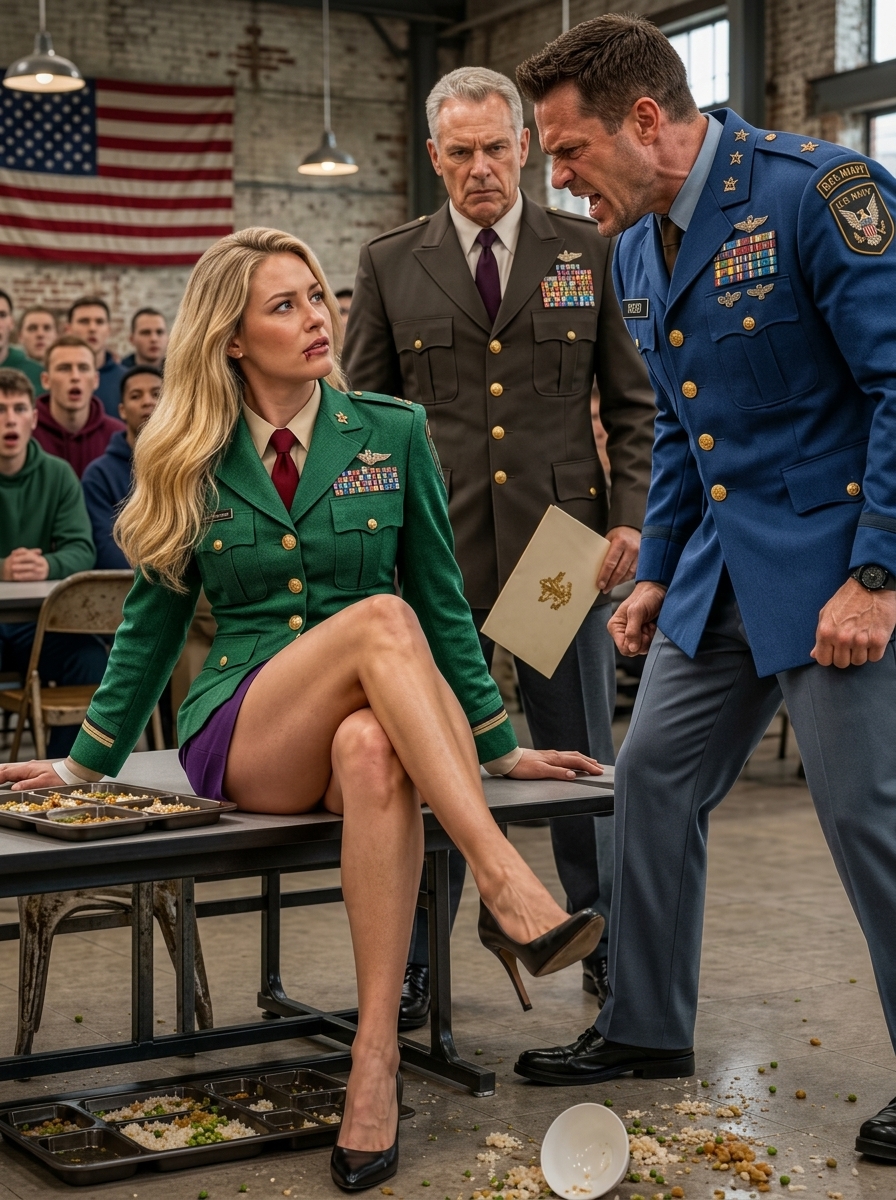
“Commander.”
The word landed harder than Reed’s fist.
Nobody moved.
Nobody breathed.
Reed stared at me.
His face drained of color.
Bennett extended the sealed orders.
“Your appointment orders.”
Advertisement
I accepted the envelope.
“Thank you, Admiral.”
Bennett continued.
“Effective immediately, you are assuming command authority over the training evaluation and standards review attached to this facility.”
A fork hit the floor somewhere behind me.
Reed looked as if someone had removed the ground beneath his feet.
He stared at the sealed orders.
Then at me.
Then at Bennett.
“Commander?”
His voice sounded different.
Smaller.
Admiral Bennett’s eyes narrowed.
“Yes, Chief.”
Reed swallowed.
“But she—”
Bennett waited.
Reed stopped himself.
Advertisement
“She what?”
The admiral’s voice was quiet now.
That was worse.
Reed looked around the room as though someone might rescue him.
Nobody did.
Bennett stepped closer.
“You assumed she was a civilian?”
Reed said nothing.
“An administrative employee?”
Nothing.
“Someone beneath your concern?”
The silence became painful.
Then Bennett asked the question Reed clearly did not want to answer.
“Would any of those things have made striking her acceptable?”
“No, sir.”
“Speak up.”
“No, Admiral.”
“Correct.”
Bennett looked at me.
May you like

The Boy With Something Moving Beneath His Skin: An ER Doctor’s Terrifying 3 A.M. Discovery

My Father Humiliated My Kids at Family Brunch—So I Stopped Paying for My Brother’s Wedding
I could see questions in his face.
But there was one thing he understood already.
I had not identified myself.
That had been intentional.
My orders were not effective until Bennett formally delivered them.
Until that moment, I had no interest in walking through the facility surrounded by salutes and rehearsed behavior.
I wanted to see the command before the command knew I was watching.
That was exactly why I had arrived early.
Not undercover.
Not secretly.
Simply unnoticed.
And within twenty-three minutes, Walker Reed had shown me more than any briefing packet ever could.
Advertisement
Admiral Bennett turned to the command master chief.
“Secure this room.”
“Yes, Admiral.”
Reed’s eyes widened.
“Sir, that isn’t necessary.”
Bennett looked back at him.
“I haven’t determined what’s necessary yet.”
“It was one punch.”
Nobody moved.
Reed realized too late how terrible that sentence sounded.
Bennett’s voice became ice.
“One punch?”
Reed opened his mouth.
Closed it.
The admiral pointed toward a chair.
“Chief Reed, sit down.”
Reed remained standing.
For the first time since he hit me, his confidence cracked completely.
Advertisement
“Admiral, I can explain.”
“You will.”
Bennett nodded toward the chair.
“After medical personnel examine the Commander.”
The corpsman finally moved.
He approached me cautiously.
“Ma’am?”
“I’m fine.”
He looked at the blood.
“Respectfully, ma’am, you may not be.”
Fair point.
I let him examine my ribs while Bennett spoke quietly with the captains.
Across the room, Reed sat alone at a table.
Nobody went near him.
Five minutes earlier, he had owned the room.
Now people could barely look at him.
Advertisement
Power disappears quickly when people realize it was built on permission.
The corpsman pressed gently along my side.
I inhaled sharply.
“Possible fracture,” he said.
“Bruising?”
“At minimum.”
He checked my mouth.
“You bit through part of your cheek.”
“I noticed.”
He almost smiled.
Then he remembered where we were.
Behind him, Admiral Bennett said, “Commander.”
I turned.
“I need your account.”
“You’ll have it.”
“And the security footage.”
I nodded toward the southern camera.
“Camera three should have the clearest angle.”
Advertisement
Reed looked up immediately.
That reaction told me everything.
Bennett noticed.
“So should camera two,” I added. “Depending on whether the serving-line divider blocks the initial contact.”
One captain stared at me.
“You checked the camera angles?”
“I checked the room.”
Reed’s expression tightened.
I continued.
“He crossed the red galley boundary before striking me. Camera three is mounted directly above that lane.”
The captain turned to the command master chief.
“Preserve the footage now.”
“Already being done, sir.”
Reed stood abruptly.
Advertisement
“Admiral, I want legal counsel.”
Bennett did not react.
“That is your right.”
Reed glanced toward me.
“And I want it documented that she provoked me.”
Every recruit in the room seemed to stiffen.
Bennett looked almost curious.
“How?”
“She was disrespectful.”
I said nothing.
Reed continued.
“She challenged me in front of junior personnel.”
“Before or after you struck her?” Bennett asked.
Reed stopped.
The question hung there.
One of the recruits near the wall stared at the floor.
Advertisement
His hands were trembling.
I had noticed him earlier.
Young.
Maybe nineteen.
A fading bruise curved beneath his jaw.
Too yellow to be fresh.
Too symmetrical to look accidental.
I looked at Reed’s knuckles again.
Repeated impact trauma.
My stomach tightened.
This was bigger than one lunch tray.
I turned to Bennett.
“Sir.”
He followed my gaze toward the recruit.
“Yes?”
“I think we need individual statements.”
Reed’s head snapped toward me.
“From everyone.”
The recruit with the bruise looked up.
Advertisement
For a moment, our eyes met.
Fear.
Then something else.
Hope.
Admiral Bennett saw it too.
“Agreed.”
Reed pushed away from the table.
“This is ridiculous.”
The command master chief stepped between us.
“Sit down, Chief.”
Reed stared at him.
“You know me.”
“I do.”
“I’ve served this command for twelve years.”
“I know.”
“I’ve bled for this country.”
The command master chief’s face did not change.
“So have a lot of people.”
Reed looked around the room.
“You people are going to let this happen?”
Advertisement
No one answered.
His anger returned.
Not because they were condemning him.
Because they were no longer protecting him.
Then the young recruit with the bruise stood.
His chair scraped loudly across the floor.
Every head turned.
He swallowed.
“Admiral?”
Bennett faced him.
“Yes, sailor?”
The recruit looked at Reed.
Reed stared back.
The kid nearly sat down again.
I knew that moment.
Everyone who has ever been afraid of a powerful person knows that moment.
The second when telling the truth feels more dangerous than surviving the lie.
Advertisement
I spoke quietly.
“Look at the admiral.”
The recruit turned toward Bennett.
Not Reed.
Bennett waited.
The recruit took a breath.
“Chief Reed hit me too, sir.”
The mess hall changed.
Reed shot to his feet.
“That’s a lie.”
The command master chief blocked him.
The recruit flinched.
Bennett’s expression hardened.
“When?”
“Three weeks ago.”
“Where?”
“Equipment room.”
“Why?”
The recruit hesitated.
“I dropped part of a weapons-cleaning kit.”
Reed laughed bitterly.
“He’s leaving out half the story.”
Bennett turned on him.
“You will remain silent.”
Reed clenched his jaw.
The recruit continued.
“He said I embarrassed the team. Then he hit me.”
“Once?”
The recruit looked down.
“No, sir.”
A chair moved on the opposite side of the room.
Another sailor stood.
“Me too.”
Then another.
“He shoved me into a locker during second phase.”
Another voice came from behind me.
“He hit Daniels after swim qualification.”
Another.
“He made Porter tell medical he’d fallen during obstacle training.”
The corpsman beside me went still.
Bennett turned toward him.
“You know about that?”
The corpsman’s face went pale.
“I treated Porter, sir.”
“And?”
The corpsman swallowed.
“He said he slipped.”
“But?”
“I didn’t believe him.”
“Why didn’t you report it?”
The man lowered his eyes.
No answer was necessary.
We all knew why.
Reed.
His medals.
His combat record.
His reputation.
His friendships.
His legend.
People had confused achievement with immunity.
The admiral looked around the room.
“Anyone else?”
For several seconds, nothing happened.
Then hands began rising.
Three.
Five.
Seven.
Nine.
Eleven.
Reed stared at them.
His face went from anger to disbelief.
“You ungrateful little—”
“Enough.”
My voice cut through the room.
Reed turned toward me.
For the first time, he did not look amused.
He looked afraid.
I stepped away from the corpsman despite the pain in my ribs.
“Sit down.”
His eyes narrowed.
“You think because Bennett handed you a piece of paper—”
“No.”
I moved closer.
“I think because you’re currently under direct order to remain seated, you should remain seated.”
His jaw tightened.
He looked toward Bennett.
The admiral said nothing.
He did not need to.
Reed sat.
I looked at the recruits.
“Nobody discusses statements with anyone else.”
Heads nodded.
“You will be interviewed separately.”
More nods.
“No retaliation.”
I glanced at the instructors.
“Formal or informal.”
Several men shifted uncomfortably.
“If anyone interferes with a witness, pressures a witness, mocks a witness, changes training assignments because of a witness, or suddenly discovers a reason that witness deserves punishment, I want to know.”
The room was silent.
“Immediately.”
“Yes, ma’am,” someone said.
Then others followed.
“Yes, ma’am.”
For the first time, the fear in that room moved in a different direction.
Not toward Reed.
Away from him.
The medical evaluation confirmed what the corpsman suspected.
One cracked rib.
Severe bruising.
A laceration inside my mouth.
Nothing life-threatening.
Nothing heroic.
Just pain.
And evidence.
While I was being examined in the clinic, investigators pulled the mess hall footage.
Camera three captured everything.
Reed stepping over the red boundary.
His shoulder rotating.
His fist striking my ribs.
My tray flying.
Me dropping.
Then Reed standing over me.
Audio from the camera was weak.
Camera two was better.
It caught his voice.
Didn’t know they let office girls eat with warfighters.
Pick it up.
Every word.
No ambiguity.
No missing context.
No misunderstanding.
By sunset, eleven recruits and four former trainees had provided statements.
By midnight, investigators had twenty-three names.
Some incidents were small.
Shoves.
Threats.
Humiliation.
Punishment disguised as “motivation.”
Others were not.
One sailor had been treated for a fractured orbital bone after an incident recorded as an accidental fall.
Another had suffered two broken fingers.
A third had withdrawn from training after what his paperwork described as “failure to adapt.”
His statement described something very different.
Reed had cornered him after he reported an unsafe exercise.
That report had disappeared.
So had another complaint.
And another.
By the following morning, the investigation was no longer about whether Walker Reed had punched me.
That part was easy.
The question was how many people had been forced into silence before I happened to be standing there with a lunch tray.
Admiral Bennett met me in a conference room shortly after 0600.
My ribs were wrapped.
My cheek was swollen.
Coffee sat untouched in front of me.
He entered carrying a thick folder.
“How bad?”
“I’ve had worse.”
“That’s not an answer.”
“Cracked rib.”
His eyes narrowed.
“Anything else?”
“Pride survived.”
Bennett almost smiled.
Almost.
Then he placed the folder on the table.
“Twenty-three statements.”
I stared at it.
“Already?”
“More coming.”
He sat across from me.
“Command climate investigators found something else.”
I waited.
“Several injury reports involving Reed’s trainees show nearly identical language.”
“What language?”
Bennett opened the folder.
He read from the page.
“Member states injury occurred during unsupervised physical conditioning.”
He flipped several pages.
Again.
Same sentence.
Again.
Same wording.
Different sailors.
Different months.
Different injuries.
I leaned back carefully.
“Someone was coaching the reports.”
“That’s the concern.”
“Who signed them?”
Bennett slid the paperwork toward me.
My eyes moved down the forms.
One instructor’s name appeared repeatedly.
Then another.
And another.
Nine instructors had been in that mess hall.
Now I understood why some of them had looked at each other when I mentioned Reed’s hands.
They knew.
Maybe not everything.
But enough.
Bennett watched me.
“You still want the command?”
I looked up.
“What?”
“Your orders can be delayed.”
“No.”
“You were assaulted before your appointment was even announced.”
“Exactly.”
He studied me.
“Explain.”
“If this happened before I took command, then that’s the strongest argument for taking command now.”
Bennett remained silent.
I tapped the folder.
“Reed is one man.”
I looked toward the door.
“The silence around him is the larger problem.”
Bennett nodded slowly.
That was why he had brought me there.
Not because he wanted revenge.
Because he wanted to know whether I understood the difference.
Three days later, I returned to the same mess hall.
The food had been cleaned up.
The chairs were straight.
The red boundary line gleamed beneath the lights.
Camera three still watched from the wall.
This time everyone knew who I was before I walked through the door.
Conversation stopped.
People rose.
“Commander on deck!”
I hated that part.
Not the respect.
The sudden performance.
“Seats.”
Everyone sat.
I did not stand behind a podium.
I did not give them a speech about courage.
I did not mention Reed’s medals.
I did not mention my rib.
Instead, I carried a lunch tray.
Rice.
Vegetables.
Mashed potatoes.
Almost identical to the meal that had hit the floor three days earlier.
I sat at the same table.
For several seconds, nobody spoke.
Then the young recruit with the fading bruise approached.
“Ma’am?”
“Yes?”
He looked uncomfortable.
“Can I sit here?”
I gestured toward the chair.
“That’s what chairs are for.”
He sat.
A few seconds later, another recruit joined us.
Then another.
Soon the room began making noise again.
Forks.
Trays.
Conversation.
Ordinary sounds.
The kind people do not appreciate until they have heard a room become terrified.
Halfway through lunch, the bruised recruit asked me something.
“Ma’am?”
“Yes?”
“Why didn’t you tell him who you were?”
I set down my fork.
“Would it have mattered?”
He hesitated.
“He wouldn’t have hit you.”
“Exactly.”
The recruit frowned.
I continued.
“If the only reason someone treats another person with dignity is because of rank, then they don’t understand dignity.”
He looked at the table.
I could tell he was thinking about that.
“So you knew he’d do something?”
“No.”
That was important.
“I wasn’t testing Reed.”
I glanced toward the red line.
“I arrived early because I wanted to see this command without everyone preparing a presentation for me.”
“And you found him.”
“No.”
I looked around the room.
“I found all of you.”
He seemed confused.
I nodded toward the recruits.
“I found sailors who had been scared into silence.”
Then toward the instructors.
“And leaders who had convinced themselves silence was safer than responsibility.”
I picked up my fork.
“That’s what we’re fixing.”
The investigation lasted months.
There was no dramatic courtroom moment where Reed suddenly confessed everything.
Real accountability rarely works that neatly.
He denied some allegations.
Disputed others.
Claimed certain physical confrontations were part of legitimate training.
Investigators examined records, medical reports, camera footage, witness testimony, and command communications.
Some allegations could be proven.
Some could not.
But the mess hall assault required almost no interpretation.
The cameras had captured it from two angles.
Seventy-eight recruits saw it.
Nine instructors saw it.
A corpsman saw it.
And Reed himself had effectively acknowledged it when he called it “one punch.”
He was removed from instructional duties while the investigation proceeded.
Additional personnel were reassigned pending review.
Several reporting procedures changed immediately.
Medical personnel were given direct independent channels to flag suspicious injuries.
Junior sailors received confidential reporting options outside their immediate training chain.
Security footage retention periods were extended.
Most importantly, instructors were reminded of something that should never have needed reminding.
Training people to endure hardship is not permission to abuse them.
The facility changed slowly.
Then quickly.
A strange thing happened once people realized Reed was no longer standing behind every consequence.
They started talking.
Not gossiping.
Reporting.
Safety problems surfaced.
Broken equipment got documented.
Training schedules were challenged when recovery periods were ignored.
A recruit admitted he was injured before an exercise instead of hiding it until the injury became worse.
An instructor stopped a drill because conditions had crossed the safety threshold.
Months earlier, he might have been mocked for it.
This time nobody laughed.
That mattered.
One afternoon, nearly four months after the mess hall incident, Admiral Bennett returned.
He found me standing near the same red line where Reed’s polished boots had been planted.
My rib had healed.
The cut inside my cheek was long gone.
The command master chief was arguing with maintenance about a ventilation problem.
Recruits were complaining loudly about lunch.
In other words, normal life had returned.
Bennett stood beside me.
“Looks different.”
“It is.”
“Reed’s final administrative findings came through.”
I looked at him.
He held a folder.
Another folder.
Not sealed this time.
I did not reach for it.
“Do I need to know right now?”
“No.”
“Then it can wait.”
Bennett looked amused.
“Four months ago you counted every exit in this room.”
“I still do.”
“The cameras?”
“Three.”
“The people?”
I looked around.
“More important than the cameras.”
He nodded.
We stood in silence for a moment.
Then Bennett asked, “Do you ever think about hitting him back?”
The question surprised me.
I smiled.
“For about three seconds.”
“Only three?”
“Maybe four.”
He laughed.
Then I became serious.
“But that would have given him exactly what he understood.”
Bennett studied me.
“Which was?”
“Power.”
I watched a group of recruits walk past.
“He believed strength meant being the person everyone feared.”
“And you?”
I thought about the old master chief.
Four seconds in.
Hold two.
Six seconds out.
Don’t fight the room.
Read it.
“Strength is making sure people don’t need to be afraid of you before they’ll do the right thing.”
Bennett nodded.
Then he handed me the folder.
I finally took it.
Before leaving, he glanced toward the tables.
“Commander.”
“Admiral.”
“One thing.”
“Sir?”
“Next time someone throws a punch at you…”
I waited.
He looked at the security camera.
“Try not to destroy government-issued lunchware.”
I stared at him.
Then laughed for the first time when thinking about that day.
“Can’t promise that, sir.”
He walked away.
I remained beside the red line.
A new class of recruits had arrived that morning.
Most of them knew the story.
Stories travel fast inside military commands.
Some versions claimed I had been an admiral in disguise.
One insisted I was an NCIS operative who had spent six months hunting Reed.
Another claimed I had deliberately allowed him to hit me as part of a secret investigation.
None of it was true.
The truth was simpler.
I had walked into a mess hall.
A powerful man looked at me and decided I was insignificant.
He believed I had no rank worth respecting.
No connections worth fearing.
No authority worth considering.
So he showed me exactly who he was.
Then Admiral Richard Bennett walked through the doors carrying sealed orders that showed everyone exactly who I was.
But that was never the real lesson.
My rank should not have mattered.
The sealed orders should not have mattered.
The word “Commander” should not have been the thing that made Walker Reed’s face lose its color.
Because even if I had been exactly what he thought I was—
an office worker,
a visitor,
a civilian,
a junior sailor,
a woman with no powerful title at all—
he still would have been wrong.
Months later, I passed the young recruit who had been the first to speak.
The bruise beneath his jaw was gone.
He was walking with another trainee when he saw me.
He stopped.
“Commander.”
I nodded.
“How’s training?”
“Hard.”
“Good.”
He smiled.
“But fair.”
I started walking again.
Then he called after me.
“Ma’am?”
I turned.
He hesitated before speaking.
“I don’t think I would’ve said anything that day if you hadn’t been there.”
For a moment, I did not know what to say.
Then I remembered the silence after Reed hit me.
Seventy-eight recruits.
Nine instructors.
One corpsman.
Dozens of people waiting for someone else to move first.
“You were the one who stood up,” I told him.
He nodded.
“So were you.”
I smiled.
“No.”
I glanced toward the mess hall doors.
“I just stayed standing.”
Then I walked away.
And that was when I finally understood something.
The hardest hit I had ever taken really had happened inside that mess hall.
But it was not the punch.
It was seeing an entire room full of good people convinced that one powerful man was too important to challenge.
That hurt more than the cracked rib.
More than the blood.
More than the humiliation.
Because Reed’s real weapon had never been his fist.
It was the belief that nobody would stop him.
For years, that belief had protected him.
Until one afternoon, surrounded by witnesses, he swung at the wrong woman.
His fist knocked my lunch tray to the floor.
His laughter filled the silence.
And then the doors opened.
Admiral Richard Bennett walked inside.
He carried sealed orders with my name on them.
And within minutes, Walker Reed learned something no medal, deployment, title, or reputation could protect him from.
Accountability.
I still remember the look on his face when Bennett addressed me by rank.
But what I remember even more clearly is what happened afterward.
One frightened recruit stood up.
Then another.
Then another.
Until the silence Reed had spent years building finally broke.
And once it broke—
he could never control that room again.